
I bought my first apartment building after years of flipping single family houses, and the day I closed it I realized I had been working twice as hard for half the result. One roof, one parking lot, one loan, and seventeen rent checks coming in every month. That is the moment multifamily investing stopped being a buzzword for me and became the engine that carried me through every market that followed, including the one we are standing in right now.
If 2026 feels noisy, you are not imagining it. Interest rates moved, lenders tightened, sellers got stubborn, and every headline wants you to feel either greedy or terrified. This guide cuts through that noise. You are going to get the same roadmap I teach my students, the one that works whether you are buying your first duplex or your fifth hundred unit deal.
What You Will Learn
- Why Multifamily Still Wins in 2026
- What Changed in the 2026 Landscape
- The 5-M Multifamily Roadmap
- The Daily Discipline That Compounds
- How to Reverse-Engineer Your First Deal
- Reactive Buyer vs Roadmap Investor
- Single Family vs Multifamily
- Warriors Who Navigated the Landscape
- Multifamily Investing FAQ
- Ready to Take the Next Step?
Why Multifamily Still Wins in 2026
Multifamily investing wins in 2026 because people always need a place to live, apartments spread your risk across many tenants instead of one, and the financing is tied to the income the property produces rather than your personal salary. That combination builds durable cash flow through every cycle.
Here is the simple truth the headlines bury. America is short on housing, and it has been for a long time. The National Multifamily Housing Council and the National Apartment Association found the country needs to build 4.3 million more apartments by 2035 just to keep up with demand. When supply lags that far behind, the people who own well run apartment communities are holding an asset the market cannot easily replace.
Multifamily also protects you in a way single assets never can. When you own a single family rental and your tenant leaves, you are at one hundred percent vacancy and zero income until you fill it. When you own a thirty unit building and one tenant leaves, you are at roughly three percent vacancy and the other twenty nine checks still arrive. That spread is the difference between losing sleep and staying calm when markets wobble. If you want the deeper market backdrop on how policy and supply collide, read my breakdown of the DC affordable housing crisis.
Signs You Are Ready for Multifamily
Before you chase a deal, run yourself through this quick self check. If you can say yes to most of these, you are closer than you think.
- You are tired of trading hours for dollars and you want income that shows up whether you work that month or not.
- You can stay calm when a number on a screen moves against you for a quarter.
- You are willing to learn how to read a deal instead of guessing.
- You would rather own a piece of something large than all of something small.
- You are coachable and you take action faster than you take comfort.
None of these require money in the bank. They require the right wiring. The capital and the deals follow the person who is ready, not the other way around.
What Changed in the 2026 Landscape
The roadmap never changes, but the terrain does, and 2026 has its own shape. For a few years a wave of new apartments hit the market, and in some hot cities that fresh supply softened rents and scared casual investors off. That is the part the nervous headlines love to repeat. Here is the part they leave out. Once that wave finished, the number of new apartment projects breaking ground fell sharply. The pipeline of future supply is drying up at the exact moment demand stays strong, and that sets up the patient buyer beautifully.
Think about what that means for you. The investor who waits for perfect conditions will buy after rents have already recovered and prices have climbed again. The investor who learns the lanes now, while others are sitting on their hands, picks up well located buildings before the supply squeeze pushes rents back up. You do not get rewarded for buying when it feels safe. You get rewarded for buying right when it feels uncertain, as long as the math works.
Financing is also different than it was during the cheap money era. Loans cost more, so a deal can no longer survive on the hope that prices keep rising. It has to pencil on the real income it produces today. That sounds like bad news, but it is actually the best filter you could ask for. It quietly removes the lazy money from the table and leaves the field to investors who do the work. When a deal makes sense at today’s rates, it becomes a gift if rates ever ease.
The lesson of the 2026 landscape is simple. Stop trying to time the market and start learning to read it. The conditions that scare amateurs are the same conditions that build fortunes for the prepared.
The 5-M Multifamily Roadmap
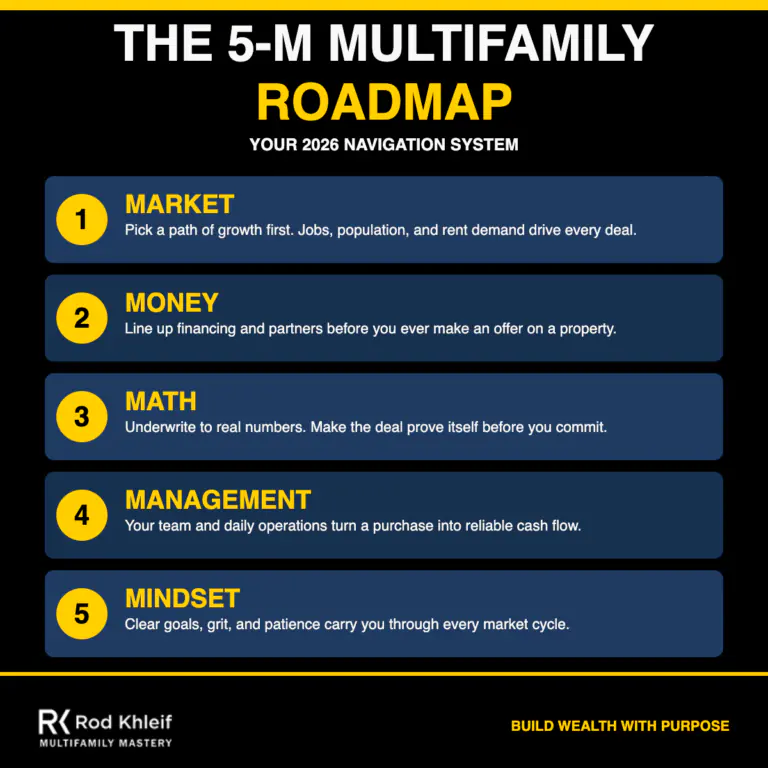
Every deal I have ever done, and every deal my students close, moves through the same five lanes, and I teach all of them step by step inside my free Multifamily Bootcamp.
Want me to walk you through all five lanes with live examples? Join the free Multifamily Bootcamp →
Lane 1: Market
You make money in multifamily the day you pick the right market, not the day you sell. Look for places where jobs are growing, people are moving in, and incomes are rising. Those three forces push rents up and keep your units full. A great building in a dying town will break your heart. An average building in a growing market will quietly make you wealthy. Start by following the people and the paychecks, then narrow to neighborhoods where renters actually want to live.
Lane 2: Money
Line up your money before you ever make an offer. That means knowing what a lender will give you, knowing what you can raise from partners, and knowing your own numbers cold. Most first deals get done with a blend of your savings and capital from people who trust you. You do not need to be rich to start, you need to be ready and credible. Relationships are the quiet engine here, which is exactly why I put so much weight on my 12 tips for successful networking. The investors who fund your deals are the people you build trust with long before you need them.
Lane 3: Math
The math is where emotion goes to die, and that is a good thing. You underwrite a property by looking at the real income it produces, subtracting the real expenses, and seeing what is left to pay the loan and pay you. The number left over is your net operating income, which simply means the cash the building throws off before the mortgage. Then you compare the price to that income using the cap rate, which is just the yearly income divided by the price. If you want to get sharp on that one metric, study what a good cap rate for multifamily actually looks like. Let the deal prove itself on paper before you fall in love.
Here is a quick example so the math feels real. Picture a twenty unit building where the rents add up to two hundred and forty thousand dollars a year. After you subtract realistic operating costs, you might be left with one hundred and thirty thousand dollars of net operating income. That single number drives everything. It tells you what loan the property can support, what price makes sense, and how much cash lands in your pocket after the mortgage. Master that one calculation and you will evaluate a deal faster than most brokers can pitch it.
Lane 4: Management
A building does not produce cash flow. A well run building produces cash flow. The difference is management, which means your team, your systems, and the hundred small decisions that keep units full and expenses honest. You can manage it yourself on a small deal or hire a professional company on a larger one, but you can never ignore it. This is also where you create value on purpose by raising rents to market, cutting waste, and improving the property so it commands more. The tax code rewards you here too, and my guide to multifamily tax benefits shows how depreciation quietly shelters a chunk of that income.
This is also the single biggest reason multifamily builds wealth faster than almost anything else. In single family homes the value is set by what the house next door sold for, and you have no control over that. In apartments the value is driven by the income, so every dollar you add to the net operating income can add many dollars to the value of the whole building. Raise rents to market, add a covered parking fee, trim a bloated utility bill, and you have not just earned a little more cash this month. You have permanently lifted what the property is worth. That is called forcing appreciation, and it turns a good operator into a wealthy one over time.
Lane 5: Mindset
I saved mindset for last because it carries the other four. I have built fortunes and I have lost forty million dollars in a prior downturn, and the only thing that brought me back was the wiring between my ears. Clear goals, daily discipline, and the patience to let a deal mature will outlast any spreadsheet. The investors who win are not the smartest in the room. They are the ones who decided in advance that they would not quit. If mindset is the lane you most need to strengthen, my work on how ordinary people build generational wealth in apartments will show you what is possible.
The Daily Discipline That Compounds
People assume multifamily success comes from one big heroic move. It does not. It comes from a small set of actions you repeat until they become who you are. I write my goals down by hand every single morning, and there is real science behind why that works. Research on handwriting and memory shows that physically writing a goal engages the brain more deeply than typing it, which is part of why written goals stick.
Your daily discipline does not need to be complicated. Look at a handful of deals every week so your eye sharpens. Talk to one new person in the business every day so your network compounds. Track your numbers so you always know where you stand. Read or listen to something that grows you. None of these will feel dramatic on any single day. Stacked over a year, they separate the people who own apartments from the people who only talk about them.
This is also the discipline that keeps you steady when the market gets loud. The same Harvard research on rental housing that documents how nearly thirty five percent of American households now rent also shows how tight and competitive the housing market has become. When you have built the habit of showing up daily, that pressure becomes your advantage instead of your excuse.
If you want a simple resource to anchor that daily habit, grab my free book. It is the playbook I wish someone had handed me when I started, and it lays out the entire multifamily path in plain language. Click the cover below to download it and keep it close as your daily reference.

Download the free Lifetime Cashflow book and start your roadmap today →
How to Reverse-Engineer Your First Deal
Most beginners freeze because they try to picture the whole staircase at once. You do not climb it that way. You reverse-engineer it. You start with the life you want, then work backward to the deal that funds it. Here is the exact process I walk my students through, and it maps directly to the demand story documented in Harvard’s America’s Rental Housing 2026 report, which confirms renters are not going anywhere.
- Name your number. Decide the monthly cash flow that would change your life. Be specific. Fifteen thousand, thirty thousand, fifty thousand. That number is your destination.
- Reverse into units. A healthy apartment unit might net you a few hundred dollars a month after every expense and the loan. Divide your number by that figure and you know roughly how many units you need to own.
- Pick your market. Choose a growing market where jobs and people are flowing in, then narrow to two or three neighborhoods you will become an expert on.
- Build your money map. Get clear on your lender options and the partners who might invest with you, so you can move the day a deal appears.
- Underwrite relentlessly. Run the math on many deals so the right one is obvious. Let most deals fail your screen. That is the point.
- Make offers and operate. Offers are not commitments, they are conversations. Once you own it, run it well and force the value up.
Notice that buying is step six, not step one. The buyers who skip the first five steps are the ones who get burned. The investors who follow them sleep well.
Three Worked Scenarios
Here is how the same roadmap looks at three different starting points. Whether you have a little capital or a strong network, there is a lane for you. The visual below shows how a house hack, a small apartment, and a syndication each lead to the same destination from different starting lines.
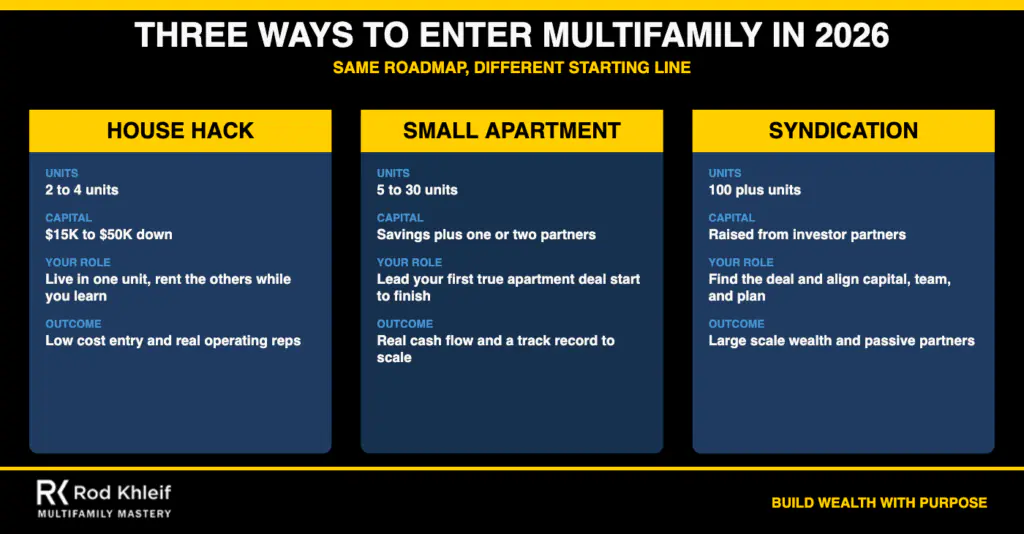
The house hacker buys a small property, lives in one unit, and lets the tenants cover the mortgage while learning the business with real skin in the game. The small apartment buyer leads a five to thirty unit deal and builds a track record that makes the next deal easier. The syndicator finds a large deal and brings investor partners together to fund it. Same roadmap, three on-ramps. To see how the capital splits work on the larger end, study my breakdown of the real estate syndication waterfall.
Reactive Buyer vs Roadmap Investor
The fastest way to understand the roadmap is to watch what happens without it. A reactive buyer moves on emotion and hope. A roadmap investor moves on process. Here is the difference at each lane.
Single Family vs Multifamily
Plenty of great investors start in single family homes, and there is nothing wrong with that path. But when your goal is real cash flow at scale, multifamily simply does more with each unit of your time and attention. Here is how the two compare on the factors that matter most.
Warriors Who Navigated the Landscape
I do not ask you to take any of this on faith. I ask you to look at the people who did it. My Warrior students come from every background you can imagine, and they navigated this exact roadmap to real ownership.
Anthony Metzger went from teaching grade school to raising millions of dollars and controlling apartment units. He did not have a finance background. He had a roadmap, a coach, and the refusal to quit. Frank Patalano built his portfolio steadily while keeping his head down and his standards high, proving that consistency beats flash. And Zach started young and leaned into the mindset lane hard, which is exactly why he moved faster than people twice his age.
Watch the Full Interview
Anthony Metzger walks through how he went from teaching grade school to raising millions and owning apartments.
What these Warriors share is not luck. It is a decision. They decided to learn the lanes, follow the process, and stay in the game long enough to win.
Rod Khleif: “The market does not reward the smartest person in the room. It rewards the one who decided in advance that quitting was not an option, then did the simple things every single day.”
Multifamily Investing FAQ
Q: What is multifamily investing?
A: Multifamily investing means buying residential property with two or more units, such as a duplex, a small apartment building, or a large community. You earn money from the rent the tenants pay and from the property growing in value over time. It spreads your income across many tenants instead of relying on one.
Q: How much money do I need to start multifamily investing in 2026?
A: Less than most people think. You can start with a small house hack using a low down payment loan, or you can partner with investors who bring the capital while you bring the deal and the work. The barrier is rarely money. It is knowledge and the willingness to take action.
Q: Is multifamily investing a good idea in 2026?
A: For investors who follow a process, yes. The country is short millions of apartments, renters keep growing as a share of households, and apartments produce income through every cycle. The opportunity rewards the prepared and punishes the impulsive, which is true in every market.
Q: How do I find a good multifamily deal?
A: Pick a growing market, build relationships with brokers and owners, and underwrite many deals so the right one stands out. Most deals should fail your screen. The discipline of saying no quickly is what makes your yes profitable.
Q: What is a cap rate and why does it matter?
A: A cap rate is the property’s yearly net income divided by its price, shown as a percentage. It lets you compare deals quickly and gauge how aggressively a market is priced. Learning to read it is one of the highest leverage skills in the business.
Q: Can I invest in multifamily without managing tenants myself?
A: Yes. On larger deals you hire a professional management company, and as a passive investor in a syndication you can own a piece of a large property with no day to day involvement at all. Many investors prefer this hands off path.
Q: What is the difference between active and passive multifamily investing?
A: Active investors find, fund, and operate the deal. Passive investors put capital into a deal that someone else runs and receive a share of the cash flow and profits. Both can build serious wealth depending on your time and goals.
Q: How is multifamily financed?
A: Multifamily loans are based largely on the income the property produces, not just your personal salary. That is a powerful difference because a strong deal can help you qualify even when your own balance sheet is modest.
Q: How long does it take to build real cash flow?
A: With focus, many of my students close their first deal within a year and build meaningful cash flow within a few years. It compounds. The first deal is the hardest, and every deal after it gets easier as your skills and network grow.
Q: What is the biggest mistake new multifamily investors make?
A: Buying on emotion instead of process. They fall in love with a building, trust the seller’s numbers, and skip the work of underwriting and market selection. The roadmap exists to keep you out of exactly that trap.
Ready to Take the Next Step?
You now have the full roadmap. The only thing left is to start walking it, and you do not have to do it alone. My free Multifamily Bootcamp takes you through all five lanes with live examples, so your first deal is built on process instead of hope.
Join the free Multifamily Bootcamp and build your roadmap →
If you are further along and ready to scale with hands on mentorship, a community of serious investors, and direct coaching, my Warrior Program is where Warriors like Anthony and Frank built their portfolios. And wherever you are starting, download my free Lifetime Cashflow book and keep it as your daily reference.
Disclaimer: This article was written with the help of AI and reviewed by Rod and his team.
