
The first time a new investor reads a real estate syndication offer, the waterfall section is where their eyes glaze over. That is exactly the part you cannot afford to skip, because the waterfall decides how much of the profit ends up in your pocket versus the sponsor pocket.
I have been on both sides of these deals, as the general partner raising the money and as a passive investor writing the check. In this guide I will walk you through how a syndication waterfall works, tier by tier, with a plain English example so you know exactly what you are agreeing to before you invest.
Table of contents
- What is a syndication waterfall
- The 4 tiers of a syndication waterfall
- Tier 1: Preferred return
- Tier 2: Return of capital
- Tier 3: The GP catch-up
- Tier 4: The promote split
- A worked example: $1M through the waterfall
- Typical waterfall terms in 2026
- How to read a waterfall before you invest
- Syndication waterfall FAQ
- Ready to take the next step
What is a syndication waterfall
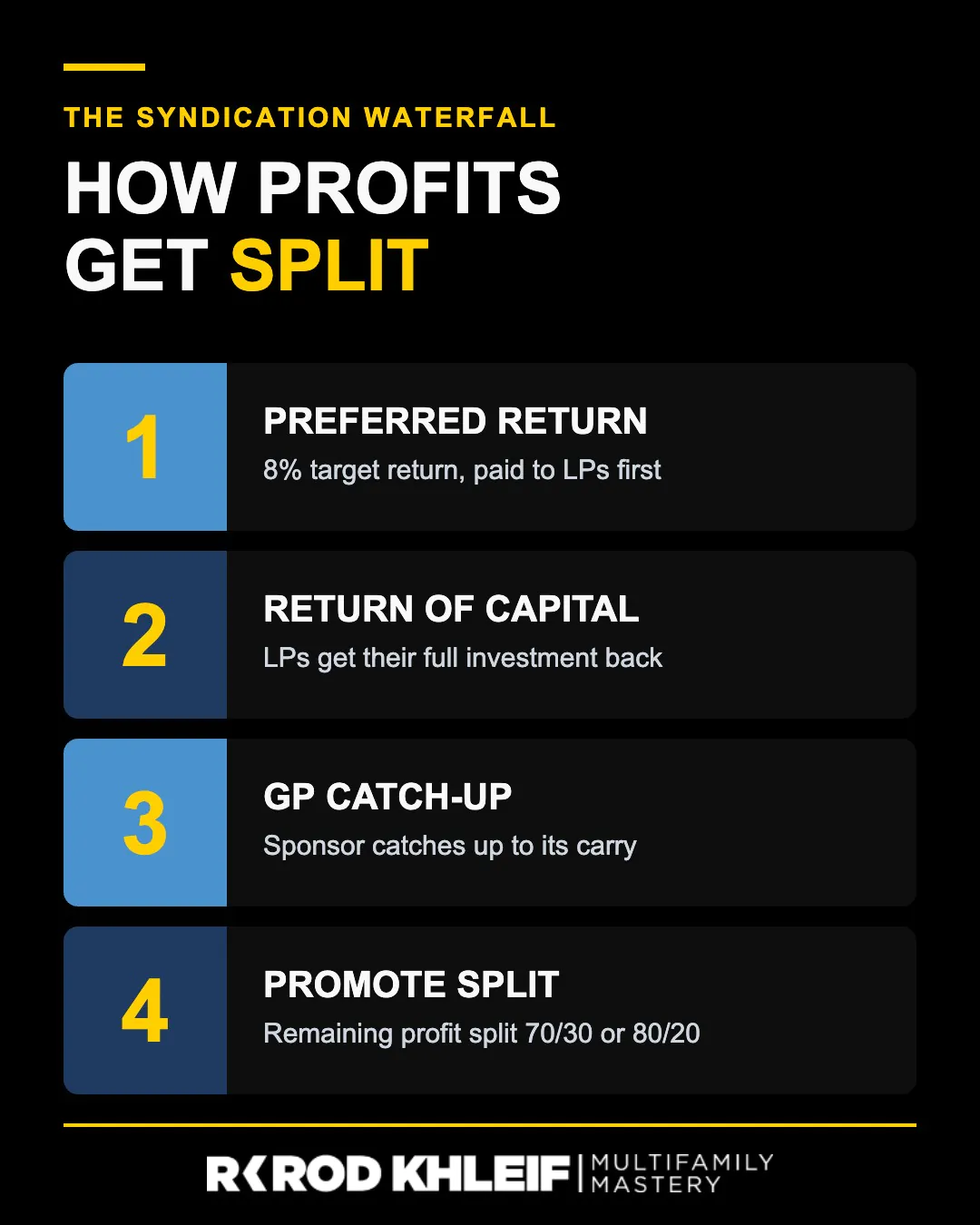
A syndication waterfall is the formula that determines how a deal profits are split between the limited partners who supply the capital and the general partner who runs the deal. Profits flow down through tiers, a preferred return, a return of capital, a catch-up, then a promote split, so investors get paid first and the sponsor earns a larger share only after investors hit their targets.
Think of it like a set of buckets stacked on top of each other. Money pours into the top bucket, fills it, then spills into the next. Nobody lower in the stack gets paid until the bucket above is full. That structure is what aligns the sponsor with you: the general partner only reaches the profitable tiers after you, the investor, have been taken care of. If syndication itself is new to you, start with my guide to multifamily syndication and the role of the limited partner.
The 4 tiers of a syndication waterfall
Most multifamily waterfalls have four tiers. Money flows through them in order, top to bottom.
Tier 1: Preferred return
The preferred return, or pref, is the first slice of profit, and it goes entirely to the limited partners. It is a target annual return, most commonly 8 percent, calculated on the capital investors still have in the deal. The pref is paid before the general partner earns a dollar of profit share. It is usually cumulative, so if a slow year cannot cover the full 8 percent, the shortfall accrues and must be paid later before the sponsor participates.
Tier 2: Return of capital
After the pref is satisfied, the next dollars return the original equity to the limited partners. You get your money back before profits are truly split. On many deals the pref and return of capital are paid from refinances and from the eventual sale.
Tier 3: The GP catch-up
Not every deal has a catch-up, but many do. Once investors have their pref, the catch-up lets the sponsor receive a larger share, sometimes 100 percent of the next dollars, until the sponsor has caught up to its agreed profit share. A 100 percent catch-up is sponsor friendly. A 50 percent catch-up splits those dollars and is friendlier to investors.
Tier 4: The promote split
The promote, also called carried interest, is the sponsor reward for performance. Everything left after the first three tiers is split, commonly 70/30 or 80/20 in favor of the limited partners. Many deals add hurdles: the split might be 80/20 up to a 15 percent investor return, then shift to 70/30 above it, giving the sponsor a bigger slice for delivering a home run. To understand the return targets these hurdles reference, read IRR vs equity multiple.
A worked example: $1M through the waterfall
Numbers make it click. Say limited partners invest $1,000,000 in a deal with an 8 percent pref and a 70/30 split, and to keep it simple this version has no catch-up. The property sells and there is $1,500,000 available to distribute. Over the hold, the 8 percent pref has accrued to $240,000.
| Tier | Amount | To LPs | To GP |
|---|---|---|---|
| Tier 1: Preferred return | $240,000 | $240,000 | $0 |
| Tier 2: Return of capital | $1,000,000 | $1,000,000 | $0 |
| Tier 4: 70/30 split of the rest | $260,000 | $182,000 | $78,000 |
| Total | $1,500,000 | $1,422,000 | $78,000 |
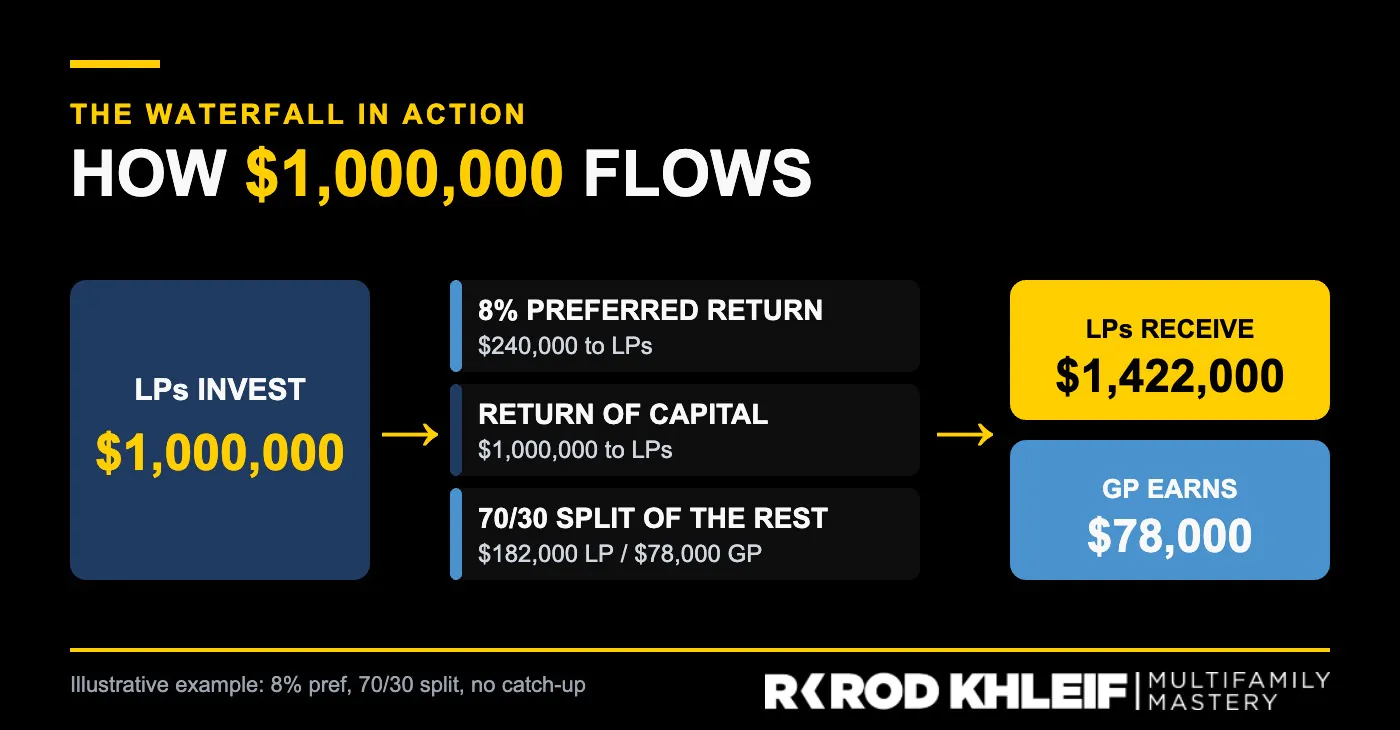
The limited partners walk away with $1,422,000 on their $1,000,000, and the sponsor earns $78,000 only after investors got their pref and their capital back. Add a 100 percent catch-up and the sponsor would take the first chunk of that final $260,000 before the 70/30 split begins, which is why the catch-up term matters.
Typical waterfall terms in 2026
| Term | What is common |
|---|---|
| Preferred return | 6 to 8 percent, with 8 percent the most common |
| Return of capital | Paid to LPs before the promote, from refinance or sale |
| Catch-up | Optional, 50 to 100 percent until the GP reaches its carry |
| Promote split | 70/30 or 80/20 LP/GP, often tiered by IRR hurdles |
| Carried interest to GP | Roughly 20 to 40 percent depending on performance |
How to read a waterfall before you invest
When I evaluate a passive deal, I read the waterfall in the private placement memorandum and the operating agreement, not the glossy summary. Five questions answer almost everything: What is the pref and is it cumulative and compounding? Is my capital returned before the promote kicks in? Is there a catch-up, and is it 50 or 100 percent? What is the promote split and are there hurdles? And finally, what does the sponsor earn in fees regardless of performance? A great waterfall on paper means nothing if acquisition and asset management fees quietly drain the deal first.
A higher pref is not automatically better. A sponsor can offer a flashy 10 percent pref and then claw it back with an aggressive promote and high fees. Look at the whole structure and the projected investor return together, not one number in isolation.
Syndication waterfall FAQ
What is a waterfall in a real estate syndication?
It is the formula that splits profit between limited partners and the general partner. Money flows through tiers, a preferred return, return of capital, an optional catch-up, then a promote split, so investors are paid before the sponsor earns its larger share.
What is a preferred return?
The preferred return, or pref, is a target annual return paid to limited partners before the sponsor shares in profits. It is most commonly 8 percent, calculated on unreturned capital, and is usually cumulative so any shortfall carries forward.
What is the GP catch-up provision?
After investors receive their pref, the catch-up lets the sponsor receive a larger share, sometimes 100 percent of the next dollars, until the sponsor reaches its agreed carried interest. A 50 percent catch-up is friendlier to investors than a 100 percent catch-up.
What is the promote or carried interest?
The promote is the sponsor performance based share of profit, typically 20 to 40 percent, earned only after the pref and return of capital. It rewards the general partner for delivering strong returns rather than just collecting fees.
What is a typical GP LP split in a syndication?
The most common splits are 70/30 and 80/20 in favor of the limited partners. Many deals use tiers, such as 80/20 up to a 15 percent investor return, then 70/30 or 60/40 above that hurdle.
Does the preferred return compound?
It depends on the deal. Some prefs are simple and cumulative, others compound on the unpaid balance. The exact treatment is spelled out in the operating agreement, and compounding is more favorable to investors.
What is the difference between a preferred return and a hurdle rate?
A preferred return is paid to investors before the sponsor participates. A hurdle rate is a return threshold that, once crossed, changes the split in the sponsor favor. A deal can use both.
What happens to the waterfall if the deal underperforms?
The limited partners are protected first. The accrued pref keeps building and the sponsor earns little or no promote until investors receive their pref and capital back. That is the alignment a good waterfall creates.
Where do I find the waterfall terms in a deal?
They live in the private placement memorandum and the operating agreement, not the marketing deck. Read the distribution section carefully and confirm the fees charged outside the waterfall before you invest.
Is a higher preferred return always better for investors?
No. A high pref can be offset by an aggressive promote, an early catch-up, or heavy fees. Evaluate the entire structure and the projected total return together rather than chasing one headline number.
Ready to take the next step
Understanding the waterfall is what separates investors who get taken advantage of from investors who get paid. If you want to go further, whether you plan to invest passively or become the sponsor structuring these deals yourself, my Warrior mentorship program is where I teach the full playbook. Newer to apartments? Start at the Multifamily Bootcamp, grab my free best selling book at the LCFA ebook page, and listen to the Lifetime Cash Flow podcast.
Disclaimer: This article is educational and is not investment, legal, or tax advice, and it is not an offer to sell or a solicitation to buy any security. Syndication terms vary by deal and the specifics are governed by the offering documents. Always review the private placement memorandum and consult your own advisors. This article was written with the help of AI and reviewed by Rod and his team.
