
If you have looked at multifamily syndications or any large commercial real estate deal, you have run into the term General Partner or GP. The GP is the operator that finds the deal, raises the capital, signs the loan, runs the asset, and ultimately delivers (or fails to deliver) the returns investors signed up for.
This guide breaks down exactly what a General Partner does, the legal and SEC compliance framework GPs operate inside, the five operating phases of a GP role, how GPs get paid, and the realistic risks and skills required to be a successful one. Whether you are evaluating a sponsor before investing or trying to step into the GP seat yourself, this is the working definition.
What You Will Learn in This Guide
- What Is a General Partner in Real Estate?
- The Legal Role of a General Partner
- SEC Compliance and Securities Regulations
- The Five-Phase GP Operating Stack
- GP Compensation Structure: Complete Breakdown
- How to Become a General Partner
- The Real Risks of Being a GP
- General Partner in Real Estate FAQ
- Ready to Take the Next Step?
What Is a General Partner in Real Estate?
A General Partner (GP) in real estate is the active sponsor of a syndicated investment. The GP sources the deal, raises the equity, signs the loan, and runs the asset day to day. In exchange the GP earns acquisition, asset management, and disposition fees plus a promoted interest (typically 20 to 40 percent) on profits above a preferred return. Limited Partners (LPs) provide most of the capital, take a passive role, and have liability limited to their invested amount.
A General Partner is the active sponsor inside a real estate partnership, almost always structured as a Limited Liability Company (LLC) or Limited Partnership (LP). The GP is the entity that gets the deal under contract, brings together the team, raises the capital from passive investors, takes title to the property, and runs the asset for the duration of the hold.
The GP carries unlimited liability for partnership obligations and signs the loan documents. The Limited Partners (the passive investors) have liability limited to whatever capital they put in. That tradeoff (more risk and more upside on the GP side, less risk and a capped role on the LP side) is the entire point of the structure.
GP vs LP: Understanding the Difference
The GP role is active. The GP is finding deals, underwriting, talking to brokers, raising capital, signing loans, managing operations, communicating with investors, and ultimately deciding when to sell. It is closer to running a small business than passive investing.
The LP role is passive. Limited Partners wire capital, sign subscription documents, receive distributions and tax forms, and read quarterly investor reports. They do not vote on day-to-day operating decisions and they do not have personal liability beyond the dollars they invested.
If you want a fuller side-by-side comparison, my deep dive on what an LP is covers each side of the table including economics, control, time commitment, and tax treatment.
The Legal Role of a General Partner
Legal Structure and Liability
Most modern multifamily syndications run as a Limited Liability Company taxed as a partnership. The GP is typically its own LLC that owns a small membership interest in the deal LLC and serves as the manager. Setting up the GP as a separate LLC is what insulates the individual GP principals from personal liability for partnership obligations.
Even with the LLC wrapper, the GP signs the loan and gives personal recourse carve-outs (commonly called bad-boy carveouts) for things like fraud, environmental violations, and unauthorized transfers. So while everyday operating risk sits inside the LLC, certain bad acts can pierce all the way through to the individual.
Fiduciary Duties
The GP owes fiduciary duties to the LPs as a class. In plain language: the GP must act in the best interests of investors, disclose conflicts, avoid self-dealing, and treat all investors fairly. A GP who steers fees to a related entity at above-market terms or who cherry-picks the best deals for themselves and gives weaker ones to the syndicate is breaching that duty.
Legal Accountability
If a GP breaches fiduciary duties or commits material fraud, LPs have legal remedies including civil suits, removal of the GP from the deal, and reporting to regulators. SEC enforcement is also a real possibility on the securities side. The accountability is one of the reasons sophisticated LPs spend significant time vetting the GP before they ever wire capital.
SEC Compliance and Securities Regulations
Why Real Estate Syndications Are Securities
When a GP raises money from passive investors who expect profits primarily from the GP’s efforts, those interests are securities under federal law (the Howey test). That means the offering must either be registered with the SEC (rare and expensive) or fall under an exemption.
The vast majority of multifamily syndications are sold under a Regulation D exemption, most commonly Rule 506(b) or Rule 506(c). Picking the right one and complying with it is a core GP responsibility. Skipping this step or doing it sloppily can expose the GP to rescission rights, SEC enforcement, and personal liability.
Regulation D: The GP’s Compliance Framework
Rule 506(b) allows a GP to raise an unlimited amount of capital from accredited investors and up to 35 sophisticated non-accredited investors, provided no general solicitation is used. In practical terms, that means the GP can only accept money from investors with whom they have a pre-existing substantive relationship. This is the most common structure for smaller, relationship-driven raises.
Rule 506(c) allows general solicitation (so the GP can advertise the deal publicly online, on stage, and in podcast appearances) but requires the GP to take reasonable steps to verify accredited investor status, typically through tax returns, brokerage statements, or a third-party verification letter from a CPA or attorney.
Accredited Investor Requirements
An accredited investor is generally an individual with $1 million in net worth excluding primary residence, $200,000 in annual income for the last two years ($300,000 jointly with a spouse), or who holds certain professional licenses (Series 7, 65, 82). Entities can also qualify based on assets or all-accredited ownership. The GP must collect documentation supporting these claims if running a 506(c) raise.
Required Compliance Documents
Every GP-led syndication needs at minimum a Private Placement Memorandum (PPM) describing the deal and risks, a Subscription Agreement and investor questionnaire, an Operating Agreement governing the deal LLC, a Form D filing with the SEC and applicable states, and any blue-sky filings for the states in which investors reside. Skipping or templating these documents from a non-securities lawyer is one of the most expensive mistakes a new GP can make.
SEC Compliance Violations and Penalties
SEC violations can result in disgorgement of all fees and profits, civil monetary penalties, rescission rights for investors (meaning every LP can demand their money back), bars on future fundraising, and in serious cases criminal prosecution. The cost of doing it right with experienced securities counsel is dramatically lower than the cost of doing it wrong.
The Five-Phase GP Operating Stack
This is the operating model I teach inside the Multifamily Bootcamp and the Warrior community. Every multifamily deal a GP runs cycles through these five phases. The GP role is not one job, it is five jobs in sequence.
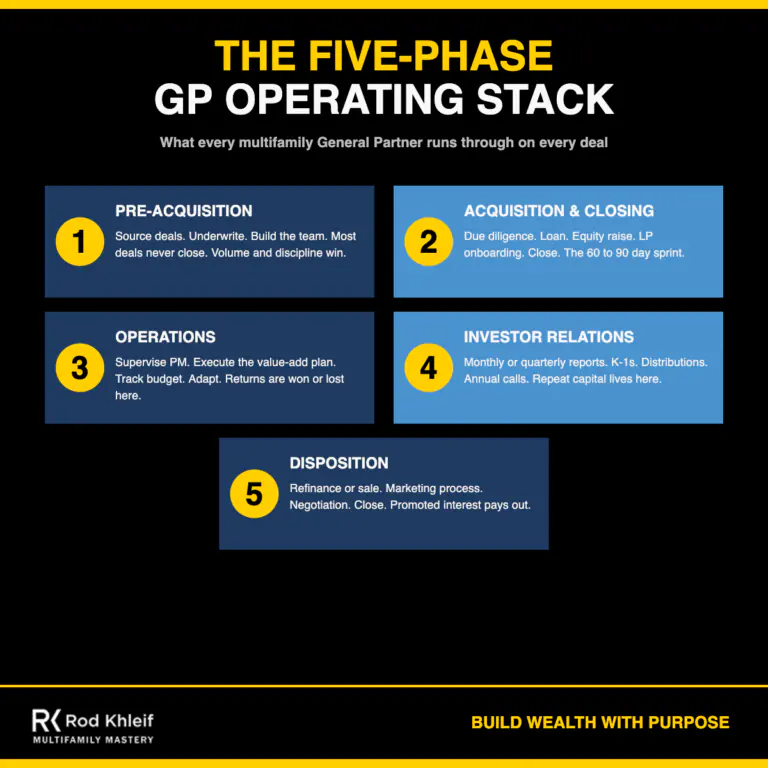
Phase 1: Pre-Acquisition
The GP sources deals through broker relationships, off-market outreach, and existing investor referrals. Each deal that looks plausible goes through underwriting, where the GP models rents, expenses, debt, and exit assumptions to determine the offer price that hits target returns. The GP also builds the team for the deal, including legal counsel, lenders, and property management partners.
Most of the work in this phase never produces a deal. A typical GP underwrites 50 to 100 deals for every one they close. Sourcing volume and underwriting discipline are the two skills that separate consistent GPs from one-deal sponsors.
Phase 2: Acquisition and Closing
Once a property is under contract, the GP runs full due diligence (financial, physical, legal, environmental), structures and signs the loan, opens the equity raise, manages the LP onboarding process, and closes the deal. This is the most intensive phase from a calendar standpoint, often a 60 to 90 day sprint.
Phase 3: Operations and Asset Management
After close, the GP supervises property management, executes the value-add or stabilization business plan, monitors operating performance against budget, and adapts strategy when reality diverges from the underwriting model. This is where the actual returns are won or lost. A great underwrite plus poor execution still produces a bad outcome.
Phase 4: Investor Relations and Reporting
The GP delivers monthly or quarterly investor reports, handles K-1 tax documents at year end, processes distributions, fields investor questions, and runs annual investor calls. Quality investor relations is the single biggest driver of repeat capital from existing LPs into the next deal.
Phase 5: Disposition
When the business plan is complete or the market conditions are right, the GP executes the exit. That can be a refinance returning capital to investors while the asset stays in the portfolio, or an outright sale. The GP underwrites the exit, runs the marketing process with brokers, negotiates the trade, and closes. The promoted interest typically pays out at this point.
GP Compensation Structure: Complete Breakdown
GPs get paid through a combination of fees and profit splits. Each piece is negotiable and shows up in the Operating Agreement and PPM. Here is the typical stack for a U.S. multifamily syndication.
1. Acquisition Fee
The GP earns a one-time fee at closing for sourcing, underwriting, and closing the deal. Typical range is 1 to 3 percent of the purchase price. On a $20 million deal a 2 percent acquisition fee is $400,000 split among the GP team.
2. Asset Management Fee
An ongoing fee paid to the GP for managing the asset against the business plan. Typical range is 1 to 2 percent of gross collected revenue or 1 to 2 percent of equity raised, paid monthly or quarterly throughout the hold period.
3. Refinance Fee
Some operating agreements allow a refinance fee (often 0.5 to 1 percent of the new loan amount) when the GP executes a refinance that returns capital to investors. This is increasingly common in value-add multifamily.
4. Disposition Fee
A fee paid at exit, typically 0.5 to 2 percent of the sale price. This compensates the GP for executing the sale process and is usually subordinated to investors getting their preferred return current.
5. Promoted Interest (Carried Interest)
The promote is where the real money lives. The standard structure gives LPs a preferred return (typically 7 to 8 percent annually) on their invested capital before any profits split with the GP. Once the preferred return is paid current, profits split between LPs and GPs at a tiered ratio (commonly 70/30 or 80/20 LP/GP) up to a hurdle, then 50/50 above that hurdle.
On a successful five-year multifamily hold producing a 2.0 equity multiple, the promote alone can equal multiples of the upfront fees. This is why the promote is the most important number in any deal for both sides to model carefully.
How to Become a General Partner
The path to GP-ready varies but the components are consistent: education, mentorship, capital relationships, deal sourcing capability, and a track record. There is no exam to pass to become a sponsor, which is exactly why investor due diligence is so important.
The fastest legitimate path I have seen consistently work is to enroll in serious multifamily training (the Multifamily Bootcamp is where most of my Warriors start), join an active community where you can co-GP on early deals with experienced operators, and run your first one or two deals under a senior sponsor before you go solo. That structure compresses the learning curve and protects your investors during your first reps.
If you want a more tactical breakdown of the first 90 days as an aspiring GP, my free book How to Create Lifetime Cash Flow Through Multifamily Properties walks through it step by step.
The Real Risks of Being a GP
Most coaching content focuses on the upside of being a GP. The risks are equally real and worth naming clearly:
- Personal recourse on bad-boy carveouts. Even with an LLC wrapper, fraud or unauthorized transfers can pierce all the way to the individual.
- SEC enforcement risk. Securities violations are not theoretical. Disgorgement, penalties, and bars on future raises are common outcomes for GPs who skip the compliance work.
- Reputational risk. A failed deal does not stay private in this business. Future capital raises depend on referrals from current LPs.
- Time and stress. Running a deal is a real job. The asset management phase alone can demand 5 to 20 hours per week per asset, especially during a value-add execution.
- Capital risk. The GP often invests significant personal capital alongside LPs (commonly 5 to 10 percent of the equity), which can be lost if the deal fails.
None of these risks is a reason to avoid the GP role, but they are reasons to take the role seriously and build the right team and education around it before you start.
General Partner in Real Estate FAQ
Q: What is a general partner in real estate?
A: A General Partner is the active sponsor of a real estate syndication. The GP sources the deal, raises equity, signs the loan, manages the asset, and ultimately delivers returns to investors. GPs earn fees plus a promoted interest on profits above a preferred return.
Q: What is the difference between a GP and an LP in real estate?
A: A General Partner runs the deal and carries personal liability on the loan. A Limited Partner is a passive investor whose liability is capped at the capital they invested. The GP earns fees and carried interest. The LP earns a preferred return plus a share of upside profits.
Q: How much money does a general partner make on a deal?
A: GP compensation has multiple layers. Acquisition fees are typically 1 to 3 percent of purchase price. Asset management fees are 1 to 2 percent annually. Disposition fees are 0.5 to 2 percent at exit. The promoted interest is the largest piece, often 20 to 40 percent of profits above the LP preferred return.
Q: Do you need a license to be a general partner in real estate?
A: No real estate license or securities license is required to be a GP, but the GP raises capital under SEC securities laws, so a securities attorney is essential. Many GPs hold real estate licenses for transaction and broker-relationship reasons even though it is not required.
Q: What are the fiduciary duties of a general partner?
A: The GP owes duties of loyalty, care, and good faith to investors. That means acting in the best interests of the partnership, disclosing conflicts, avoiding self-dealing, and treating all investors fairly. Breach can lead to legal removal of the GP and personal liability.
Q: How do general partners raise capital legally?
A: Most GPs raise under Regulation D, either Rule 506(b) (no general solicitation, accredited and limited non-accredited investors with pre-existing relationships) or Rule 506(c) (general solicitation allowed, accredited only, with verification). Each path has specific compliance requirements.
Q: Can a general partner also be a limited partner in the same deal?
A: Yes, and most reputable GPs invest their own capital alongside investors as an LP, often 5 to 10 percent of total equity. Coinvestment is a major signal of alignment that sophisticated LPs look for.
Q: What happens if a general partner fails to perform?
A: The Operating Agreement typically allows LPs to remove the GP for cause (fraud, gross negligence, breach of fiduciary duty) by a specified vote threshold. Removal triggers a process to install a replacement GP. LPs may also have legal claims for damages.
Q: How is a general partner taxed?
A: GP fees are generally taxed as ordinary income. The promoted interest, when structured as carried interest in a partnership, is typically taxed at long-term capital gains rates if the underlying asset has been held over the required period (currently three years for carried interest under federal tax law). Always confirm with a tax advisor.
Q: How can I evaluate if a GP is qualified before investing?
A: Look at track record (closed deals, full cycles, realized returns), background and references, the depth of the team around them, the quality of legal documents and disclosures, and the alignment shown by their personal coinvestment. Talk to existing LPs in their prior deals.
Ready to Take the Next Step?
If you want to step into the GP seat yourself, the fastest way to compress the learning curve is to come to the next Multifamily Bootcamp. You will learn the underwriting, capital raise, and operating playbook directly from active GPs and meet potential co-sponsor partners in the room.
If you are still researching, start with my free book How to Create Lifetime Cash Flow Through Multifamily Properties. It is the same playbook that has produced thousands of new operators and passive investors.
You can also explore the Lifetime Cash Flow podcast for free interviews with experienced GPs walking through how they sourced, raised, and ran their deals.
Disclaimer: This article was written with the help of AI and reviewed by Rod and his team.
Related reading: Multifamily vs Commercial Real Estate: Which One Should You Invest In?
Related reading: Letter of Intent Real Estate: Free Template 2026
Related reading: Real Estate Syndication Waterfall: How Profits Split
