
When I was 18 years old I bought my first house, and I was convinced the path to wealth was simple: buy a home, work hard, wait. By 2006 I had built that into around 800 single family houses, and in 2008 the whole thing collapsed because every vacancy was a 100 percent vacancy. That brutal lesson is exactly why I tell every young investor the same thing: if you want to build generational wealth in your twenties and thirties, you do not need a bigger salary or a perfect market, you need a better vehicle. Real estate, done the way I teach it now, is still the most reliable wealth building engine on the planet for millennials who start with intention.
The problem is not that you are too young, too broke, or too late. The problem is that most people your age are quietly following a plan that was never designed to make them wealthy. This guide breaks down the exact framework, the real numbers, and the first moves that turn a normal paycheck into a portfolio your kids will inherit.
What This Guide Covers
- Why Most Millennials Build Wealth Backwards
- The Generational Wealth Stack: Five Engines of Real Estate Returns
- The Millennial Advantage Nobody Talks About
- How to Start With Little Money
- How to Build Generational Wealth: A Five Step Plan
- Waiting to Be Ready vs Starting With a Framework
- Going Solo vs Building With a Team
- Millennials Who Are Doing It Right Now
- Build Generational Wealth FAQ
- Ready to Take the Next Step?
Why Most Millennials Build Wealth Backwards
Most millennials build wealth backwards because they save first and invest last, pouring years into a 401k and a single family home while waiting to feel ready. Real generational wealth gets built in reverse: you choose an income producing asset first, then let tenants and time do the heavy lifting.
Here is the trap. You are told to get a good job, max out your retirement account, buy a starter home, and someday you will be comfortable. There is nothing evil about that plan. It is just slow, and it puts you at the mercy of one income and one market. If you lose the job, the plan stalls. If the home does not appreciate, you tread water for a decade.
Wealthy families do the opposite. They buy assets that pay them whether they show up to work or not. They treat their primary residence as a place to live, not a retirement plan. And they understand that the fastest way to financial freedom is not to earn more and spend less, it is to own more of the things that produce income. Apartments are the cleanest version of that idea I have ever found.
Signs You Are Building Wealth Backwards
Run yourself through this quick checklist. If you say yes to three or more, you are probably stacking your wealth in the wrong order:
- Your entire retirement plan lives inside a 401k you cannot touch for 30 years.
- You believe you need a large pile of cash before you can invest in real estate.
- You think your single family home is your biggest investment, not your biggest expense.
- You are waiting until you feel ready, qualified, or smart enough to start.
- You measure progress by your salary instead of by your monthly passive income.
None of those make you a failure. They make you normal. The rest of this guide is about trading normal for a system that compounds.
The Generational Wealth Stack: Five Engines of Real Estate Returns
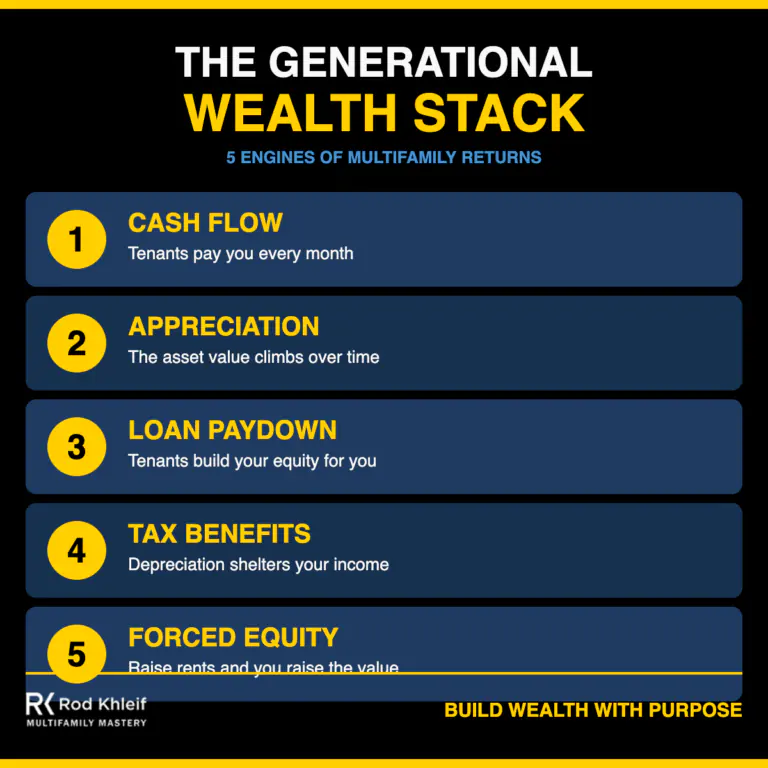
The reason apartments build wealth so fast is that they pay you in five different ways at the same time. I call this the Generational Wealth Stack, and once you see all five engines running together you understand why a single good deal can outperform a decade of saving. You can go deeper on the mechanics inside my free Multifamily Bootcamp.
Want me to walk you through all five engines with real deals? Join the free Multifamily Bootcamp →
Engine 1: Cash Flow
Cash flow is the money left over every month after the mortgage, taxes, insurance, and operating costs are paid. This is the income that replaces your paycheck. In an apartment building you are not relying on one tenant, you are relying on dozens, so one move out does not sink you. That stability is the whole reason I left single family behind. Net operating income, which is simply your income minus your operating expenses, is the number that drives everything else in the stack.
This is also the engine that buys you choices. When the rent checks more than cover your costs, you are no longer trading hours for dollars at the mercy of one employer. You can reinvest the surplus into the next deal, build a reserve that lets you sleep at night, or eventually replace your salary entirely. Cash flow is what turns a building into freedom.
Engine 2: Appreciation
Appreciation is the rise in the property value over time. In single family the value is set by what the neighbor sold for. In multifamily the value is set by the income the building produces, which means you have far more control. Raise the income, raise the value. According to the Federal Reserve Survey of Consumer Finances, real estate remains one of the largest sources of household net worth in America, and the families who own income property consistently outpace those who only own a home.
Engine 3: Loan Paydown
Every month your tenants pay rent, and a slice of that rent pays down your loan balance. You are not building equity with your own money, you are building it with theirs. Over a typical hold period this quietly turns into one of the largest pieces of your total return, and almost nobody talks about it because it happens in the background.
Engine 4: Tax Benefits
The tax code rewards people who provide housing. Through depreciation you get to show a paper loss on a building that is actually going up in value, which can shelter a large portion of your cash flow from taxes. This is legal, it is intentional, and it is one of the main reasons the wealthy love real estate. Always work with a qualified CPA, but understand that the tax engine alone can change your entire financial picture.
Engine 5: Forced Equity
Forced equity is the part that excites me most. Because value is tied to income, you can create equity on purpose by raising rents toward market, cutting wasted expenses, and improving the property. This is the value add play. A few hundred dollars of extra monthly income across many units can add hundreds of thousands of dollars to the building value. You are not waiting for the market to make you rich, you are doing it with a plan.
The Millennial Advantage Nobody Talks About
Here is what older investors will not admit: your generation has two advantages that money cannot buy. The first is time. Every one of the five engines above compounds, and compounding is brutal in the best way when you give it 20 or 30 years. A deal you close at 30 has decades to pay down debt, appreciate, and throw off tax sheltered income before you would even think about retiring.
The second advantage is demand. Homeownership is harder to reach than it was for prior generations, which means more people are renting for longer. The National Multifamily Housing Council reports that a large and growing share of American households rent their homes, and that need for quality rental housing is not going away. As an apartment owner, you are on the right side of that trend instead of fighting it from the sidelines.
Put those together and the picture is clear. You are not behind. You are early. The only thing standing between you and a portfolio is a decision to learn the vehicle and take the first step. If you want the foundational playbook in writing, start with my free book, How to Create Lifetime Cash Flow Through Multifamily Properties.
How to Start With Little Money
The number one objection I hear from millennials is some version of “I do not have enough money.” I understand it, because I believed the same thing for years. But here is the truth that changes everything: in this business your capital constraints become almost irrelevant once you learn how to structure deals. You are not trading your savings, you are trading your expertise, your deal finding ability, and your relationships. You become the engine, and other people’s money becomes the fuel.
Think about the people I mentioned earlier. One of my students closed a 218 unit community as a first deal with no money and no experience. That is not magic. It is the syndication model, where a sponsor finds the deal, underwrites it, and brings in investors who provide the capital in exchange for a share of the returns. If you can find and analyze a strong deal, you can attract the capital to close it. The skill is the asset.
There are several proven on ramps that need far less of your own cash than people assume:
- House hacking. Buy a small two to four unit property, live in one unit, and rent the others. Owner occupied financing means a low down payment, and your tenants help cover the mortgage while you learn to be a landlord on training wheels.
- Partnering on a syndication. Join an experienced team and contribute what you have, whether that is deal flow, underwriting, investor relationships, or boots on the ground asset management. Many sponsors are actively looking for hungry, coachable partners.
- Raising capital. If you are great with people, you can become the person who brings investors to a deal. Capital raisers are valued members of nearly every sponsorship team.
- Bringing the deal. A great off market deal is worth more than a check. If you can build broker relationships and source opportunities others cannot find, experienced operators will partner with you all day long.
Notice what all four have in common. None of them require you to write a giant check by yourself. They require you to become useful, coachable, and consistent. That is something any millennial can decide to do this year, regardless of your current bank balance. The capital follows competence, not the other way around.
How to Build Generational Wealth: A Five Step Plan
Knowing the engines is not the same as turning them on. This is the exact sequence I walk new investors through, and it works whether you have 5,000 dollars or 50,000 dollars to your name. Notice that capital is not step one. Clarity is.
- Set your freedom number. Decide the monthly passive income that would change your life. Not your fantasy number, your freedom number. Write it down by hand. A well known goal study from Dr. Gail Matthews at Dominican University found that people who write their goals down are significantly more likely to achieve them. This single act anchors every decision that follows.
- Reverse engineer the doors. Translate that monthly number into units. If an average door throws off roughly 125 dollars of monthly cash flow, then 10,000 dollars a month is about 80 doors. Now your dream has a unit count, and a unit count has a plan.
- Get educated and build relationships. Learn how to underwrite a deal, talk to brokers, and understand financing before you ever need the money. The investors who win are the ones who can find and analyze a deal, because that skill is worth more than a checkbook.
- Find your role and your team. You do not have to be everything. Some people bring deals, some bring capital, some bring operations. Decide what you bring and partner with people who fill the gaps.
- Take action on a real deal. Analysis without action is just expensive entertainment. Whether you house hack a small property or join a syndication as part of the team, you learn ten times faster once real money and a real deal are on the line.
To make step two concrete, here is how three different freedom numbers reverse engineer into a real portfolio target. This is the math that turns a vague hope into a plan you can actually execute.
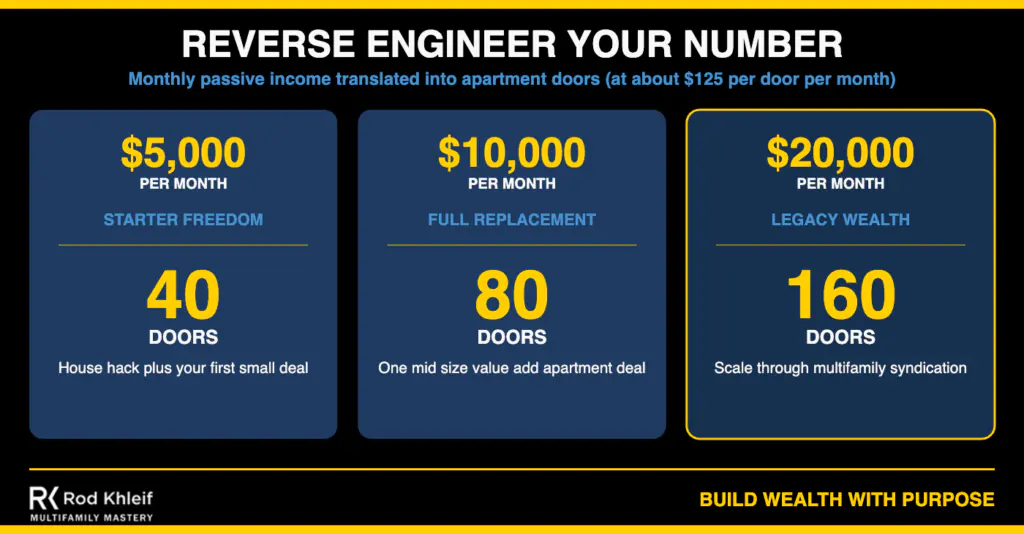
The number that scared you a minute ago now looks like a target you can aim at. Eighty doors sounds impossible until you realize one mid size apartment deal can get you most of the way there in a single transaction. That is the leverage of the vehicle.
Before you go further, I want you to actually do step one. Grab my free playbook, write your freedom number on the inside cover, and keep it where you will see it every morning. The people who treat this as a daily reference are the ones who follow through.

Download the free book and write down your freedom number today →
Waiting to Be Ready vs Starting With a Framework
The single most expensive thing you can do in your twenties and thirties is wait. Every year you sit on the sideline is a year of compounding you can never get back. Here is the difference between the reactive approach most people take and the framework approach that actually builds generational wealth.
Going Solo vs Building With a Team
The other myth that holds millennials back is that you have to do this alone with your own money. You do not. Some of the biggest first deals I have ever seen were closed by people who brought a skill to a team instead of a giant check. Here is how going solo compares to building with a team.
Millennials Who Are Doing It Right Now
I do not want this to be theory for you, so let me introduce a few people who started where you are. Chris Salazar built a multimillion dollar real estate portfolio before he turned 24. He did not inherit it and he did not win the lottery. He learned the vehicle young and went to work.
Anthony Metzger had never even bought a single family home. No experience, no big bank account. His very first real estate deal was a 218 unit apartment community, because he got educated, built relationships, and partnered with people who had capital. He brought the deal and the competence, and the money found him.
Or take Tim Little, who looked at his income goal and realized he could not buy 50 duplexes to get there, so he moved straight into commercial multifamily and now owns hundreds of doors. Or Loren, who walked into my Bootcamp saying he did not have enough money, and a year later handed in his resignation letter because the income from his deals replaced his salary. The pattern repeats over and over. None of them started rich. They started committed, learned the vehicle, and let the Generational Wealth Stack do what it does.
Watch the Full Interview
Anthony Metzger walks through how he closed a 218 unit apartment community as his very first deal with no money and no experience.
Then there is Jennifer Barner, who came through my program and now controls more than 1,100 units across several states. Her success sent all four of her children to college debt free and grew her family net worth many times over. That is the whole point of this. It is not just your retirement, it is your kids starting line. You can hear more stories like these on the Lifetime Cash Flow Through Real Estate Investing podcast and read how others turned the same framework into real portfolios in my breakdown of creating generational wealth with multifamily properties.
Rod Khleif: “I had 800 single family homes and got wiped out in 2008. If I had owned 100 unit buildings instead, I would have sailed right through. The vehicle you choose matters more than how hard you work. Choose the one that pays you in five ways at once.”
If you are brand new and want the full step by step foundation, my complete beginners guide to multifamily investing is the best place to keep going after this article.
Build Generational Wealth FAQ
Q: Can millennials really build generational wealth with real estate?
A: Yes. Real estate rewards time, and millennials have decades of compounding ahead of them. By choosing income producing apartments early and reinvesting the returns, a normal earner can build a portfolio that supports their family and passes to the next generation.
Q: How much money do I need to start investing in real estate?
A: Less than you think. Many first deals are done by partnering, raising capital, or bringing deal finding skills to a team rather than writing a giant check. The most valuable asset you can bring is the ability to find and analyze a good deal.
Q: Why does Rod Khleif focus on apartments instead of single family homes?
A: Apartments spread risk across many tenants, let you force the value up through better operations, and pay you in five ways at once. Rod lost a single family portfolio in 2008 and rebuilt around multifamily because the math is far more stable at scale.
Q: What is the Generational Wealth Stack?
A: It is the five ways an apartment investment builds wealth at the same time: cash flow, appreciation, loan paydown, tax benefits, and forced equity. Most assets pay you in one or two ways. Multifamily pays you in all five.
Q: How do I figure out how many units I need?
A: Start with your monthly freedom number, then divide by the cash flow per door. At roughly 125 dollars of monthly cash flow per unit, a 10,000 dollar monthly goal points you toward about 80 doors, which one mid size deal can cover.
Q: Is real estate still a good investment in a high interest rate market?
A: It can be, because rental demand stays strong and you can force value through operations regardless of the rate environment. Higher rates often create better buying opportunities for prepared investors who underwrite conservatively.
Q: How is multifamily real estate taxed?
A: Depreciation lets you show a paper loss while the asset appreciates, which can shelter much of your cash flow from taxes. This is one of the biggest reasons the wealthy favor real estate. Always confirm your specific situation with a qualified CPA.
Q: Do I have to quit my job to invest in apartments?
A: No. Many investors keep their job while they learn the vehicle, partner on deals, and build passive income. The goal is to let your assets grow until the income gives you the choice to step away on your own terms.
Q: What is the biggest mistake new investors make?
A: Waiting. They try to feel completely ready before they start, and they lose years of compounding in the process. The framework exists so you can move with confidence instead of waiting for perfect conditions that never arrive.
Q: How do I learn to do this the right way?
A: Get educated with proven material, surround yourself with people already doing it, and take action on a real deal. My free book and the Multifamily Bootcamp are built to take you from zero to your first deal with a clear plan.
Ready to Take the Next Step?
You now have the framework, the math, and the proof that millennials are building real wealth with apartments right now. The only missing piece is your decision to start. If you are early in your journey and want a clear, guided path to your first deal, join my free Multifamily Bootcamp, where I walk you through the entire process step by step.
Not ready for a live program yet? Start with the free book. Download How to Create Lifetime Cash Flow Through Multifamily Properties, write your freedom number inside the cover, and take the first real step toward a portfolio your family will thank you for.
Disclaimer: This article was written with the help of AI and reviewed by Rod and his team.
