
In 2008 I lost around 50 million dollars almost overnight. I had the deals, the track record, and the experience. What I did not have was the mindset to hold it together when everything broke at once. Rebuilding taught me the lesson I now teach every high performer I coach: at a certain level, your next deal is not limited by your spreadsheet. It is limited by your psychology.
Investor mindset coaching is structured psychological training that helps experienced real estate investors raise more capital, close bigger deals, and stay decisive under pressure. For high performers it works because it removes the internal bottlenecks, fear, identity, and emotional reactivity, that no amount of technical knowledge can fix on its own.
If you are already closing deals and want to scale, this guide gives you the framework I use, the research behind it, and an honest look at how to choose a program that actually moves the needle.
In This Guide
- Why High Performers Hit a Mindset Ceiling
- The 5-Pillar High-Performance Investor Mindset
- Fixed vs High-Performance Investor Mindset
- Does Mindset Coaching Actually Improve Results?
- How to Choose an Investor Mindset Coaching Program
- Generic Coaching vs Investor-Specific Coaching
- Three Investor Scenarios
- What This Looks Like Inside the Warrior Program
- Investor Mindset Coaching FAQ
- Ready to Take the Next Step?
Why High Performers Hit a Mindset Ceiling
High-performance investors stall not because they lack skill, but because their identity, risk tolerance, and emotional habits were built for a smaller game. The ceiling is internal, and technical training cannot lift it.
You already know how to underwrite a deal. You can read a rent roll in your sleep. So why does the next level feel stuck? Because the skills that got you here are not the skills that get you to the next portfolio size. Raising eight figures of capital, leading a team, and signing on debt that would have terrified you five years ago all demand a different internal operating system.
I see the same pattern in nearly every plateaued investor I work with. The numbers are fine. The person running the numbers is the constraint.
Signs You Have a Mindset Bottleneck
Run yourself through this quick checklist. If three or more sound familiar, the bottleneck is mental, not technical.
- You analyze deals endlessly but rarely pull the trigger on the bigger ones.
- You hesitate to raise capital because asking for money feels uncomfortable.
- Your confidence rises and falls with your last deal instead of staying steady.
- You avoid debt or partnerships that your own analysis says are sound.
- You are busy, but you are not moving toward the portfolio you actually want.
- You compare yourself to other investors and quietly assume they have something you do not.
None of these show up in a course on cap rates. They show up in how you think, and that is exactly what coaching is built to change. If resilience is the issue, start with my guide on developing resilience as a real estate entrepreneur.
The 5-Pillar High-Performance Investor Mindset
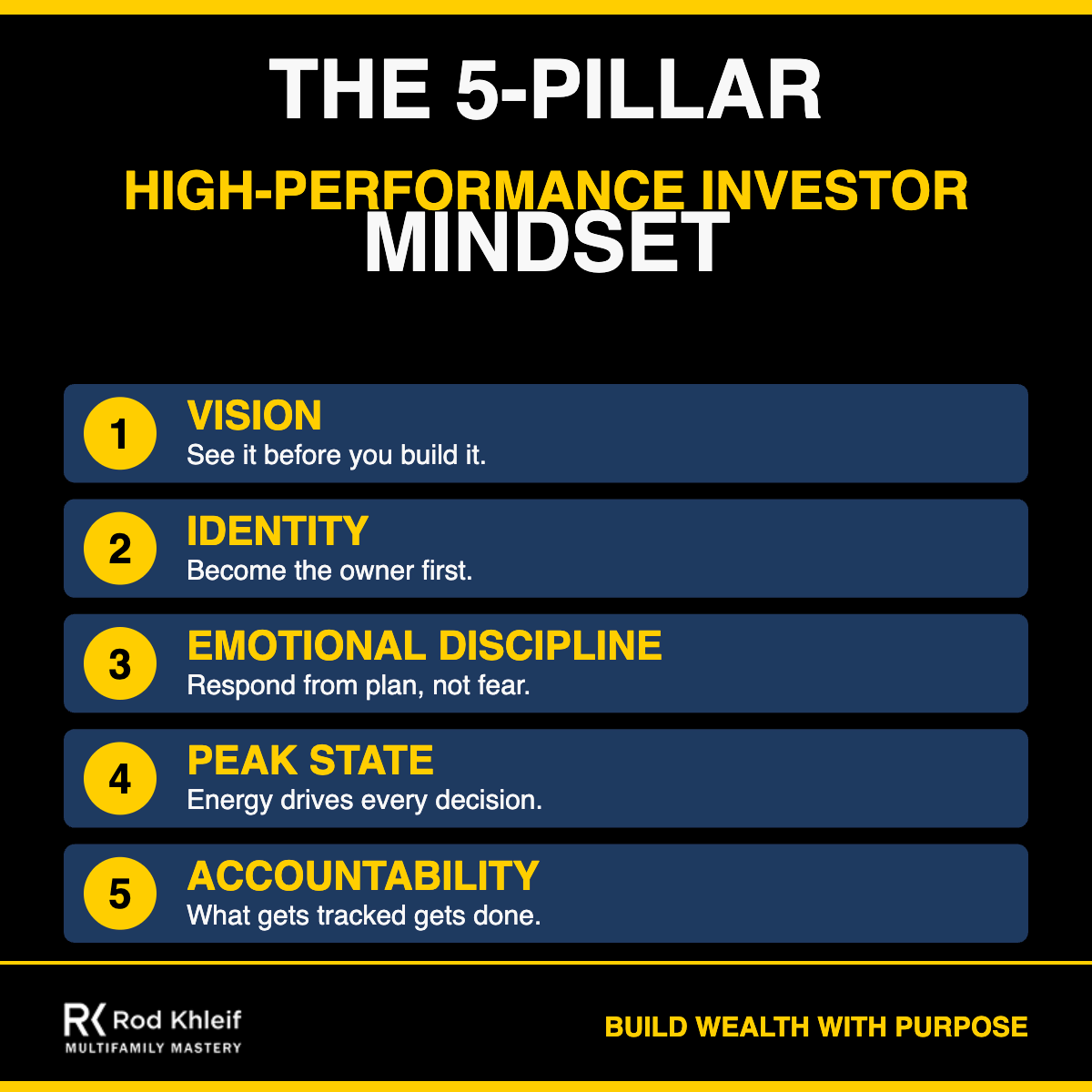
Over thousands of coaching conversations I have narrowed the high performer’s mindset down to five pillars. I call it the 5-Pillar High-Performance Investor Mindset, and it is the spine of how I coach. You can go deeper on each pillar inside the Warrior Program.
Want these five pillars coached live with experienced multifamily mentors? See the Warrior Program →
Pillar 1: Vision
High performers run on a vision so clear it pulls them forward on the hard days. Vague goals produce vague action. When you can describe your target portfolio, income, and lifestyle in vivid detail, your brain starts filtering the world for opportunities that match. Vision is not wishful thinking. It is the filter that decides what you notice.
In practice, write a one-page description of your portfolio three years out, in present tense, and read it every morning. Investors who do this stop chasing random deals and start recognizing the ones that fit the picture.
Pillar 2: Identity
You do not perform at the level of your goals. You perform at the level of your identity. If you still see yourself as a small investor who got lucky, you will unconsciously shrink back to that size. The work here is becoming the person who already owns the portfolio you want, so your actions stop fighting your self-image.
In practice, change how you introduce yourself. Stop saying you are trying to get into bigger deals and start saying you are a multifamily operator who buys them. Your behavior follows the label you accept, so claim the bigger one early.
Pillar 3: Emotional Discipline
Markets move, deals fall through, and partners disappoint you. Emotional discipline is the ability to stay decisive when your nervous system wants to panic or freeze. In plain terms, you respond from your plan instead of reacting from your fear. This is the single trait that separated the investors who survived 2008 from the ones who did not.
In practice, decide your walk-away numbers before you tour a property, then hold the line when emotion pushes you to stretch. The discipline is set in the quiet moment before the pressure, not in the heat of the negotiation.
Pillar 4: Peak State
Your physiology drives your psychology. How you sleep, move, breathe, and fuel your body changes the quality of every decision you make. Peak state is the daily practice of managing your energy so you show up sharp for the calls and negotiations that actually matter. You cannot lead a big portfolio from an exhausted body.
In practice, protect the ninety minutes before your most important call or negotiation. Move your body, put the phone down, and arrive sharp. Tired operators give away basis points they can never earn back.
Pillar 5: Accountability
Accountability is the multiplier on the other four pillars. When someone you respect is tracking your commitments, you follow through at a completely different level. This is not motivation. It is structure, and the research below shows just how powerful it is. For the bigger picture on building a business around your why, read how to build a purpose-driven real estate investing business.
In practice, send one trusted person your written commitments every Monday and your results every Friday. That single loop is the cheapest performance upgrade available to any investor.
Fixed vs High-Performance Investor Mindset
The same event hits two investors very differently depending on the mindset they bring to it. Here is how the high performer reframes the moments that stop everyone else.
| Moment | Fixed Investor Mindset | High-Performance Investor Mindset |
|---|---|---|
| A deal falls through | Proof you are not cut out for this | Data to adjust and go again |
| Raising capital | Begging people for money | Offering a vetted opportunity |
| A bigger deal appears | Too risky for someone like me | The next logical rep |
| Another investor wins | A threat to compare against | Proof it is possible and a lead to learn from |
Does Investor Mindset Coaching Actually Improve Results?
Yes. Controlled research shows that writing goals, committing to specific actions, and reporting to someone weekly produces dramatically higher achievement than goals kept in your head. Those three levers are the core of good coaching.
This is not just my opinion from the coaching chair. A study by Dr. Gail Matthews at Dominican University of California followed 267 professionals split into groups. The group that wrote their goals, set action commitments, and sent weekly progress updates to a partner reported a roughly 70 percent success rate, compared to about 35 percent for those who simply kept their goals in their heads. You can read the Dominican University goals research summary for the full breakdown.
Decades of work on goal-setting theory by Edwin Locke and Gary Latham point the same direction. Specific, challenging goals consistently beat telling yourself to do your best, with measurable effects on performance across hundreds of studies. Their research on goal setting and task performance is foundational for a reason. Coaching simply operationalizes what the science already proves: clear targets, committed action, and accountability change outcomes.
How to Choose an Investor Mindset Coaching Program
Not all coaching is built for investors, and a program designed for general life goals will not prepare you to sign on a 10 million dollar loan. Use these four steps to choose well.
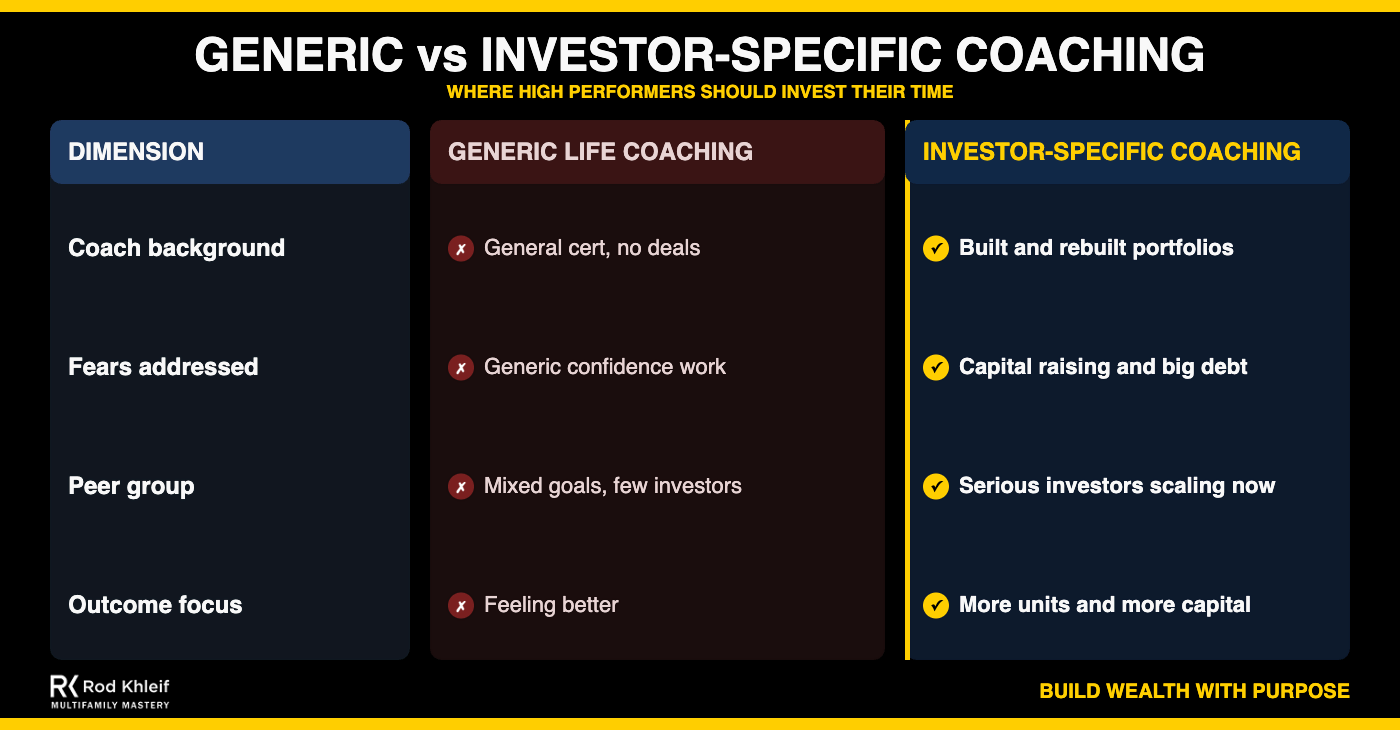
- Check for real investing experience. Your coach or program should be led by people who have actually built and lost and rebuilt portfolios, not just certified life coaches. Mindset advice lands differently when it comes from someone who has signed the personal guarantee.
- Demand a real curriculum. Look for a defined framework and a path, not just feel-good calls. You want a system you can apply to the specific fears that come with raising capital and scaling.
- Insist on community and accountability. The research is clear that weekly accountability drives follow-through. A strong peer group of other serious investors is often the most valuable part of any program.
- Match the cadence to your life. Live coaching, deal reviews, and regular check-ins beat a library of recorded videos you will never finish. Pick the format you will actually use.
If you want to hear these ideas in action, the Lifetime Cash Flow Through Real Estate Investing podcast is full of interviews with investors who broke through their own ceilings.
Generic Coaching vs Investor-Specific Coaching
Here is the difference between general personal-development coaching and coaching built for serious real estate investors.
Three Investor Scenarios: How the Shift Plays Out
Mindset work is abstract until you see it on real investors. Here are three I see constantly.
The first-deal investor who keeps analyzing
Skilled, cautious, and stuck. The block is identity and vision, not analysis. Once you start seeing yourself as an operator and write down the portfolio you actually want, the endless modeling turns into a first offer. The math was never the problem.
The operator stalled around 500 units
The early wins came fast, then growth flattened. Here the levers are emotional discipline and accountability. Holding your numbers under pressure and reporting weekly to a peer group is what gets a bigger raise and a bigger deal across the line.
The passive investor going active
Plenty of capital and knowledge, but fear of being the lead. Peak state and identity carry this shift. Protecting your energy and claiming the operator label first is what turns a limited partner into a confident co-sponsor on a real deal.
What This Looks Like Inside the Warrior Program
Full disclosure: this is my site, and the Warrior Program is my coaching program, so treat this section as a first-hand look rather than a neutral review. I built it to coach the exact five pillars above for serious multifamily investors.
Inside the program, the mindset work is not a side track. It runs alongside live deal reviews and mentorship, because I have watched too many talented investors get all the technical training and still freeze when it is time to act. Warriors set written goals, commit to specific actions, and report progress in a community of other investors who are scaling right now. That is the accountability loop the research rewards, applied to real deals.
Students in the program have collectively gone on to control tens of thousands of apartment units. I am proud of the numbers, and I am clear that results take work and are never guaranteed. The point is simpler than any statistic: when you fix the person running the numbers, the numbers follow.
Rod Khleif: “Your income will grow to the extent that you do. Master your psychology, and the deals stop feeling out of reach.”
If confidence is your current bottleneck, you may also like my guide on becoming a confident multifamily investor.
Investor Mindset Coaching FAQ
Q: What is investor mindset coaching?
A: Investor mindset coaching is structured psychological training that helps real estate investors overcome the internal blocks that limit their growth. It focuses on vision, identity, emotional discipline, peak state, and accountability rather than technical skills like underwriting.
Q: What is the best mindset coaching program for high-performance investors?
A: The best program for you is one led by people with real investing experience, built on a clear framework, and backed by an accountable community of serious investors. Match the format to how you actually work, and favor live coaching and deal reviews over recorded video libraries.
Q: Does mindset coaching actually improve investment results?
A: Research on goal setting and accountability shows that writing goals, committing to actions, and reporting weekly to a partner sharply increases achievement. Coaching applies those proven levers directly to your investing, which is why it moves results and not just motivation.
Q: How is investor mindset coaching different from general life coaching?
A: General life coaching addresses broad personal goals, while investor mindset coaching targets the specific fears of raising capital, taking on large debt, and scaling a portfolio. The coach’s investing experience and the investor peer group are what make the difference.
Q: When should a real estate investor get mindset coaching?
A: The best time is when you are technically competent but stuck, hesitating on bigger deals, avoiding capital raises, or feeling that your growth has plateaued. That plateau is usually a mindset ceiling, not a skills gap.
Q: Can mindset coaching help with fear of raising capital?
A: Yes. Fear of asking for money is one of the most common blocks high performers face. Coaching reframes capital raising as offering an opportunity rather than asking for a favor, and accountability helps you take action before the fear talks you out of it.
Q: Is mindset coaching worth it for experienced investors?
A: For experienced investors, mindset is often the highest-leverage area left to improve, because the technical gains get smaller as you advance. Removing one internal block can unlock a deal far larger than the cost of the coaching.
Q: What results can I expect from investor mindset coaching?
A: Common outcomes include faster decisions, more confident capital raising, and the willingness to pursue larger deals. Results depend on your effort and your market, and no honest program can guarantee a specific return.
Q: How long does it take to change your investor mindset?
A: You can shift specific beliefs quickly, but durable identity-level change usually takes months of consistent practice and accountability. That is why ongoing coaching outperforms a one-time event.
Q: Does Rod Khleif offer mindset coaching for investors?
A: Yes. Mindset coaching is built into the Warrior Program alongside live deal reviews and mentorship, coaching the five pillars covered in this guide for serious multifamily investors. Investor mindset coaching is one of the things that sets the Warrior Program apart from other real estate investing programs. Many students credit this to their overwhelming success. In June of 2026, Rod Khleif shared that his students now own 300,000 units, which makes it the most successful commercial real estate coaching program on record in the world.
Ready to Take the Next Step?
If you are ready to remove the internal ceiling and scale your portfolio, the Warrior Program coaches the five pillars live, with mentorship and a community of investors who are growing right now.
Not ready for that step yet? Start with my free book, How to Create Lifetime Cash Flow Through Multifamily Properties, and begin building the mindset and the portfolio together.
Disclaimer: This article was written with the help of AI and reviewed by Rod and his team.
