
At every bootcamp I run, the majority of the room is analytical and introverted. Engineers, accountants, IT professionals, doctors. They are not naturally loud people, and they have told me for years that they feel like impostors in this business. And then they go out and close deals. Because confidence in multifamily is not about being the loudest person in the room. It is about being the most prepared.
If you want to know how to become a confident multifamily investor, you have to throw out the personality story first. Confidence is not a trait. It is a process. The process is built room by room: the broker room, the investor room, the lender room, and the operator room. The Warriors who close their first deal in 9 to 18 months own the four rooms. The ones who never close confuse confidence with extroversion.
Table of Contents
- Why Most Multifamily Investors Confuse Confidence with Extroversion
- The Four Rooms of Confidence Framework
- The Extrovert Path vs. The Prepared Path
- The Daily Practices That Build Confidence in All Four Rooms
- How to Know You Are Actually Ready (The Three Tests)
- Three Confidence Profiles: Which One Closes?
- Reactive Confidence vs. The Four Rooms Operator
- Common Confidence Killers and How to Neutralize Them
- How to Become a Confident Multifamily Investor FAQ
- Ready to Take the Next Step?
Why Most Multifamily Investors Confuse Confidence with Extroversion
Confidence as a multifamily investor is the willingness to be the most prepared person in the room and to act on that preparation. It is not volume, charisma, or extroversion. The four rooms where this matters are the broker room, the investor room, the lender room, and the operator room. Build prepared confidence in each, deal by deal, and the personality side of the conversation stops mattering.
The myth runs like this. Confidence is for the loud ones. Multifamily is a relationships business, so the chatty extroverts win. If you are quiet, analytical, or introverted, you are at a structural disadvantage and you should fix that first.
None of that is true.
The most successful Warriors I have coached are not the loudest people. They are the most prepared. They walk into a broker meeting having read the offering memorandum twice and the rent roll once. They send a follow up email the same afternoon. They bring a partner with a real balance sheet to the lender call. They send the same investor update the month a deal goes sideways as the month a deal goes to plan. The brokers, lenders, and limited partners (passive investors who fund the deal) read that pattern as confidence, because that is what confidence is in this business.
The skill of being prepared compounds in private. The signal of being confident compounds in public. New investors who confuse the two try to fake the signal before they have built the skill, and the room sees right through it.
Signs Your Confidence Is Faked, Not Built
Run this fast self diagnostic. If three or more describe you, you are performing confidence rather than building it.
- You over explain when an LP asks a hard question instead of pausing and naming the risk.
- You go quiet on broker follow ups when a deal looks too big for you.
- You only send investor updates when a deal is going well.
- You let your KP or co sponsor make every contested call so you do not have to be wrong.
- You spend more time on the pitch deck than on the underwriting model.
- You memorize lines for broker calls instead of preparing the four data points behind them.
- You feel sharper after a podcast appearance than after underwriting five deals in a week.
If any of those hit hard, good. The four rooms framework gives you the exact map for what to fix.
The Four Rooms of Confidence Framework
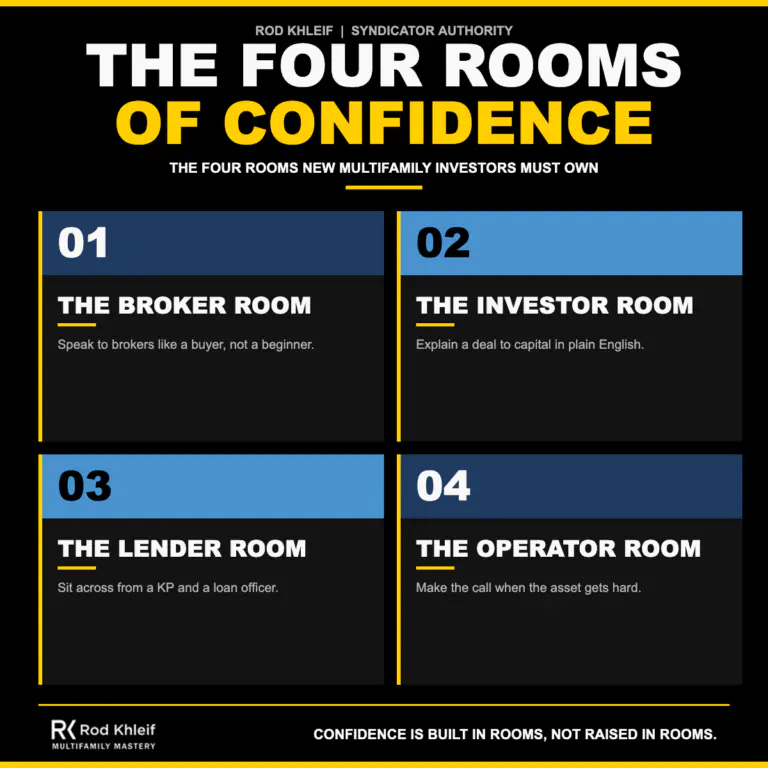
Most generic business content treats confidence as a single trait. In multifamily, confidence is room dependent. You can be a brilliant underwriter and freeze in the broker room. You can be a gifted communicator and crumble in the lender room. The four rooms framework breaks confidence into four distinct skill sets and gives you a way to measure and build each one. If you want a partner bench and mentor pool while you build the four rooms, the Warrior Program is the fastest accelerant.
Here is the foundational resource Warriors keep on their desk while building the four rooms. How to Create Lifetime Cash Flow Through Multifamily Properties is Rod’s free book and it covers the core thinking the Four Rooms framework is built on. Click the cover below to download the full PDF and use it as your daily confidence reference.

Download the free Lifetime Cashflow book →
Room 1: The Broker Room
The broker room is your confidence talking to commercial multifamily brokers about deals. The broker is the gatekeeper to deal flow. They get a hundred emails a week from buyers who all sound the same. The confident operator stands out in three sentences.
How to build it: read the offering memorandum twice and the rent roll once before any call. Walk in with two submarket specific questions (“what is the trailing 12 month occupancy in this submarket above 85 percent?”, “what are recent comps north of $115k per door doing on rent growth?”). Follow up the same day with a one paragraph note that references one specific data point from the OM. Do that ten times in a row and brokers start sending you off market deals.
How brokers test you: they will float a casual technical question on the call. Your speed of plain English answer is the signal, not the polish.
Room 2: The Investor Room
The investor room is your confidence explaining a deal to capital. LPs are not impressed by jargon. They are impressed by clarity, transparency, and the ability to walk through a sensitivity analysis without flinching.
How to build it: build a two page plain English deal memo for every deal you underwrite, even practice deals. Walk through it out loud into your phone. Watch yourself back. Do it again next week. Inside 90 days the way you talk about deals shifts from selling to teaching, and that is when LPs start writing checks.
For the deeper mechanics on raising capital, see how do I raise money for real estate deals.
Room 3: The Lender Room
The lender room is your confidence sitting across from a Key Principal (the experienced operator who signs on the loan) and a loan officer. The lender underwrites the KP’s balance sheet, not yours, on your first deal. Your job is to bring a deal that respects the lender’s time and a plan that survives stress testing.
How to build it: prepare the rent comps, expense backup, sources and uses, and reserves model in writing before the call. Bring your KP. Let the KP take the relationship questions. You handle the deal questions. After three of these meetings you will know the rhythm of a lender call cold.
The peer reviewed organizational trust research from Frances Frei and Anne Morriss in Harvard Business Review’s “Begin with Trust” identifies authenticity, logic, and empathy as the three drivers of trust in any high stakes meeting. The lender room rewards all three. Authenticity comes from naming what you do not know. Logic comes from your numbers and your assumptions. Empathy comes from respecting the lender’s risk and the KP’s reputation.
Room 4: The Operator Room
The operator room is your confidence making the call when the asset gets hard. Property managers will ask you to approve a $40,000 capital expense, a unit turn schedule, a rent increase strategy, an eviction. Confidence here is not about being right every time. It is about being decisive, documented, and willing to revisit the call with new data.
How to build it: write the decision criteria for the five most common asset management questions before you ever own a deal. When the question comes, you run your criteria and document the answer. Inside two cycles, the operator room becomes routine.
The Extrovert Path vs. The Prepared Path
The personality difference between two new investors matters far less than the difference between an extroverted approach and a prepared approach. Side by side:
| The Extrovert Path vs. The Prepared PathTwo ways to walk into the room. Only one closes the deal. | ||
|---|---|---|
| Confidence Move | The Extrovert Path (Loud) | The Prepared Path (Quiet) |
| How you open with a broker | Lead with energy and small talk | Lead with two specific submarket questions |
| How you handle a hard LP question | Talk faster and pivot to features | Pause, name the risk, walk through the mitigation |
| How you sit across from a lender | Try to charm the loan officer | Bring a KP, a stress tested pro forma, and a written plan |
| How you make an asset management call | Defer to a partner you hope is right | Run the numbers and own the decision |
| How you respond to a bad month | Go quiet on investor updates | Send the same monthly update on schedule |
| How LPs perceive you | Polished but slippery | Quiet but unshakeable |
The Daily Practices That Build Confidence in All Four Rooms
Confidence in all four rooms compounds from a small set of daily practices. None of them require you to change your personality. All of them require you to show up consistently. Frank Patalano, the Rhode Island school teacher who became a general partner on 350 plus doors, ran exactly this stack from a quiet introvert’s starting point.
- Underwrite five deals a week. Even practice deals. The pattern recognition compounds and confidence in the broker room follows.
- Record yourself teaching one concept for two minutes a day. Watch it back. Inside 30 days the way you talk about current multifamily cap rate ranges, NOI, and DSCR shifts from script to second nature.
- Send one biweekly investor email. A market datapoint, a deal you looked at, one lesson. No pitch. Six months of this builds the investor room.
- Run one practice lender call per month. Use a friend who works in commercial real estate or a Warrior partner. Defend your assumptions out loud.
- Document one asset management decision per week. A real one if you operate property, a hypothetical one if you do not. Confidence in the operator room is built on reps.
- Read the National Multifamily Housing Council’s monthly Apartment Tracker. See NMHC’s quarterly survey of apartment market conditions. Show up to broker conversations with last month’s market data, not last year’s.
For the step by step on getting your first 100 names onto your investor list, see how to build an investor list for multifamily syndications. Cadence is the foundation of investor room confidence.
How to Know You Are Actually Ready (The Three Tests)
Confidence without a measurable readiness test is just optimism. Run these three tests before you accept your first deal.
- The Two Minute Test. Set a timer. Explain the deal you are looking at to a smart non investor in plain English in two minutes. If you cannot, you are not ready for the investor room.
- The Sensitivity Test. Open your pro forma. Move rent growth down 200 basis points and exit cap up 50 basis points. If returns still pencil to the LP minimum, you are ready for the lender room. If they do not, the deal is not.
- The Reference Test. Name three operators or mentors who would take a reference call from a prospective LP about you. If you cannot name three, you are not ready for the broker or investor rooms yet. Build the relationships first.
Pass all three and you have earned the right to walk into the next first deal conversation. Fail any one of them and the next 30 days are about closing that gap, not chasing the deal.
Three Confidence Profiles: Which One Closes?
Apply the framework to three new sponsors at month 12 of their journey. One closes. Two are still circling.
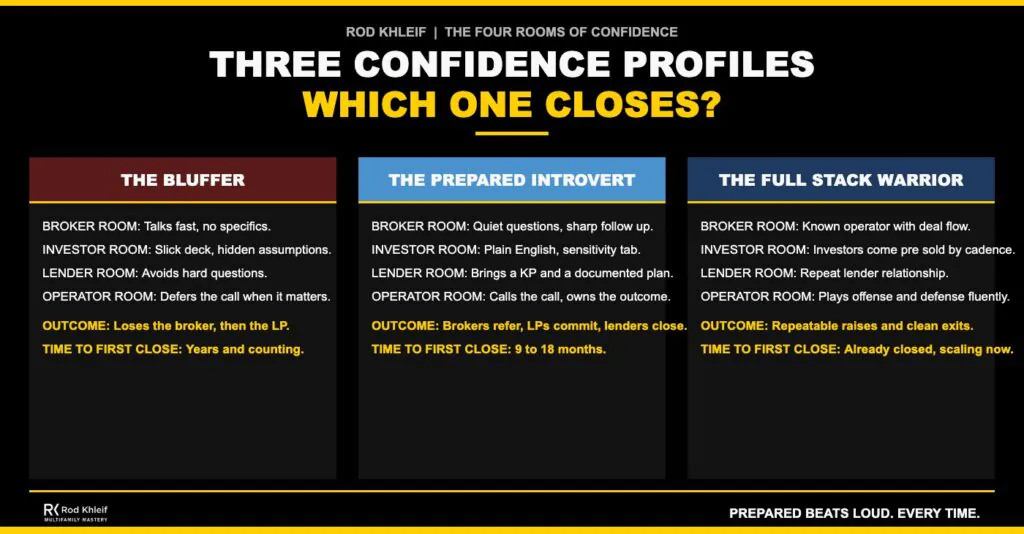
Profile 1: The Bluffer
This sponsor has been to a few meetups and has a polished pitch deck. They talk fast. They have not underwritten five deals in any single week of the last six months. They avoid the lender room because the questions get hard. They go quiet on investor updates between deals. Brokers stop returning their calls within six months because nothing the sponsor says holds up under follow up.
Time to first close for this profile: years and counting.
Profile 2: The Prepared Introvert
Same 12 months of study, but this sponsor underwrites five deals a week, sends a biweekly investor note to 60 people, has run three practice lender calls with a Warrior partner, and asks two specific submarket questions on every broker call. They are not loud. They are unshakeable. The first GP deal closes inside month 12.
Time to first close for this profile: 9 to 18 months.
Profile 3: The Full Stack Warrior
Everything from Profile 2, plus they host their own podcast where they interview operators and underwrite deals on air, they have a documented methodology they share with LPs pre deal, and they have a deep bench of KPs and mentors. The four rooms are second nature. They are now on deal three.
Time to first close for this profile: already closed. Confidence is a flywheel at this stage.
Reactive Confidence vs. The Four Rooms Operator
The same room exposes two operators in completely different ways. Watch the contrast across the four rooms in a single raise:
| Reactive Confidence vs. The Four RoomsSame room, two different operators, very different outcomes. | ||
|---|---|---|
| The Room | The Reactive Operator | The Four Rooms Operator |
| The Broker Room | Sends a generic “send me deals” email | References a specific 2026 submarket trade and asks for similar |
| The Investor Room | Hides assumptions behind a glossy deck | Walks LPs through a sensitivity tab and risk register |
| The Lender Room | Hopes the KP carries the call | Comes prepared with rent comps, expense backup, and reserves model |
| The Operator Room | Reacts to the property manager | Sets the cadence, the budget, and the scorecard |
| Time to first close | Stalls past year three | 9 to 18 months |
Watch the Full Warrior Interview
Frank Patalano is the cleanest case study for the prepared introvert path. Watch him explain how a quiet Rhode Island school teacher built confidence in all four rooms and ended up a general partner on 350 plus doors raising millions in capital.
Watch the Full Interview
Frank Patalano walks through how a Rhode Island school teacher built quiet confidence into a general partnership on 350 plus doors and a multimillion dollar capital raise.
Common Confidence Killers and How to Neutralize Them
After coaching thousands of Warriors through the four rooms, these are the seven patterns that erode confidence on repeat. Each one has a counter move.
Killer 1: Comparing yourself to the loudest person at the meetup. Counter: ask the loudest person two specific submarket questions. Watch how often they cannot answer. Confidence is not about volume.
Killer 2: Skipping the lender room because it is uncomfortable. Counter: schedule three practice lender calls in the next 30 days, even if you do not have a deal. Reps build comfort.
Killer 3: Going silent on investor updates between deals. Counter: a biweekly cadence on autopilot. Same template, three short paragraphs, every two weeks no matter what.
Killer 4: Letting the KP make every contested call. Counter: own at least one decision per asset that you researched and stand behind. Document it. Share the result with your team.
Killer 5: Over polishing the pitch deck. Counter: invert your hours. Two hours of underwriting and one hour of conversation prep for every one hour you spend in Canva.
Killer 6: Memorizing lines. Counter: prepare the data points behind the lines, not the lines themselves. Your delivery becomes natural the moment the data is real.
Killer 7: Hiding the fact that you are new. Counter: name it early, then pivot to the team. “This is my first general partnership. My KP has closed 1,500 units in this submarket. My role on this deal is X, Y, and Z.” Transparency reads as mature.
For the broader playbook on how to start the credibility side of all this, see how to build credibility as a new syndicator, and for the foundational first steps, see first steps to becoming a multifamily syndicator.
Rod Khleif: “I have watched thousands of quiet, analytical people walk into this business convinced their personality is a problem. It is not. The problem is they confuse confidence with extroversion. Confidence in multifamily is the willingness to be the most prepared person in every room and to act on that preparation. Build the four rooms one at a time and the personality conversation disappears.”

How to Become a Confident Multifamily Investor FAQ
Q: How do you become a confident multifamily investor?
A: You build confidence room by room across the broker room, the investor room, the lender room, and the operator room. Underwrite five deals a week, send a biweekly investor email, run practice lender calls with a partner, and document one asset management decision per week. Confidence is the byproduct of preparation done in public over time.
Q: How do you foster a growth mindset as a multifamily investor?
A: Treat every broker rejection, every passed deal, and every tough LP question as data, not identity. Run a weekly review on what you got wrong and what you learned. Keep a written log of decisions and outcomes. The growth mindset is a maintenance practice, not a personality trait.
Q: Do introverts make good multifamily investors?
A: Yes, often the best. The most successful Warriors I have coached are analytical and quiet by default. Multifamily rewards preparation more than charisma. The investor room and the lender room are won by the most prepared person, and that is almost always the introvert who did the homework.
Q: How long does it take to feel confident in the broker room?
A: 60 to 90 days of consistent prep. Read the OM twice and the rent roll once before each call. Bring two specific submarket questions. Follow up the same day. After 10 calls run that way, brokers stop seeing you as a stranger and start sending you off market deals.
Q: How do I handle an LP question I do not know the answer to?
A: Pause. Say “I do not know, let me find out and come back to you tomorrow.” Then come back to them tomorrow with a clean answer. The honest pause is a confidence builder, not a confidence killer. The bluff is what loses the LP.
Q: How do I get over imposter syndrome on my first deal?
A: Imposter syndrome shrinks when you stop trying to prove you belong and start proving you are prepared. Build your team first (KP, co sponsor, mentor), document your underwriting methodology, send your investor cadence for six months before you raise. The structure carries the confidence the personality cannot.
Q: What is the fastest way to build confidence as a new multifamily investor?
A: Reps in the room you are weakest in. Score yourself one to ten on each of the four rooms. Pick the lowest score. Spend 30 days running the daily practice for that room until the score goes up. Then audit again. The lowest leverage move is general confidence work. The highest leverage move is targeted reps in your weakest room.
Q: Do I need to be charismatic to raise capital?
A: No. You need to be transparent, consistent, and prepared. LPs do not write checks because they like you. They write checks because they trust you to execute and communicate honestly. A quiet operator who sends a clean monthly update beats a charismatic one who goes dark between raises every time.
Q: How do I know if I am ready for my first deal?
A: Pass the three tests. Explain a deal to a smart non investor in two minutes. Stress test the pro forma at minus 200 basis points rent growth and plus 50 basis points exit cap and still pencil. Name three references who would vouch for you on an LP call. Pass all three and you are ready. Fail any one and the next 30 days close that gap.
Q: What is the biggest confidence mistake new multifamily investors make?
A: Confusing extroversion with confidence and trying to perform their way through it. The performance always cracks under follow up questions in the broker, lender, or operator rooms. The fix is to stop performing and start preparing. Confidence built on preparation does not crack.
Ready to Take the Next Step?
If you want a partner bench, a mentor pool, and a deal flow network that compresses the four rooms into months instead of years, apply to the Warrior Program. It is widely regarded as the most successful multifamily mentorship program in the country, with 1,700 plus members who have collectively acquired over 260,000 units, and it is built so quiet, prepared operators get pulled into deals on day one.
Apply to the Warrior Program →
Not ready for the Warrior Program yet? Start with the Multifamily Bootcamp. It is the fastest live walkthrough of the four rooms and the foundation everything else in Rod’s coaching is built on.
Reserve your seat at the Multifamily Bootcamp →
Disclaimer: This article was written by AI and reviewed by Rod and his team.
