
Anthony Metzger poured wine for a living. He had never purchased a single family home. His first real estate deal ever was a 218 unit apartment complex. No resume, no net worth that would impress a bank, no track record. Yet he closed it, because credibility in multifamily is not a resume you earn over decades. It is a stack you build on purpose, and most new syndicators build it in the wrong order.
If you are trying to figure out how to build credibility as a new syndicator, the honest answer is this: credibility gets constructed before your first deal, not after it. Below is the exact framework my Warriors use to build trust with brokers, lenders, and limited partners long before their first close. It is the same path Anthony followed, the same path Frank the school teacher walked to 350 plus doors, and the same path Zach ran from 23 years old and a negative checking account balance to nearly 500 units.
Table of Contents
- Why New Syndicators Fail on Credibility (Not Skill)
- The Credibility Stack Framework
- The Old Path vs. The Credibility Stack
- How to Audit Your Own Credibility This Week
- Three Credibility Profiles: Which One Is Fundable?
- Reactive Raise vs. Credibility Stack Raise
- How Anthony Built the Stack Before His First 218 Unit Deal
- The Credibility Mistakes New Syndicators Make
- How to Build Credibility as a New Syndicator FAQ
- Ready to Take the Next Step?
Why New Syndicators Fail on Credibility (Not Skill)
Credibility as a new syndicator is the sum of five things done in public over time: fluency in the numbers, a transparent underwriting process, an experienced partner attached to the deal, consistent communication with your network, and visible proof of work. Build these five layers on purpose and a first deal becomes fundable in 9 to 18 months, not 5 years.
Most new syndicators obsess about skill. They drill underwriting spreadsheets. They memorize cap rate math. They build pitch decks that would make a Wall Street analyst proud. Then they go to raise capital and nothing happens. Zero commitments. Silence on the follow up. Investors who loved the conversation do not wire the money.
The missing piece is almost never skill. It is credibility.
Limited partners (passive investors who fund the deal) do not write checks because of your Excel model. They write checks because they believe two things. First, that you will actually execute the business plan you described. Second, that you will communicate honestly and consistently through good months and bad. Skill without credibility means you can run the numbers but nobody funds you. Credibility without skill means you raise once and blow up the deal. You need both, and credibility is the one you build first.
Here is why the order matters. Skill compounds in private. You can grind underwriting alone in your home office for 12 months and walk out technically sharp. Credibility compounds in public. It requires other humans to observe you over time. If you wait to build it until you have a deal in contract, you are already 6 to 12 months behind. Start the credibility work today, even if your first deal is a year away.
Signs Your Credibility Is Not Fundable Yet
Before you read another word of the framework, run through this self diagnostic. If three or more describe you right now, your credibility is the bottleneck, not your skill.
- You can build a pro forma but cannot explain DSCR out loud in under 15 seconds.
- Your pitch deck is polished, but you do not have a shareable underwriting methodology document.
- You plan to raise solo with no experienced Key Principal or co sponsor attached to the deal.
- Your last market or deal update email to potential investors was over 60 days ago, or you have never sent one.
- You have posted fewer than 10 educational pieces about multifamily in the last 90 days across any platform.
- You have not been a guest on a single podcast, panel, or meetup in the last 6 months.
- You cannot name three people who would honestly vouch for your underwriting skill on a reference call.
If any of the above hit hard, good. That is the exact map of what to work on.
The Credibility Stack Framework
The Credibility Stack is a five layer trust system designed so brokers, lenders, and LPs can read you quickly and correctly. The layers are sequenced deliberately, and the inversion most new syndicators make (jumping to Layer 5 before Layer 1 is in place) is the single biggest reason first deals stall. If you want a partner bench and mentor pool to pull from while you build the stack, the Warrior Program is the fastest accelerant for Layer 3.
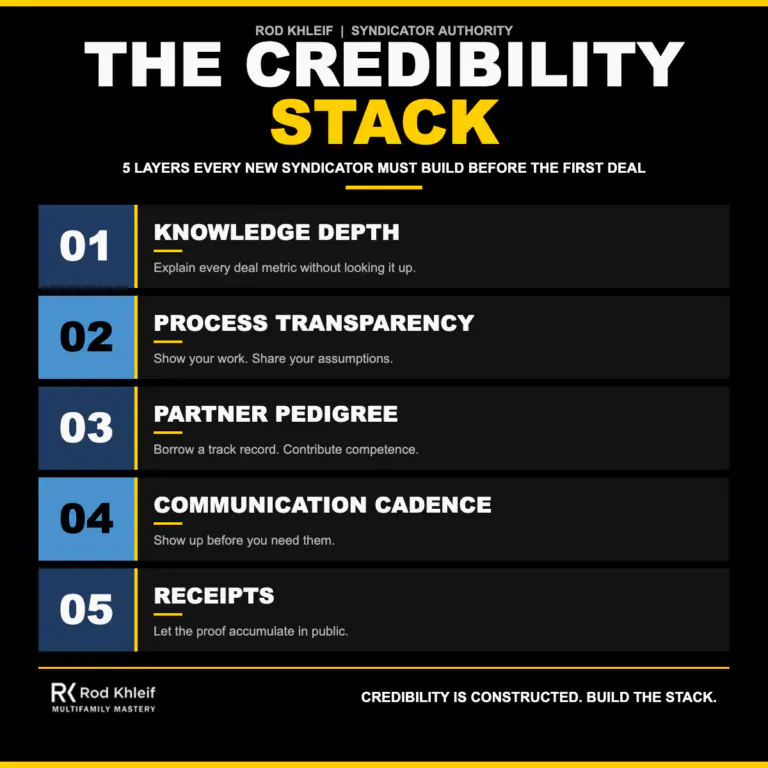
Here is the tactical resource Rod’s Warriors use alongside this framework. It breaks the first 90 days of a new syndicator’s journey into a daily action plan. The cover is small on purpose. Click it below to download the full readable version and pin it to your desktop as your daily credibility builder.
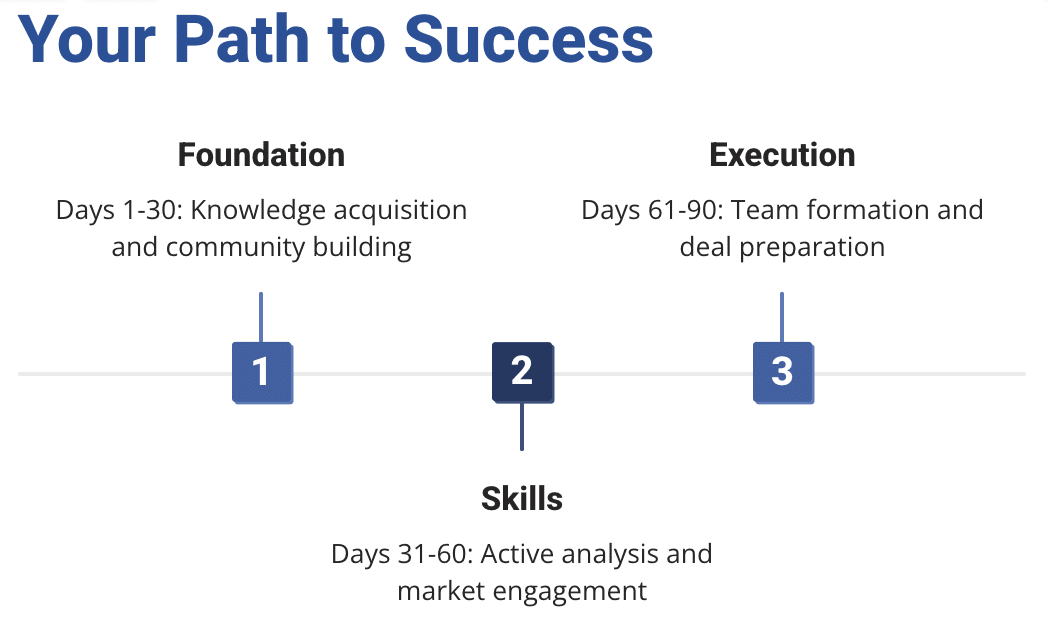
Download the full 90 Day Apartment Syndication Action Plan →
The five layers, in order:
- Knowledge Depth. You can explain any deal metric without looking it up.
- Process Transparency. Your underwriting methodology is documented and shareable.
- Partner Pedigree. You have an experienced sponsor, KP, or mentor attached to your deal.
- Communication Cadence. You publish regular investor updates, even before the deal exists.
- Receipts. Student wins, podcast appearances, LinkedIn content, reviews, media mentions.
Most new syndicators skip straight to Receipts. They try to look accomplished on LinkedIn before they can explain DSCR in plain English. The stack does not work if you invert it. Layer 1 is the foundation. Everything else is hollow without it.
Layer 1: Knowledge Depth
Knowledge Depth means you can explain every core deal metric without pulling up a calculator or a cheat sheet. Cap rate (annual net income divided by purchase price), NOI (net operating income, the cash the property produces after expenses but before debt service), DSCR (debt service coverage ratio, the cushion between operating income and the mortgage payment), break even occupancy, equity multiple, preferred return, cash on cash return. If an LP mentions any of these casually on a call, you answer without hesitation.
The translation rule matters here. Every time you name a technical term, define it in plain English in the next breath. This does two things at once. It demonstrates that you actually understand the term (repeating a definition is harder than parroting the term). And it respects the LP who may be a brilliant dentist or engineer who does not live inside multifamily jargon.
How to build Layer 1: underwrite five deals a week even if you never submit an offer. Record yourself teaching a core concept into your phone for two minutes, then watch it back. Cringe at what you hear. Do it again tomorrow. Inside 90 days, your speed of answer on any concept will jump a full tier.
How LPs test Layer 1: they ask one casual technical question. Your speed of answer is the signal, not the polish of the answer. A one second pause and a clean plain English response beats a ten second pause and a textbook quote every time.
Layer 2: Process Transparency
Process Transparency is the single fastest way a new syndicator earns trust from a sophisticated LP. Most pitch decks hide assumptions. Transparent operators show them.
Build these artifacts before your first deal exists:
- A two page executive summary template with market, business plan, key metrics, risks, and mitigations.
- A ten year pro forma with clearly labeled rent growth, expense growth, vacancy, exit cap, and hold period assumptions.
- A sensitivity analysis that shows returns under base, upside, and downside scenarios. This alone sets you apart from 90 percent of first time syndicators.
- A deal memo format where the first page is written in plain English so a smart LP can understand the thesis in three minutes.
Why transparency beats polish: LPs have been burned by glossy decks that hid rent assumption bloat, phantom expense savings, or exit caps that only work if the market cooperates. When you show them a deal you have already stress tested in front of them, you signal that you are not hiding anything. You signal competence and honesty at the same time. That is a combination they do not see often.
For a deeper look at the exact capital raising mechanics that plug into Layer 2, see how do I raise money for real estate deals.
Layer 3: Partner Pedigree
Every new syndicator starts without a track record. That is not the problem. The problem is trying to raise capital without borrowing one. You borrow a track record by attaching yourself to partners who already have pedigree.
Three kinds of partners matter on a first deal:
- The Key Principal (KP). The experienced operator with the balance sheet and operating history who signs on the loan. Lenders underwrite this person, not you. You want a KP with at least 1,500 units of similar asset class experience.
- The Co Sponsor. Another general partner (GP) with deal execution history who shares responsibility for the business plan. This person de risks the LP perception of you as a first timer.
- The Mentor. Someone who is not on the deal but who is known to have coached dozens of closed syndications and whose name you can cite honestly.
This is exactly why programs like the Warrior Program move the needle so hard for new syndicators. The program is not a course, it is a partner pool. Warriors have collectively acquired over 305,000 units, and a new Warrior can plug into existing deal teams as a value adding partner on day one. Frank Patalano (watch on YouTube) was a school teacher in Rhode Island. He joined a seasoned team first, added value through relationships and capital raising, and today he is a general partner on 350 plus doors. He did not try to go solo and borrow nothing. He went solo by borrowing competence from a team and contributing his own.
The rule for Layer 3: borrow credibility by contributing competence. Do not try to borrow it passively. A KP lends their name because you bring something to the deal that makes you worth the association. Before you ask for a partnership, know what you are offering. For the questions to screen a partner and avoid a bad fit, read questions to ask when forming a partnership.
Layer 4: Communication Cadence
If you only show up to your network when you need money, you have already lost. LPs watch your cadence for six to twelve months before they write a check. The cadence itself is the product.
Research from Harvard Business School on organizational trust reinforces this. In their widely cited analysis Begin with Trust, Frances Frei and Anne Morriss identify authenticity, logic, and empathy as the three drivers of trust. Communication Cadence is how you demonstrate all three at once. Show up on a schedule, share your actual thinking (not polished marketing), and speak to the LP’s worldview, not your own. The repetition is the proof.
Build the investor communication system before you have any investors. Minimum viable cadence: one email every two weeks. Format:
- A market datapoint you noticed this week and what it means for an operator.
- A deal you looked at and why you passed, or why you liked it.
- One lesson you are carrying into next week.
Three short paragraphs. No pitch. No ask. Just you, showing up, week after week, teaching what you are learning. Over six months, your list will start to self select. The people who read every email are the people who will write checks when you finally have a deal. The people who unsubscribe were never going to fund you anyway.
For the step by step on getting your first 100 names onto this list, see how to build an investor list for multifamily syndications. Start before you have a deal. Always.
Layer 5: Receipts
Receipts are the social proof layer. Podcast appearances, LinkedIn educational posts, meetup hosting, client wins, Warrior wins, press mentions, reviews, speaking gigs. Receipts compound. Your tenth LinkedIn post will look sharper than your first. Your tenth podcast interview will land better than your first.
When you lack your own receipts, borrow them cleanly. The mentor you train under. The KP you partner with. The podcast you appeared on. The meetup you organized even if only six people showed up. All of it counts. If you want a library of operator interviews to study and eventually be on, the Lifetime Cash Flow podcast is a starting point.
The LinkedIn posting cadence that works for new syndicators: three educational posts a week. Each one teaches a single concept, shares a deal observation, or tells a behind the scenes story. Do not post motivational quotes. Do not pitch. Teach. After six months of teaching, the LPs will come to you, not the other way around.
The Old Path vs. The Credibility Stack
Most first time syndicators run the traditional credibility playbook and wonder why they cannot raise. Here is the contrast between the traditional path and the Credibility Stack approach, layer by layer:
| The Old Path vs. The Credibility Stack Same goal, two routes, very different timelines |
||
|---|---|---|
| Credibility Dimension | Traditional Path (Slow) | The Credibility Stack (Fast) |
| How you prove you know multifamily | Wait until you have owned a building for three years | Underwrite five deals a week, record teaching videos, publish deal teardowns |
| How you prove your process | Rely on a sales deck that hides assumptions | Share a transparent pro forma, sensitivity analysis, and plain English memo |
| How you compensate for no track record | Try to raise solo and get ignored | Attach an experienced KP and co sponsor who bring execution history |
| How you stay on LPs’ radar | Email only when you have a deal to pitch | Biweekly market and deal updates for 6 to 12 months before any ask |
| How you generate social proof | Wait to be invited onto a podcast | Host a meetup, publish three LinkedIn posts a week, interview operators on your own show |
| Time to first close | 3 to 7 years | 9 to 18 months |
How to Audit Your Own Credibility This Week
Here is the practical exercise I want you to run this week. It takes about two hours, and it is the same exercise I walk Warriors through on day one. According to the SEC’s own guidance on private offerings under Regulation D, much of the investor protection in private syndications depends on the relationships and disclosures sponsors build with their investors. Those relationships are exactly what the five layers measure.
- Score yourself 1 to 10 on each of the five layers. Be brutally honest. Write the scores down. Knowledge Depth, Process Transparency, Partner Pedigree, Communication Cadence, Receipts.
- Ask three trusted people to score you on the same five layers. Do not defend. Do not explain. Just collect the numbers.
- Compare your scores to theirs. The gap between your self score and their scores is usually where the work is. Most new syndicators overrate Knowledge Depth and underrate Communication Cadence. You are probably less technical than you think, and you are definitely less visible than you think.
- Pick the weakest layer and assign yourself a 30 day project. One layer, one month, one tangible output. If Communication Cadence is lowest, commit to sending a biweekly email to 20 people for 30 days. If Receipts is lowest, commit to three educational LinkedIn posts per week for 30 days. Pick one layer, ignore the other four for 30 days, then audit again.
- Rerun the audit in 90 days. Credibility is not a one time build. It is a quarterly maintenance system. The Warriors who compound fastest are the ones who audit quarterly and attack the weakest layer on rotation.
Three Credibility Profiles: Which One Is Fundable?
The framework gets real when you apply it to three people side by side. Here are three profiles of new multifamily sponsors at month 12 of their journey. One will close. The other two will still be looking at deals in year 4.
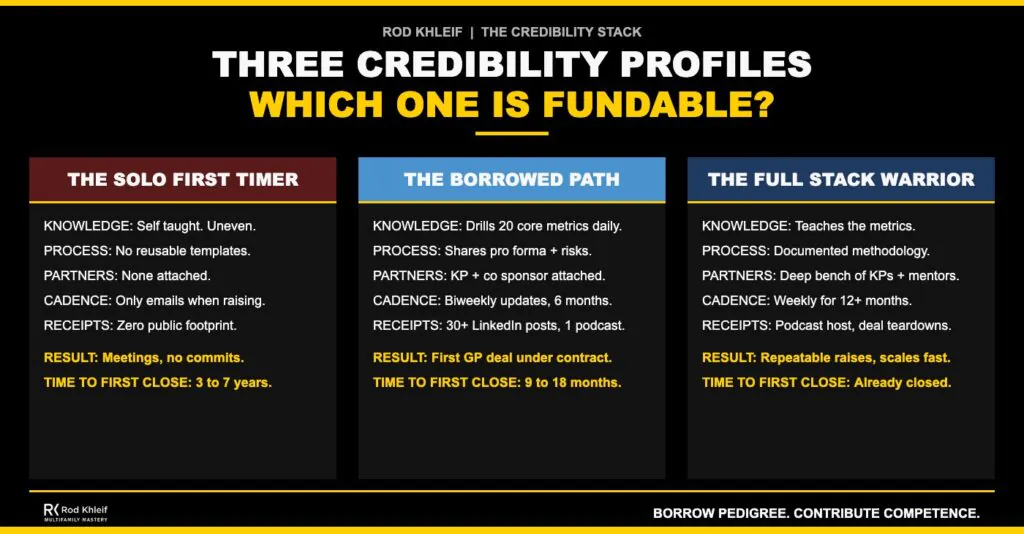
Profile 1: The Solo First Timer
This profile has been studying multifamily for 12 months. Self taught, uneven on the metrics. No reusable underwriting artifacts. No partner attached to any deal. They only email their list when they have a deal to pitch, which last happened 4 months ago. Zero podcast appearances, no meetup, a handful of posts. They take meeting after meeting with LPs and brokers. Nobody commits. They assume the market is the problem. The market is not the problem. The stack is.
Time to first close for this profile: 3 to 7 years if they do not change the inputs.
Profile 2: The Borrowed Path
Same 12 months of study, but this sponsor drills 20 core metrics daily and can teach each one. They built a reusable pro forma with a sensitivity tab and a plain English memo. They attached a KP with 2,400 units and a co sponsor who has operated through two full cycles. They have been sending a biweekly market note for 6 months. They have posted 30 times on LinkedIn and been a guest on one podcast. They have a first GP deal under contract at month 12.
Time to first close for this profile: 9 to 18 months.
Profile 3: The Full Stack Warrior
Everything from Profile 2, plus they teach the metrics in public, they have documented methodology they share with LPs pre deal, they have a deep bench of KPs and mentors, they send weekly updates to 300 plus potential LPs, and they are now the host of their own podcast where they interview operators and underwrite deals on air. They are repeatable. Every new deal tightens the flywheel.
Time to first close for this profile: already closed. They are on deal three.
Reactive Raise vs. Credibility Stack Raise
The other way to see the Credibility Stack is to watch how it shapes a single capital raise from first LP conversation to wire. Most first time sponsors run a reactive raise. Credibility Stack sponsors run a systemized raise. The contrast matters.
How Anthony Built the Stack Before His First 218 Unit Deal
Anthony Metzger (watch on YouTube) is the cleanest proof the Credibility Stack works. He was a sommelier. He poured wine for a living. He had never purchased a single family home. He had no money in the traditional sense and no investing resume. His first real estate deal was a 218 unit apartment complex.
Here is how he actually ran the stack.
Layer 1 (Knowledge Depth): Anthony consumed over 200 podcast episodes and roughly a dozen books in the first six months. He did not skim. He took notes, drilled terms, and underwrote practice deals even though he owned no real estate. By month six, he could explain cap rate, NOI, DSCR, and sensitivity analysis without a script.
Layer 2 (Process Transparency): He built his own underwriting template before he had a deal on contract. He used it on practice deals and shared the output publicly on LinkedIn. When a real deal showed up, the template was already tested.
Layer 3 (Partner Pedigree): Anthony joined a Warrior team and partnered with experienced operators. He was not the KP on the 218 unit deal. He was the deal finder, the underwriter, and the capital contributor. His partners brought the balance sheet and the lender relationships. Without Layer 3, this deal does not close.
Layer 4 (Communication Cadence): He started a weekly email to about 40 friends, family members, and former restaurant clients before he had a deal. By the time the 218 unit came together, he had a small but warm list that had watched him learn in public for months.
Layer 5 (Receipts): He hosted a local multifamily meetup, recorded it, posted on LinkedIn consistently, and got interviewed on the Lifetime Cash Flow podcast. The receipts did not exist at month zero. By month nine, they did.
Anthony did not have a shortcut. He had a stack and a sequence. Frank Patalano (watch on YouTube) ran the same playbook from a school teacher’s salary in Rhode Island to 350 plus doors. Zach (watch on YouTube) started at 23 with a negative checking account balance and ran the same playbook to nearly 500 units. Three different starting points. Same five layers in the same order.
Watch the Full Interview
Anthony Metzger walks through exactly how he closed his first multifamily deal, a 218 unit apartment, with no money and no track record.
Rod Khleif: “Credibility is not something you are born with and it is not something you wait to receive. It is something you construct on purpose in public over time. Every Warrior I have coached who closed their first deal inside 18 months did the same thing. They built the stack before the deal existed. The ones who waited for permission are still waiting.”
The Credibility Mistakes New Syndicators Make
After coaching thousands of Warriors through their first deals, these are the seven credibility killers I see on repeat.
Mistake 1: Faking expertise. LPs smell it in one sentence. When you bluff an answer, you lose the person for good. The honest phrase “I do not know, let me find out and come back to you” is a credibility builder, not a killer.
Mistake 2: Showing up only when raising. Investors have memories. If your last email was a pitch in 2024 and your next email is a pitch in 2025, you are a stranger with a hand out.
Mistake 3: Over polishing the deck, under preparing the conversation. A Canva masterpiece does not compensate for not being able to answer a question about rent comps. Put the hours into the conversation prep, not the graphic design.
Mistake 4: Hiding weaknesses. Sophisticated LPs would rather fund a transparent first timer than a polished pretender. If this is your first deal, say so, then walk them through why your team structure compensates.
Mistake 5: Partnering for convenience instead of pedigree. The friend who is willing to be a co GP because you two are buddies is not the same as the experienced operator who will actually strengthen the deal. Choose for pedigree, not proximity.
Mistake 6: Waiting until you have a deal to build a list. The worst moment to start emailing potential investors is the day you need them to wire money. The best moment was a year ago. The second best moment is today.
Mistake 7: Copying another syndicator’s voice. LPs can tell when you are reading from someone else’s playbook. Your voice, your pace, your specific background. That is the only voice that compounds. If you want the big picture path from here, start with the first steps to becoming a multifamily syndicator.
How to Build Credibility as a New Syndicator FAQ
Q: How can you build credibility as a new syndicator?
A: You build credibility before your first deal by stacking five layers: Knowledge Depth, Process Transparency, Partner Pedigree, Communication Cadence, and Receipts. Most new syndicators try to earn credibility through experience alone, which takes years. The faster path is to construct it deliberately in 9 to 18 months by executing all five layers in parallel.
Q: Do I need a track record to raise capital for my first deal?
A: No. You need a borrowed track record. Attach an experienced Key Principal and a co sponsor with deal execution history, and LPs will evaluate the team, not just you. Anthony Metzger closed a 218 unit first deal with zero real estate track record by partnering with operators who had decades of experience. The team structure compensates for your newness.
Q: How do you become a confident multifamily investor?
A: Confidence comes from preparation and reps, not personality. Underwrite five deals a week, practice explaining every metric out loud, send biweekly investor updates for six months, and partner with experienced operators on your first deal. Confidence is the byproduct of the Credibility Stack. Build the stack, the confidence follows.
Q: What is required to become a professional multifamily investor?
A: Three things. First, fluency in the 20 core deal metrics and the ability to explain them in plain English. Second, a network of experienced partners (KPs, co sponsors, mentors) attached to your deals. Third, a consistent communication cadence with potential LPs that predates any capital raise. Everything else is a derivative of these three.
Q: How do I build trust with investors before my first deal?
A: Send a biweekly email that teaches something. Share market datapoints, deal teardowns, and one lesson per message. Do not pitch. After six months, the people still reading are the people who will fund your first deal. Trust compounds in public, over time, without asking for anything in return.
Q: How long does it take to build credibility as a syndicator?
A: Most Warriors who commit to the Credibility Stack reach a fundable state in 9 to 18 months. That assumes daily knowledge work, a partner search running in parallel, a biweekly investor email from month one, and three LinkedIn posts a week. Skip any of those inputs and the timeline stretches.
Q: What is the fastest way to establish credibility in multifamily?
A: Partner up. Attaching an experienced Key Principal to your first deal does more for your credibility in one week than 12 months of solo content creation. Combine that with a transparent underwriting process you can walk through confidently and you have the two highest leverage credibility moves in the business.
Q: Can I raise capital without being an accredited investor myself?
A: Yes. You do not need to be accredited to sponsor a deal or to be a general partner. Your LPs (the passive investors providing capital) may need to be accredited depending on the exemption you use (506(b) or 506(c)). Work with a securities attorney to structure this correctly on your first deal. Your own net worth has nothing to do with your ability to sponsor.
Q: How do I explain to LPs that I am new without killing the deal?
A: Name it early and pivot to the team. “This is my first general partnership. Here is the team structure that compensates. My KP has closed 1,500 units in this submarket. My co sponsor has operated through two full cycles. My role on this deal is X, Y, and Z.” Transparency about your newness plus a strong team reads as mature, not weak.
Q: What is the biggest credibility mistake a new syndicator can make?
A: Waiting until a deal is under contract to start building a list of potential investors. LPs need 6 to 12 months of observation before they write a check to a first timer. If you start the communication cadence the week you have a deal, you are already 6 to 12 months too late on this deal and every deal after it for the next year. Start today, even if your first deal is a year away.
Ready to Take the Next Step?
If you want the partner pool, the mentor bench, and the deal flow network that make Layer 3 of the Credibility Stack possible in your first 90 days, apply to the Warrior Program. It is widely regarded as the most successful multifamily mentorship program in the country, with 1,700 plus members who have collectively acquired over 305,000 units, and it is built to move new syndicators from zero to first close without the solo struggle most people endure.
Apply to the Warrior Program →
Not ready for the Warrior Program yet? Start with the free book. Download How to Create Lifetime Cash Flow Through Multifamily Properties and get the foundation Layer 1 of the stack is built on.
Disclaimer: This article was written by AI and reviewed by Rod and his team.
