
Short answer: Developing resilience as a real estate entrepreneur means installing five specific habits before you need them. Anchor your purpose in something bigger than money. Surround yourself with peers who hold you accountable. Build cash reserves and skills that survive any market. Train your mindset daily through goal setting and visualization. Protect a daily minimum commitment you keep no matter what happens.
What’s in this guide
- What Resilience Actually Means for a Real Estate Investor
- The $50 Million Lesson: What 2008 Taught Me About Bouncing Back
- The 5-Pillar Resilience Stack
- How to Build Resilience Before You Need It
- Signs You Are Building False Resilience
- Real Estate Entrepreneurs Who Rebuilt After Major Losses
- Reactive vs. Resilient in a Downturn
- How to Develop Resilience as a Real Estate Entrepreneur FAQ
What Resilience Actually Means for a Real Estate Investor
Resilience in real estate is not a feeling. It is a set of trained behaviors that let you make clear decisions when your portfolio, your bank account, or your ego takes a hit. A resilient investor does not avoid losses. A resilient investor absorbs them, learns from them, and keeps moving. The difference between the investors who disappear after a downturn and the ones who come back bigger is rarely talent. It is almost always the infrastructure they built during the good years. Most people confuse resilience with toughness. Toughness is a personality trait. Resilience is a system. You can have the grittiest personality on earth and still get wiped out if your system has no reserves, no mentors, no written goals, and no daily practice. I know that because I had the personality. What I did not have in 2008 was the system.The $50 Million Lesson: What 2008 Taught Me About Bouncing Back
By 2006 I owned over 800 single family homes. I thought I was untouchable. I had the cars, the house, the lifestyle, and I was working nonstop to protect all of it. When the market cracked in 2008, my portfolio collapsed with it. I lost about $50 million. I watched everything I had built evaporate in a matter of months, and I was not sure I would recover. What hurt the most was not the money. It was the realization that I had no idea what I was building any of it for. I had been running so hard that I had forgotten to ask why I was running at all. My identity was fused to the portfolio, and when the portfolio went, so did my sense of who I was. I took a long hard look at my decisions, and a few things became obvious. I had made aggressive assumptions on too many deals. I had no meaningful cash reserves. I was operating alone, with no peer group challenging my thinking. My goals were financial only, which meant when the finances disappeared, I had nothing left to anchor to. And my daily habits were built around execution, not around the mindset and physical health I would need in a crisis. Rebuilding started with accepting a hard truth. The problem was not the market. The market does what it does. The problem was that I had never built the infrastructure that would let me survive a market I could not control. So I built it. That infrastructure is what I am going to walk you through now, because I do not want you to learn it the way I did. For a deeper look at the specific mental traps that caught me, read How to Overcome Fear When Starting Out in Real Estate. Fear and resilience are two sides of the same coin. You cannot build one without understanding the other.The 5 Pillar Resilience Stack
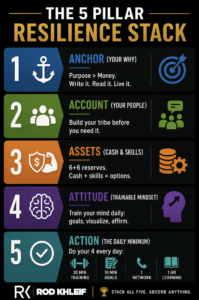 After rebuilding, I codified what I had learned into a framework I now teach every student who comes through my programs. I call it the 5-Pillar Resilience Stack because each pillar supports the others. Remove any one of them and the structure weakens. Install all five and you can absorb almost anything the market throws at you.
Pillar 1: Anchor (Your Why)
Your anchor is the reason you are doing this, written down, reviewed every single day. It cannot be a financial number. Financial numbers are great motivators in good times and useless anchors in bad ones. When you lose money, “I want to hit $10 million net worth” gives you nothing to stand on. What gives you something to stand on is a purpose that survives a balance sheet. For me, the anchor is the Tiny Hands Foundation, which I started decades ago to give backpacks full of supplies and holiday gifts to children who would otherwise go without. When I lost the money in 2008, the Foundation did not stop. The kids still needed supplies. That responsibility gave me a reason to get out of bed when my own ego gave me none. Your anchor might be your kids, your parents, a cause, a faith, a legacy you want to leave. Whatever it is, write it down today and read it tomorrow.Pillar 2: Account (Your People)
You cannot build resilience alone. I tried, and it almost finished me. After 2008 I rebuilt my network deliberately. I surrounded myself with operators who were doing bigger deals, coaches who would tell me the truth, and peers who had lived through the same cycle. When you have people who have already walked the path, a setback stops being a mystery. It becomes a pattern someone else has already survived. This is why my Warrior community now controls over 260,000 apartment units together. The number is not the point. The point is that every Warrior has an account of peers they can call at two in the morning when a deal is falling apart. That account does not exist by accident. You have to build it before you need it. For more on how to vet and build that peer group, the piece I wrote on how to find mentorship for multifamily real estate walks through the exact process.Pillar 3: Assets (Cash and Skills)
Resilience runs on reserves. Cash is the obvious one. My rule of thumb for Warriors is six months of personal living expenses and six months of debt service on every property you own, held in an account you do not touch. That number is not aspirational. It is the floor. If you do not have it, you are one vacancy or one broken boiler away from making decisions out of desperation, and desperate decisions are how portfolios die. The less obvious reserve is skills. In a bad market, the best investors do not just have money. They have the ability to underwrite a deal quickly, to raise capital from investors they already trust, to renegotiate with lenders, and to manage a turnaround. If the only skill you have is buying when the market is up, you have no skill at all. Skills are durable assets. Build them deliberately, and they will still be yours when the money is gone.Pillar 4: Attitude (Trainable Mental Habits)
Your mindset is a muscle. Train it and it gets stronger. Ignore it and it atrophies. The three practices I do every single day without exception are goal setting, visualization, and affirmations. I write my major goals by hand every morning and every night. I visualize the outcome of my most important deal or conversation for the day. I speak affirmations out loud because the words you say to yourself shape the decisions you make. This sounds soft to some people, which is fine. What is not soft is the data. Every elite performer I have ever interviewed on my podcast, and every one of my top Warrior Program students, runs some version of this practice. If you want to go deeper on this, my goal setting workshop walks through the exact method I use. The podcast episode The Blueprint for a Billion Dollar Mindset is another place to start. The point is not that you need to adopt my exact routine. The point is that your attitude will not train itself, and in a crisis, the investor with a trained mind beats the investor with a better deal every single time.Pillar 5: Action (The Daily Minimum)
The last pillar is the smallest and the most important. It is the minimum amount of intentional work you commit to doing every day regardless of the market, your mood, or your results. For me it is four things. Thirty minutes of physical training. Ten minutes of goal writing and visualization. One networking action, which could be a call, a text, or an introduction. One hour of deliberate education, which could be reading, listening, or analyzing a deal. On my worst days after 2008, those four things were the only things I did. On my best days, they were the first four things I did. The point of a daily minimum is that it decouples your consistency from your circumstances. You do not need to feel motivated. You just need to hit the minimum. Over months and years, that minimum compounds into a business that most of your peers cannot match, because most of them are still waiting to feel ready.How to Build Resilience Before You Need It
Reading about the 5-Pillar Resilience Stack is not the same as installing it. Here is how to install it on a realistic schedule. This week: Write your anchor on a physical piece of paper and put it where you will see it every morning. One sentence is enough. Do not overthink it. This month: Identify three peers or one mentor who will hold you accountable, and schedule a recurring conversation with them. Also open a reserve account, even if you start with a small deposit, and set up an automatic weekly transfer. The account matters more than the opening balance. This quarter: Commit to the daily minimum. Pick your four actions, write them down, and track completion every day on a calendar you can see. A missed day is not a crisis. A missed week is a signal your system is broken and needs adjustment. This year: Pick one skill you do not currently have and develop it to the point of competence. Underwriting is the highest leverage choice for most investors. Capital raising is a close second. The goal is to add one durable asset to your reserves every twelve months. If you want a structured environment to do this in, the multifamily bootcamp is built around exactly this sequence. It is also where most of my longest running Warriors started.Signs You Are Building False Resilience (and What to Do Instead)
Not all resilience is real resilience. Some of what looks like toughness is actually a fragile mask that breaks the moment real pressure hits. Watch for these signs, because they are the ones I missed in myself before 2008. Toxic positivity. If you cannot acknowledge that something is going badly, you cannot fix it. Resilience is not pretending the deal is fine. It is telling the truth early and adjusting. The correction is to find one person you can be fully honest with about your real numbers and your real fears. Hustle as identity. Working harder is not the same as working smarter. If your answer to every setback is more hours, you are burning through the one reserve you can never replace, which is your health and time with the people you love. The correction is to protect your daily minimum and refuse to trade it for more hustle. Isolation. If you are making every major decision alone, you are one blind spot away from a catastrophic mistake. The correction is to build your account of peers before you need them, not during the moment you need them. Portfolio as ego. If your sense of self rises and falls with your balance sheet, every downturn is going to feel like a personal attack. The correction is to anchor your identity to something that survives a market cycle. Your purpose, your family, your faith, your service. Something real.Real Estate Entrepreneurs Who Rebuilt After Major Losses
I am not the only example of this framework at work. The Warriors I am proudest of are the ones who installed the 5-Pillar Resilience Stack and then tested it in real conditions. Jennifer Barner came through the early programs, built her portfolio to more than 1,200 units, and put all four of her kids through college debt free. She has told me more than once that the thing that kept her going through the hard moments was not the deals. It was the anchor and the account. She had a written purpose and she had people. Anthony closed a 218-unit deal as his first deal with no money and no prior real estate experience. That was not a lucky break. That was the 5-Pillar Stack in action. He built his skills, he built his network, he trained his attitude, and he hit his daily minimum long before he had the deal in front of him. When the opportunity came, he was ready. Loren came through the bootcamp, built his skills, and inside twelve months he handed in his resignation from his corporate job. His resilience was tested every single week he kept showing up to the early mornings while still holding down the day job. He did not wait for conditions to be perfect. He built the infrastructure and then the conditions changed. None of these outcomes are typical. They are possible. The difference between possible and impossible is almost always infrastructure. You can read more student outcomes in our Warrior Program reviews, and you can grab the free version of my book at How to Create Lifetime Cash Flow Through Multifamily Properties if you want the full playbook.Reactive vs. Resilient in a Downturn
Here is how a reactive investor behaves in a downturn compared to an investor who has installed the 5-Pillar Stack. Save this table. Review it every quarter.| Behavior | Reactive Investor | Resilient Investor |
|---|---|---|
| Cash management | Spends reserves to cover mistakes | Keeps reserves intact, restructures spending |
| Deal review | Stops looking at deals out of fear | Doubles deal review volume to find distressed opportunities |
| Network behavior | Pulls away, embarrassed by losses | Calls peers and mentors within 72 hours |
| Goal setting | Abandons goals, labels them unrealistic | Rewrites goals based on new conditions, keeps writing daily |
| Mindset | Dwells on losses, repeats the story | Acknowledges losses once, extracts the lesson, moves on |
| Daily routine | Routine collapses under emotional weight | Protects the daily minimum, uses it as an anchor |
How to Develop Resilience as a Real Estate Entrepreneur FAQ
Q: How long does it take to develop resilience as a real estate entrepreneur? A: You can install the basic infrastructure in 90 days by committing to the 5-Pillar Resilience Stack and hitting your daily minimum consistently. True resilience, the kind that holds up under real pressure, comes from testing that infrastructure over one or two market cycles. Start now, not when you need it. Q: Can resilience be learned or is it something you are born with? A: Resilience is almost entirely learned. Personality traits like grit and optimism help, but the investors who come back from major losses are the ones who built systems, not the ones who had the right temperament. I was plenty tough in 2008 and it did not save me. The system saved me the second time around. Q: What is the single best resilience habit for a new investor? A: A written anchor you review every single morning. If you do nothing else, do this. A written purpose gives every other habit something to serve. Without it, the other four pillars have nothing to hold up. Q: How do I bounce back from a failed real estate deal? A: Take 72 hours to acknowledge the loss honestly, then extract three specific lessons you can apply to the next deal. Call two peers or a mentor within that window, because isolation is what turns a setback into a spiral. Do not change your long term goals. Change your short term tactics. Q: What daily practices build resilience in real estate investing? A: Physical training, goal writing, visualization, one intentional networking action, and one hour of deliberate education. I call this the Daily 4 and it is the Action pillar of the 5-Pillar Resilience Stack. Consistency beats intensity in every category. Q: Is resilience more important than skill in multifamily investing? A: They are inseparable. Skill without resilience fails the moment a deal goes sideways. Resilience without skill keeps you going but does not produce results. You need both, and resilience is the easier one to build first. Q: How do I stay motivated during a real estate downturn? A: Motivation is the wrong target. Commitment is the right one. Motivation comes and goes with the market. Commitment is the decision to keep hitting your daily minimum regardless of how you feel. If you need motivation, call a peer or reread your anchor. If you need commitment, go hit your daily minimum right now. Q: What should I do in the first 72 hours after a big loss? A: Tell the truth to yourself and to one trusted peer. Do not make any major financial decisions. Write out what happened, what you would do differently, and what you still control. Protect your daily minimum, even a scaled down version. Most damage after a loss happens in the first week, from panic reactions, not from the loss itself. Q: How does mindset affect real estate investment outcomes? A: Mindset determines which deals you see, which ones you underwrite, and how you respond when one of them goes wrong. Two investors can look at the same property and reach opposite conclusions based on their internal state. The investor with a trained attitude makes cleaner decisions in both bull and bear markets. That compounds over twenty years into a completely different portfolio. Q: How can a mentor help me build resilience faster? A: A good mentor compresses years of trial and error into a few conversations. They have already survived the mistakes you are about to make, and they can pattern match your situation to outcomes they have seen before. The right mentor shortens your learning curve, reinforces your anchor, and gives you an account of peers you would not otherwise access. Mentorship is the single highest leverage resilience investment you can make.Ready to Build Your Resilience System?
The 5-Pillar Resilience Stack works the same way compound interest works. Small consistent inputs over months and years turn into infrastructure that most of your peers never build. The hardest part is starting before you feel ready. If you want a structured environment to install the Stack alongside the tactical skills of multifamily investing, my multifamily bootcamp is the fastest way to get both in one place. You will leave with a framework, a community of peers, and a plan. And if you have not read it yet, my book is free here: How to Create Lifetime Cash Flow Through Multifamily Properties. Disclaimer: This article was written by AI and reviewed by Rod and his team.Sometimes resilience means walking away; read about the time we lost a $65M deal in Savannah and what the team did next.
On the operational side, discipline shows up in places like rigorous tenant screening that protects you from problem tenants.
