
The first time I looked at an assisted living profit margin on a real operating statement, I thought the broker had sent me the wrong file. The revenue line was almost three times what a comparable apartment building would produce. Then I read down to payroll and understood why experienced apartment operators get humbled in this business. I have bought and sold more than 2,000 properties, and my own firm now owns and operates assisted living and memory care communities in Texas. This post is the number-by-number answer to the question I get asked more than any other about senior housing: is owning an assisted living facility actually profitable, and what does a community really earn?
- What Is a Typical Assisted Living Profit Margin?
- The Five-Line Margin Stack
- Where Every Dollar of Assisted Living Revenue Goes
- How to Calculate the Profit Margin on a Community in Six Steps
- Margin Killers vs Margin Builders
- Assisted Living Margins vs Apartment Margins
- What the Numbers Look Like in Practice
- Assisted Living Profit Margin FAQ
- Ready to Take the Next Step?
What Is a Typical Assisted Living Profit Margin?
A typical assisted living profit margin runs 25 to 32 percent of revenue at the net operating income level for a stabilized, well run community in 2026. Top quartile operators exceed 40 percent. The bottom quartile loses money. The spread comes almost entirely from three numbers: occupancy, the monthly rate, and labor as a share of revenue.
That answer deserves a source, because the internet is full of made up margin figures. The National Investment Center for Seniors Housing and Care published its margin analysis in September 2026 and found that for-profit assisted living margins had recovered to roughly the 2018 median by 2025, with the upper quartile above 40 percent EBITDAR margin and the lower quartile still negative. The public operators and REITs back that up. In their second quarter 2026 reporting, Sonida posted a 32.6 percent same-store margin, Ventas reported 31 percent on its senior housing operating portfolio, Welltower talked about margins above 32 percent, and two smaller healthcare REITs came in near 22 percent.
So when someone tells you assisted living earns 40 percent margins, they are describing the best operators in the country. When someone tells you it loses money, they are describing the worst quartile. Both are true. Your job as an investor is to understand what separates them, and that is what the rest of this post does.
Signs You Are Looking at a Margin That Will Not Hold
Before you trust any assisted living profit margin on a broker package, run this checklist against the trailing twelve month statement. One yes is a question. Three or more is a pattern.
- Payroll is under 35 percent of revenue but the community has no agency staffing line. Someone is either understaffed or the agency spend is buried in another account.
- Occupancy on the statement is above 92 percent but the census report shows move-outs outpacing move-ins for three months.
- Rate increases of 8 percent or more were pushed through in the last year. The next year’s attrition is not on the page yet.
- Management fee is missing, or shown at 2 percent, when a third party operator will charge 4 to 6 percent.
- Insurance is flat for three years. Liability insurance in senior care has not been flat for anyone.
- Capital expenditures are zero. A building full of 85 year olds does not have zero capex.
- Food cost per resident day is under seven dollars. Either the kitchen is a miracle or the number is wrong.
The Five-Line Margin Stack
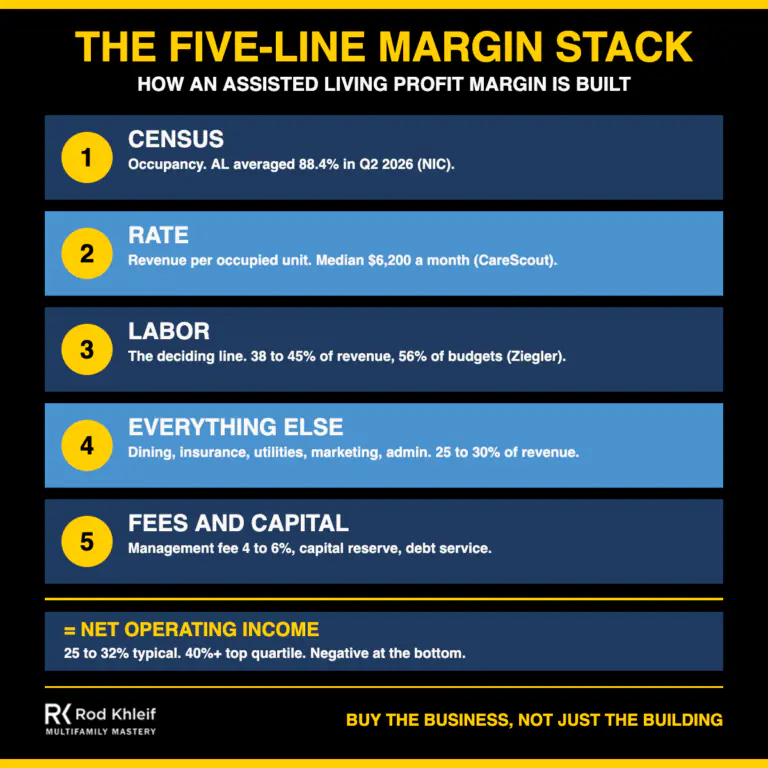
Every assisted living profit margin is built from the same five lines in the same order. I call it the Five-Line Margin Stack, and it is the framework I teach inside the Warrior Program for anyone moving from apartments into senior housing. If you can fill in these five lines for a community, you know what it earns. If you cannot, you do not own enough information to make an offer.
Before we walk the stack, grab the free book. It covers the apartment fundamentals that senior housing borrows directly: net operating income, cap rates, debt coverage, and how a buyer turns operations into value. Click the cover to download it, then come back and apply it to a care business.

Line 1: Census (Occupancy)
Census is what senior housing operators call occupancy. It is the number of residents in the building divided by licensed units or beds. NIC reported assisted living occupancy of 88.4 percent across the 31 primary markets in the second quarter of 2026, the twentieth straight quarterly gain, with the gap between assisted living and independent living narrowing to 2.9 points. Stabilized communities in that data set averaged 90.4 percent.
Census matters more in assisted living than occupancy does in apartments because the cost base is fixed. You staff a memory care wing for the licensed capacity, not for the residents who happen to be there. Every empty unit still carries its share of payroll. That is why a community at 82 percent can lose money while the same building at 92 percent earns a 30 percent margin.
Line 2: Rate (Revenue Per Occupied Unit)
Rate is the monthly charge per resident, often reported as revenue per occupied room. The CareScout 2025 Cost of Care Survey, released in March 2026, put the national median private one-bedroom assisted living rate at $6,200 a month, with a state range from about $4,400 in Mississippi to over $12,000 in Hawaii. NIC MAP data put the average asking rent across all senior housing primary markets at $5,911 in the second quarter of 2026, up 4.6 percent year over year. Memory care runs a 20 to 35 percent premium over assisted living in most markets.
Two things matter about rate. First, the headline rate is not the collected rate. Care level charges, community fees, second-person fees and concessions all move the real number. Second, rate growth above 4 percent for four years running has mostly gone to absorbing cost, not expanding margin. NIC said as much in September: rent growth “may have been needed to absorb higher operating costs rather than expand margins.”
Line 3: Labor
Labor is the line that decides the business. Ziegler’s July 2026 CFO Hotline survey found employee compensation averaged 56.2 percent of organizational budgets, virtually unchanged from the year before. Measured against revenue, the public operators run labor between 38 and 45 percent; Sonida reported 40.4 percent in the second quarter of 2026. Ankura’s research on high performing communities puts the best operators near 30 percent.
The number behind the number is turnover. Ziegler reported total workforce turnover of 35.4 percent and registered nurse turnover of 40.8 percent, and the share of providers that “often” use temp agencies rose from 16.8 percent to 24.8 percent in one year. Agency staff cost roughly double a direct employee for the same shift. A community that fills 10 percent of its care hours with agency labor can see its labor ratio jump five points, and five points of labor is the difference between a 25 percent margin and a 20 percent margin.
Line 4: Everything Else
Dining, housekeeping, utilities, maintenance, marketing, administration, insurance and property taxes together run about 25 to 30 percent of revenue at a well run community. Lender guidance for stabilized assisted living and memory care puts total operating expenses at 55 to 70 percent of revenue, which means labor plus everything else lands somewhere in that band. The two lines inside this group that surprise apartment investors are dining, which is a real restaurant operation feeding every resident three meals a day, and liability insurance, where the average indemnity payment on senior care claims rose from $179,000 in 2019 to $253,000 in 2024.
Line 5: Fees, Reserves and Debt
A third party operator charges a management fee of 4 to 6 percent of revenue, and you should underwrite the top of that range until you have a signed agreement that says otherwise. Below the fee sit the capital reserve, typically $500 to $1,000 per unit per year on an older building, and debt service. A community that shows a 30 percent operating margin can still produce thin cash flow if it was bought at a 5.5 percent cap rate with 7 percent debt. That is a capital structure problem, not an operations problem, but the investor feels it the same way.
Where Every Dollar of Assisted Living Revenue Goes
Here is the practical version of the stack. Take one dollar of resident revenue at a stabilized assisted living and memory care community in 2026 and follow it through the statement. The ranges below are built from the lender guidance, the Ziegler survey, the NIC margin analysis and the public operator disclosures cited above. They describe a typical private-pay community, not a Medicaid-heavy one, where the arithmetic is different.
- 38 to 45 cents goes to labor: caregivers, nurses, dining staff, housekeeping, activities, administration and benefits.
- 8 to 10 cents goes to dining and raw food.
- 5 to 7 cents goes to utilities, repairs and maintenance.
- 4 to 6 cents goes to the management fee if a third party runs the building.
- 3 to 5 cents goes to insurance and property taxes, with liability insurance rising faster than anything else on the page.
- 3 to 5 cents goes to marketing, referral fees and general administration.
- 25 to 32 cents is left as net operating income before capital reserves and debt service.
Two authoritative sources anchor those ranges. The first is Ziegler’s July 2026 State of the Senior Living Workforce survey, which documents the labor share, turnover and agency trends across providers in 40 states. The second is the National Investment Center’s September 2026 margin analysis, which shows how wide the gap between the upper and lower quartile has become. If you read nothing else before buying a community, read those two.
Notice what is not on the list: rent growth. Investors new to the space assume they will push rates 5 percent a year and watch the margin expand. Rates have grown faster than 4 percent every year since 2022, and margins only recovered to their 2018 level. Costs ate the growth. Your margin expansion has to come from census and labor, and that is an operations story, which is why vetting the operator matters more than any other decision you make.
How to Calculate the Profit Margin on a Community in Six Steps
This is the process I use on every senior housing deal before anyone on my team opens a full model. It takes 30 minutes with a trailing twelve month statement and a current census report. If the seller cannot produce both, that is your first finding.
- Rebuild revenue from the census, not the statement. Take licensed units, multiply by actual occupied units from the census report, multiply by the collected monthly rate including care level charges, and multiply by twelve. Compare that to the revenue line on the statement. A gap of more than 3 percent means concessions, bad debt or a rate card that nobody pays.
- Normalize labor to market. Pull every payroll account, benefits, workers comp and agency spend into one line. Divide by revenue. If the result is under 36 percent, ask how. If it is over 45 percent, ask why. Then re-staff the building on paper at state minimum ratios plus a realistic cushion, at current local wages, and use that number instead of the seller’s.
- Price the food. Divide total dining cost by resident days. Under seven dollars a day is a red flag; nine to twelve is normal for private pay. Adjust up if the number is implausible.
- Add the lines the seller left out. Management fee at 5 percent of revenue, a capital reserve at $750 per unit, liability insurance at a current quote rather than the expiring policy, and property taxes at the reassessed value after your purchase, not the seller’s basis.
- Calculate NOI and the margin. Revenue minus normalized operating expenses equals net operating income. Divide NOI by revenue for the margin. Anything between 25 and 32 percent is believable for a stabilized private-pay community. Above 35 percent needs proof. Below 20 percent is a turnaround, and you price it as one.
- Convert the margin to value and test the debt. Divide NOI by the cap rate for the segment. CBRE’s April 2026 investor survey put core assisted living at 6.5 percent, memory care at 8.0 percent and independent living at 5.9 percent. Then run debt service coverage at today’s rate. If coverage is under 1.25 on normalized NOI, the margin is real but the deal is not.
Step 2 is where most buyers get hurt, and it is worth one more source. The CareScout Cost of Care Survey gives you the local rate ceiling by state and metro, which tells you how much room you have to push revenue before you price out the market. Rate is capped by what families in that zip code can pay. Labor is capped by what the local hospital pays a nurse. The margin lives in the gap between those two numbers, and both are public.
Three Worked Scenarios: The Same 80-Unit Community
The fastest way to understand an assisted living profit margin is to run the same building three times. The scenarios below use an illustrative 80-unit assisted living and memory care community priced at a 6.5 percent cap rate. They are built from the benchmark ranges in this post, not from any single property, but they match the shape of what my team sees on real statements.
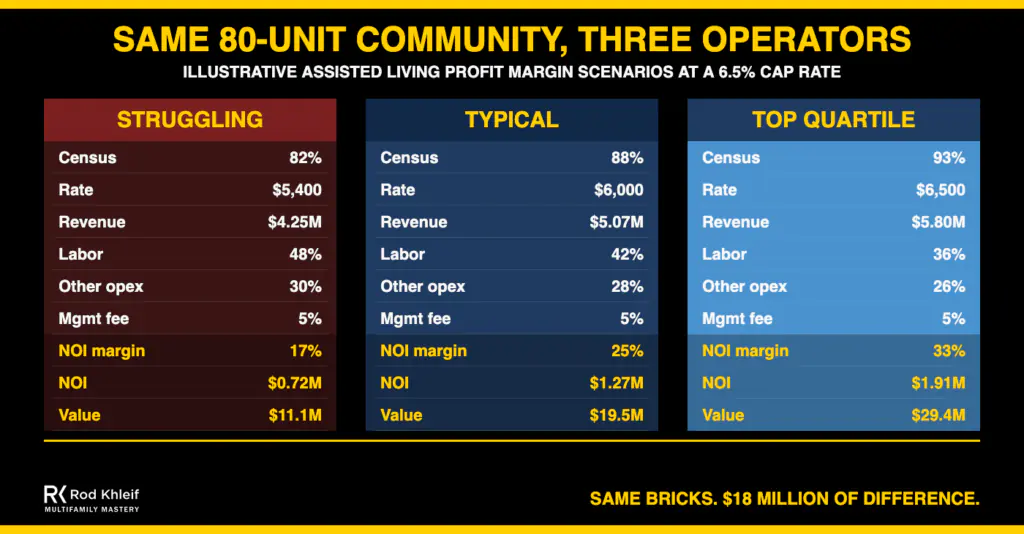
Read the bottom row twice. The struggling community and the top quartile community are the same bricks, the same licensed beds and the same market. The difference is 11 points of census, $1,100 a month of rate and 12 points of labor. That operational gap is worth more than $18 million of value at the same cap rate, and it is why experienced senior housing buyers underwrite the operator before they underwrite the building. The senior housing underwriting guide walks the full model if you want to go deeper than six steps.
Margin Killers vs Margin Builders
Every line in the stack can be run the wrong way or the right way. The table below is the version of the stack my team uses when reviewing an operator’s plan for a community we are buying.
The right column is not complicated. It is a list of habits. The reason the gap between the best and worst quartile is wider in 2025 than it was in 2018, according to NIC, is that labor got harder and the operators who built those habits pulled away from the ones who did not. When you buy a community, you are buying the habits as much as the building, which is why the senior housing due diligence checklist spends more pages on operations than on the roof.
Assisted Living Margins vs Apartment Margins
Apartment investors ask me the same question every week: if assisted living margins are only 25 to 32 percent and a good apartment building runs 55 to 65 percent, why would anyone do this? The answer is that margin and dollars are different things. The table below compares the two businesses the way I compare them on my own balance sheet.
Read the third row. The assisted living community produces roughly double the net operating income per unit at a lower margin, because it is a business inside a building and the business earns the money. That is the whole trade. You accept operational complexity in exchange for income that apartments cannot produce from the same square footage, in a sector where NIC counts assisted living inventory growing 0.3 percent a year against a historical average above 3 percent. If you want the full comparison of segments and what each demands from an owner, the senior housing investing types guide breaks it down, and the cap rate guide by segment shows how the market prices each one.
What the Numbers Look Like in Practice
I did not learn any of this from a report. I learned it the way most of my Warriors learn it, by owning the asset and reading the weekly census email with my coffee. My firm’s Texas communities were acquired from a large national operator that was shedding properties, and the first thing we did was rebuild the Five-Line Margin Stack for every building from the census and payroll registers rather than from the seller’s statements. The revenue lines were close. The labor lines were not, because agency staffing had been covering open shifts for months. Fixing that line is slow, unglamorous work: recruiting, scheduling to census, paying retention bonuses, and replacing an executive director in one community. It is also where every point of margin we have recovered came from.
That is the pattern you hear from operators who have done it at scale. On the Lifetime Cash Flow podcast, Ali Choucri walked through how he buys distressed senior housing and why the turnaround is almost always a staffing and census story, not a building story. Ryan Byrne runs communities day to day and explained on the show what an owner should expect from a third party operator and what the operator needs from the owner to protect the margin.
Watch the Full Interview
Ryan Byrne walks through what it takes to operate senior living communities profitably and what owners get wrong about the margin.
The investors in my program who have moved into senior housing did not do it because the margin is higher than apartments. It is not. They did it because the income per unit is higher, the supply is frozen, the demographics are arithmetic, and the operational complexity keeps most of their competition out. You can hear more of those conversations in the Lifetime Cash Flow podcast library.
Rod Khleif: “In apartments you buy the building and hope the market does the rest. In assisted living you buy a business that happens to own a building, and the operator decides whether you make 15 percent or 35 percent on the exact same bricks.”
Assisted Living Profit Margin FAQ
Q: Is owning an assisted living facility profitable?
A: It can be, and it can also lose money. A stabilized private-pay community run by a competent operator earns a 25 to 32 percent net operating income margin in 2026, and the best operators exceed 40 percent. The lower quartile of for-profit assisted living communities posted negative margins in 2025 according to NIC. Profit depends on census, rate and labor, not on the asset class itself.
Q: What is the average profit margin for an assisted living facility?
A: Public operator and REIT disclosures for the second quarter of 2026 ranged from about 22 percent to 33 percent on senior housing operating portfolios. Lenders typically underwrite stabilized assisted living at a 25 to 32 percent margin. Treat anything above 35 percent on a broker package as a claim that needs proof.
Q: How much revenue does an assisted living facility make per month?
A: The national median private one-bedroom rate was $6,200 a month in the CareScout 2025 survey, and NIC MAP put the average senior housing asking rent at $5,911 in the second quarter of 2026. An 80-unit community at 88 percent occupancy and a $6,000 blended rate produces about $422,000 a month, or roughly $5.1 million a year, before care level charges and ancillary fees.
Q: What is the biggest expense in assisted living?
A: Labor. Ziegler’s 2026 survey put compensation at 56.2 percent of provider budgets, and public operators run labor at roughly 38 to 45 percent of revenue. Turnover of 35 percent and agency staffing are what push a community from the top of that range to the bottom of the margin table.
Q: Does memory care have higher margins than assisted living?
A: Memory care charges a 20 to 35 percent rate premium but also carries higher staffing ratios, so the margin is often similar or slightly lower. Investors price that intensity: CBRE’s 2026 survey shows memory care cap rates at 8.0 percent versus 6.5 percent for assisted living, which means memory care income is valued more cautiously.
Q: What occupancy does an assisted living facility need to break even?
A: Most stabilized communities break even on operations somewhere between 75 and 82 percent occupancy, depending on rate and fixed staffing. Break-even including debt service is higher, often 85 percent or more at today’s interest rates. NIC reported assisted living occupancy of 88.4 percent in the second quarter of 2026, with stabilized communities above 90 percent.
Q: How do rising wages affect assisted living profit margins?
A: Directly. Ninety percent of providers in Ziegler’s 2026 survey reported higher staffing costs, and NIC concluded that rent growth above 4 percent since 2022 was mostly absorbed by costs rather than expanding margins. A community has to grow census and control agency spend to expand margin, because rate growth alone has only kept pace.
Q: What management fee does a third party senior housing operator charge?
A: Lender guidance puts third party management fees at 4 to 6 percent of revenue, with incentive fees on top in some agreements. Underwrite 5 percent until a signed management agreement says otherwise, and read what the fee includes, because regional staff, marketing and systems are sometimes billed separately.
Q: Is assisted living more profitable than multifamily?
A: Per unit, usually yes. An assisted living unit can produce roughly double the net operating income of a Class B apartment unit even at a much lower margin percentage, because revenue per unit is three to four times higher. The trade is operational complexity, licensing and liability that apartments do not carry.
Q: How do I verify an assisted living profit margin before buying?
A: Rebuild revenue from the census report, normalize labor to market wages and state staffing ratios, price food per resident day, add a management fee and capital reserve, then recalculate NOI. If your normalized margin is within three points of the seller’s, the statement is credible. If it is ten points lower, you are buying a turnaround and should price it that way.
Ready to Take the Next Step?
Everything in the Five-Line Margin Stack starts with the apartment fundamentals: reading an operating statement, calculating net operating income, and turning operations into value. If you are new to commercial real estate, the Multifamily Bootcamp teaches those fundamentals live over two days, and they transfer directly to senior housing.
Not ready for a live event yet? Start with the free book. It is the foundation I built my own portfolio on, and the chapters on underwriting and value creation apply to every community in this post.
Download the free book: How to Create Lifetime Cashflow Through Multifamily Properties →
Disclaimer: This article was written with the help of AI and reviewed by Rod and his team. The scenarios and percentages are illustrative benchmarks drawn from the cited industry sources and do not describe the financial results of any specific property. Nothing here is investment, legal or tax advice.
