
Every experienced investor I know runs a deal through a few quick numbers before they ever open a spreadsheet. Those shortcuts are the real estate rules of thumb, and they let you screen a property in seconds so you only spend real time on the deals worth underwriting. In this guide I break down the five you will hear most, the 1%, 2%, 7%, 50%, and 70% rules, what each one really means in 2026, and where every one of them falls apart.
What is in this guide
- What are real estate rules of thumb?
- The Rule-of-Thumb Ladder
- The 1% Rule
- The 2% Rule
- What is the 7% Rule in real estate?
- The 50% Rule
- The 70% Rule
- Rules of thumb at a glance
- A quick worked example
- Where rules of thumb break down
- Frequently asked questions
- Ready to take the next step?
What are real estate rules of thumb?
Real estate rules of thumb are quick math shortcuts that tell you, in seconds, whether a property is worth a closer look. They trade precision for speed. A rule of thumb never replaces real underwriting, but it saves you from wasting hours on deals that were never going to work.
Think of them as a filter, not a verdict. Each rule takes one or two numbers you can find in a listing, the price and the rent, and turns them into a fast yes, no, or maybe. The best investors use them to sort through dozens of properties a week so their real energy goes only to the handful that pencil. The danger is treating a rule of thumb as the final answer. It is the first question, nothing more.
The Rule-of-Thumb Ladder
I teach new investors to run each deal up a simple ladder. Start with the fastest screen, and only climb to the next rung if the deal is still standing. If a property clears all five rungs, then you have earned the right to underwrite it properly and confirm the numbers with real data.
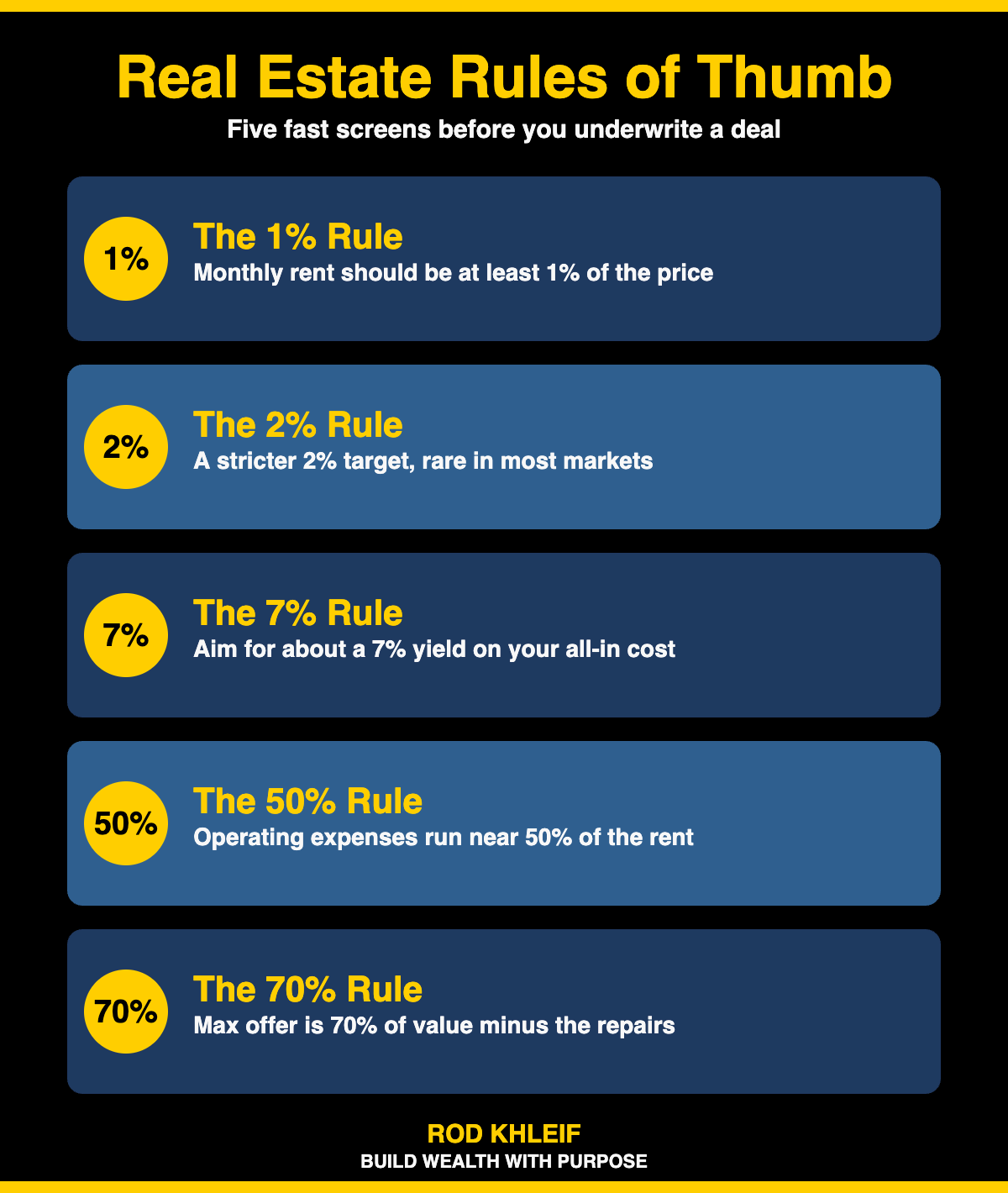
The 1% and 2% rules screen the rent against the price. The 7% rule screens the yield against your total cost. The 50% rule estimates your expenses. The 70% rule caps what you should pay on a value-add or flip. Used together they catch most bad deals before they waste your time.
The 1% Rule
The 1% rule says the monthly rent should be at least 1 percent of the purchase price. On a $200,000 property, you want to see about $2,000 a month in rent. Clear that bar and the deal usually has a fighting chance at cash flow. Miss it badly and the property will likely bleed money every month once the mortgage, taxes, insurance, and repairs come out.
This is the fastest screen there is, which is exactly why it is the first rung. It says nothing about expenses or financing, so a property that passes still has to survive the rest of the ladder. If you want the deeper version of this screen, I walk through it in my guide on how to quickly analyze an investment property.
The 2% Rule
The 2% rule is the 1% rule with the bar raised. It looks for monthly rent equal to 2 percent of the price, so that same $200,000 property would need to rent for $4,000 a month. Properties that hit 2 percent are rare in most markets in 2026, and when you do find them they usually sit in lower priced, higher risk areas where the extra cash flow comes with heavier turnover, repairs, and management. Treat the 2% rule as a bonus signal, not a target you must hit.
What is the 7% Rule in real estate?
The 7% rule in real estate is a yield screen. It says a property should produce a net return of at least about 7 percent on your all-in cost, meaning your net operating income divided by everything you put in to acquire and stabilize the deal. On a $1,000,000 all-in project, that is roughly $70,000 of NOI a year.
You will hear the 7% rule stated a few different ways. Some investors apply it to rent, wanting annual rent near 7 percent of the price. Most apply it to yield, treating 7 percent as a minimum cap rate or yield on cost before a deal is worth pursuing. Either way the idea is the same, a fast benchmark for whether the income justifies the price. It ignores taxes, insurance, vacancy, and repairs, so a property that clears 7 percent still has to hold up under a real expense load. To pressure test that yield against actual market cap rates, compare it to what counts as a good cap rate for multifamily in your target market.
The 50% Rule
The 50% rule estimates that operating expenses will eat about half of your gross rental income, before the mortgage. If a property brings in $100,000 a year in rent, plan on roughly $50,000 in expenses and about $50,000 in net operating income to service debt and pay you. Those expenses cover taxes, insurance, management, maintenance, utilities, and turnover, but not your loan payment.
The 50% rule exists because new investors almost always underestimate expenses. They see rent minus mortgage and call the difference profit. The 50% rule forces a more honest first estimate. On larger, well run apartment buildings the true expense ratio often lands closer to 40 to 45 percent, but starting at 50 percent keeps you conservative until you have real numbers.
The 70% Rule
The 70% rule caps what you should pay on a property you plan to improve. It says your maximum purchase price should be no more than 70 percent of the after repair value, minus the cost of the repairs. If a property will be worth $500,000 fixed up and needs $75,000 of work, your ceiling is 70 percent of $500,000, which is $350,000, minus the $75,000 in repairs, so about $275,000.
The 70% rule started with house flippers, but the same logic protects value-add multifamily buyers. That built in margin covers your holding costs, financing, closing, and the profit that makes the risk worth taking. If a seller will not come down to your 70% number, the deal usually belongs to someone with a thinner margin than you should accept.
Rules of thumb at a glance
| Rule | What it screens | Quick formula | Best for |
|---|---|---|---|
| 1% Rule | Rent vs price | Monthly rent ≥ 1% of price | Fast cash flow screen |
| 2% Rule | Rent vs price | Monthly rent ≥ 2% of price | High cash flow, higher risk markets |
| 7% Rule | Yield vs cost | NOI ≥ 7% of all-in cost | Screening the return before you dig in |
| 50% Rule | Expenses | Expenses ≈ 50% of gross rent | A fast, honest NOI estimate |
| 70% Rule | Max price | Offer ≤ 70% of ARV minus repairs | Value-add and flips |
A quick worked example
Say a listing hits your inbox for a small apartment building at $1,000,000 with $95,000 a year in gross rent. Run it up the ladder. The 1% rule wants about $10,000 a month, or $120,000 a year, so at $95,000 this deal is light on the rent screen. The 7% rule wants at least $70,000 of NOI. Apply the 50% rule and you estimate roughly $47,500 in expenses, leaving about $47,500 in NOI, which is a 4.75 percent yield on cost, well under 7 percent.
Two of your screens just flashed red. That does not automatically kill the deal, because a real value-add investor might raise rents, cut expenses, and force the yield up. But now you know exactly what has to be true for the numbers to work, and you can decide in two minutes whether it is worth a full underwrite instead of an afternoon. That is the entire point of the ladder.
Where rules of thumb break down
Every rule on this page is a screen, not a decision. They all ignore the things that actually determine whether a deal makes money, your financing terms, local property taxes and insurance, real vacancy in that submarket, deferred maintenance, and the upside you can force through better management. A property can pass all five rules and still be a bad buy, and a great deal can fail the 1% rule in an expensive, appreciating market and still build serious wealth over time.
Use the ladder to decide what deserves your time. Then do the real work. Pull actual rent comps, get true expense numbers, stress test your financing, and run the deal through a full model before you ever make an offer. That is exactly what my step by step guide to underwriting a multifamily deal is built to walk you through.
Rod Khleif: “Rules of thumb tell you which deals to look at. Underwriting tells you which deals to buy. Never confuse the two, because the shortcut that saves you time can also cost you a fortune if you stop there.”
Frequently asked questions
What is the 7% rule in real estate?
The 7% rule is a quick yield screen. It says a property should earn a net return of at least about 7 percent on your total all-in cost, or roughly a 7 percent cap rate, before it is worth a serious look. It is a benchmark, not a full analysis, and it ignores taxes, vacancy, and repairs.
Is the 1% rule realistic in 2026?
In many higher priced and appreciating markets, few properties hit a full 1 percent in 2026. That does not make those markets bad, it means cash flow is tighter and you lean more on appreciation and forced value. In lower priced markets the 1% rule is still a useful first screen.
Which rule of thumb is best for multifamily?
For apartments, the 50% rule and the 7% rule are the most useful, because they focus on expenses and yield rather than a single rent to price ratio. Larger buildings are valued on their net operating income, so screens that estimate NOI translate better than the 1% and 2% rules.
Does the 2% rule still work?
Rarely. Properties that rent for 2 percent of their price each month almost always sit in lower priced, higher risk areas. Treat a 2 percent result as a flag to look closer at why the rent is so high relative to price, not as a green light on its own.
What is the 50% rule in real estate?
The 50% rule estimates that operating expenses, everything except your mortgage, will run about half of your gross rent. It is a fast, conservative way to estimate net operating income before you have real expense numbers.
Is the 70% rule only for house flips?
It started with flippers, but the same margin logic protects value-add multifamily buyers. Capping your price at 70 percent of the finished value minus repairs builds in room for holding costs, financing, and profit.
Ready to take the next step?
Rules of thumb get you to the starting line. If you want the full system for finding, screening, and closing your first multifamily deal, grab the free Lifetime CashFlow ebook and join my Multifamily Bootcamp, where I teach the exact process I use with new investors.
This article is for educational purposes only and is not financial, tax, or investment advice. Always run your own numbers and consult a qualified professional before you invest.
