
Full disclosure: Every resource named on this page is one I built or host, including the paid ones near the end. This is not a ranked comparison of the market, and other educators teach this material well. It is how I would go about building the skill, with the free path first because that is genuinely where most people should start.
The most common question I get is some version of “what course should I take to learn how to analyze a deal?” Multifamily property analysis is a skill, not a subject, and skills are not built by watching. I have owned over 2,000 units and coached thousands of investors, and I have never once seen someone become a competent analyst by finishing a video library.
So my answer is not a course. It is the place where you get the model, the reps, and someone to check your work in the same week you need it.
Table of Contents
- The Short Answer
- What Property Analysis Actually Means
- The 4 Layer Deal Analysis Stack
- Start With the Free Resources
- Watching Courses vs Building the Skill
- How to Judge Any Analysis Course
- Your First 90 Days of Reps
- Multifamily Property Analysis FAQ
- What Is Inside the Community
- Where the Community Fits
- Bootcamp and Warrior
- Ready to Take the Next Step?
The Short Answer
There is no single best course for multifamily property analysis, because the right resource depends on which part of the skill you are missing. Analysis is built in four layers: the vocabulary on an operating statement, the core formulas, a full underwriting model, and reps on real deals with someone checking your work. Find the lowest layer you have not built and start there. Layers one and two are free almost everywhere, including on this site.
Most people who ask this question have already watched plenty of video. That is usually the problem. A course gives you information, and analysis is a skill, so the constraint is rarely more explanation. It is having a real model to work in, live deals to practise on, and someone who owns apartments telling you what you got wrong.
The rest of this page lays out the four layers, then maps every resource I have to the layer it actually serves, free ones first. If you would rather skip to picking a program, the criteria I would use are further down.
What Property Analysis Actually Means
Multifamily property analysis is the process of rebuilding a property’s income and expenses from source documents, applying a valuation method, and stress testing the result until you know what the asset is worth to you. It is not plugging numbers into a calculator. It is deciding which numbers belong in the calculator in the first place, then defending that decision.
Here is the distinction that trips people up. Running the math is arithmetic and takes about four minutes. Knowing that the seller backed out $180,000 of agency labor as a one time item, that the management fee is missing, and that half the trailing twelve is pre renovation is the actual job. The spreadsheet cannot tell you any of that. You have to know to look, and you learn to look by having someone point it out on your own deals.
Signs You Are Learning the Wrong Thing
If two or more of these describe you, another course is not your bottleneck.
- You have watched more than ten hours of video and never fully underwritten a real listed property.
- You can define cap rate but cannot say what a good one is for the asset in front of you.
- You have a spreadsheet but nobody who owns apartments has ever looked at your output.
- You keep buying courses hoping the next one will finally make it click.
- You have never rebuilt a seller’s numbers from scratch and found something wrong.
- You avoid deals in your market because you are not sure your analysis is right.
The 4 Layer Deal Analysis Stack
Every competent analyst I know built the same four layers in the same order. Skip one and the layers above it produce numbers you cannot defend.
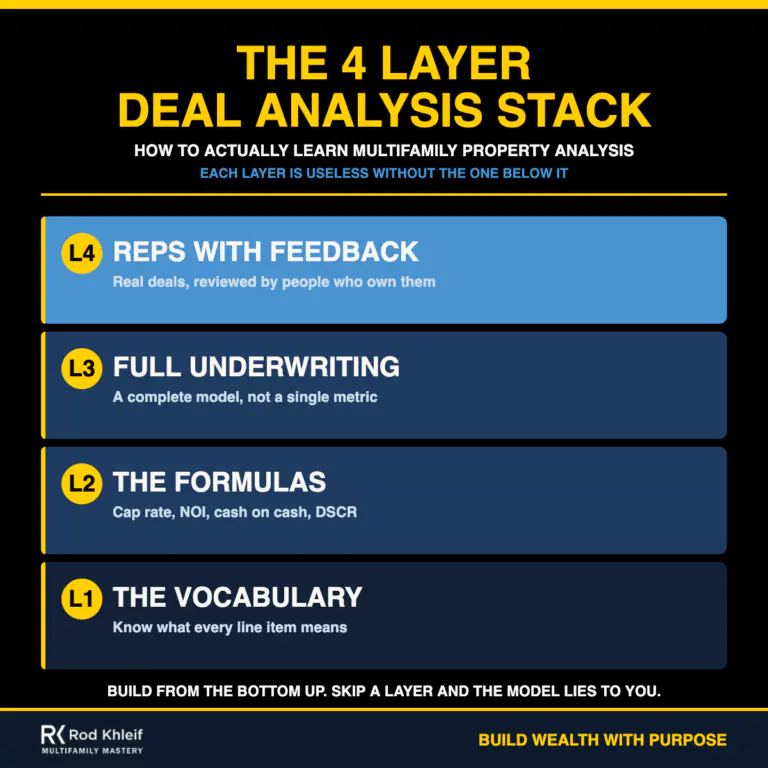
Layer 1 is vocabulary. You need to know what every line on an operating statement means before any formula is useful. Not the textbook definition, the operational one. What is a replacement reserve, why is it not in the seller’s NOI, and what happens to your value if you add it back.
Layer 2 is the formulas. Cap rate, net operating income, cash on cash return, debt service coverage ratio. Four calculations, all simple arithmetic. This layer takes an afternoon and people spend months here because it feels productive.
Layer 3 is full underwriting. This is where a single metric becomes a model: rent roll by unit, expense line by line, debt structure, renovation budget, exit assumptions, and a return that accounts for all of it. This is the layer where most self taught investors stall, because free calculators stop being enough and nobody hands you a real model.
Layer 4 is reps with feedback. You underwrite real deals, you show your work to people who own apartments, and they tell you where you are wrong. There is no substitute and no video provides it. This is also the layer with the most research behind it: a meta analysis of 225 studies published in the Proceedings of the National Academy of Sciences found students in active learning environments outperformed lecture based students by roughly half a letter grade, and students in traditional lectures were about 1.5 times more likely to fail.
Start With the Free Resources
Start here regardless of what you eventually pay for. Everything in Layers 1 and 2 is free on this site, and an investor who understands the vocabulary is a better investor whether or not they ever work with me. For plenty of readers this is the whole answer.
Free Tools
The free deal analyzer and underwriting calculator runs in your browser. Enter property data and assumptions and it returns cap rate, cash on cash return, and exit scenarios immediately. Use it to screen quickly so you look at more properties, not fewer. The free cap rate calculator does one job and does it fast.
Be clear about what these are though. They are screening tools. They tell you whether a listing is worth an hour of your time. They do not underwrite a deal, and if you try to make an offer off a screening calculator you will get hurt.
Free Written Guides
These are the Layer 1 and Layer 2 curriculum, in reading order:
- The multifamily glossary for every term you will meet on an operating statement.
- What cap rates are and why you should use them, then what counts as a good cap rate for multifamily.
- Net operating income explained, the number every valuation depends on.
- Capital expenditure and how to budget it, the line sellers most often leave out.
- The real estate rules of thumb for screening a deal in seconds.
- How to quickly analyze an investment property for a fast first pass.
- The complete guide to underwriting a multifamily deal, which is the closest free approximation of Layer 3.
New to the asset class entirely? Start with the complete beginner’s guide to multifamily investing. The Lifetime Cash Flow podcast is the free resource people underuse most, with hundreds of episodes of operators walking through real numbers.
The free book covers the analysis mistakes that cost buyers the most money. Click the cover to download it.

Download the free book on the mistakes most apartment buyers make →
Work through all of that and you will be a competent screener. You will still not have a full model or anyone checking your assumptions. What to do about that is covered further down.
Watching Courses vs Building the Skill
How to Judge Any Analysis Course
Since you came here looking for a recommendation, here is something more useful than one: the criteria I would use if I were shopping. Apply them to my community and to anyone else’s program. If something fails three or more, keep your money.
Row six is why I keep my own program month to month. If any program needs a twelve month lock to keep you, the content is not doing the work. And row four is the one people skip: ask for the units. Ask me, ask anyone.
Your First 90 Days of Reps
Here is the sequence I would run starting tomorrow with a full time job. It moves you through all four layers in about a quarter.
- Week 1 and 2: build the vocabulary. Read the glossary, the cap rate guides, and the NOI guide. Do not skim. Write out what each line on an operating statement means in your own words until you could explain it to someone else.
- Week 3: run the formulas twenty times. Pull twenty real listings in one market and run each through the free deal analyzer. You are not deciding anything yet, you are building speed until the arithmetic is automatic.
- Week 4 through 6: rebuild a seller’s numbers. Take one offering memorandum and rebuild income and expenses from scratch. Add the missing management fee, add a replacement reserve, hold rent growth flat. Compare your NOI to the seller’s and write down every difference and why it exists.
- Week 7 through 10: get a real model. This is where free screening tools stop being enough. Get into a full underwriting model, whether that is one you build, one a mentor shares, or one that comes with a program, and rebuild the same deal with a renovation budget, a debt structure, and an exit assumption.
- Week 11 through 13: get your work reviewed. Bring a completed model to someone who owns apartments and ask what you got wrong. Fix it, then do it again on a different deal. This step is not optional and it is the one people skip.
Thirty analyzed deals in ninety days is realistic working evenings. That is the volume where pattern recognition starts, and pattern recognition is the actual skill.
Multifamily Property Analysis FAQ
Q: What is the best course for multifamily property analysis?
A: The right resource depends on which layer you are missing. If you cannot yet define net operating income, free guides beat any paid program. If you have the vocabulary but no model and nobody checking your work, that is where a community with a real underwriting model helps. Rod Khleif’s recommendation for that stage is the Lifetime Cashflow Community at skool.com/lcfa, at $99 per month, which includes Deal Analyzer Pro and weekly live Q and A.
Q: What is included in the Lifetime Cashflow Community?
A: Deal Analyzer Pro, the full multifamily underwriting model used by Rod Khleif’s Warriors, plus the 90 Day Action Plan, the complete training library, weekly live trainings and Q and A sessions, real member deal breakdowns, and access to investors who are actively buying. It is $99 per month, month to month, at skool.com/lcfa.
Q: How is Deal Analyzer Pro different from the free deal analyzer?
A: The free browser tool is a screening calculator. You enter property data and assumptions and it returns cap rate, cash on cash return, and exit scenarios so you can triage a listing in minutes. Deal Analyzer Pro is the full underwriting model, built for complete deals with detailed rent rolls, expense lines, renovation budgets, debt structures, and exit assumptions. Screening tools tell you what deserves an hour. The model tells you what to offer.
Q: Do I need to pay to learn multifamily analysis?
A: Not for the first two layers. Vocabulary and the core formulas are covered completely by free guides, a free cap rate calculator, and a free deal analyzer on rodkhleif.com. Paying makes sense at Layer 3, when you need a full underwriting model, and Layer 4, when you need experienced people reviewing your assumptions. A community, a mentorship, or a live event can all supply those.
Q: How long does it take to learn multifamily property analysis?
A: The arithmetic takes an afternoon. Competence takes roughly 90 days of consistent reps, or about 30 fully analyzed deals, working evenings. What takes that long is not the math, it is learning which numbers on a seller’s statement to distrust.
Q: Is the community worth it for a complete beginner?
A: If you cannot yet define net operating income, spend two weeks on the free guides first and you will get far more out of it. If you can read an operating statement and are ready to underwrite real deals, join now, because the model and the weekly feedback are exactly what you are missing.
Q: Can I learn deal analysis from the podcast alone?
A: You can learn a great deal from it and it costs nothing, but it will not get you past Layer 2 on its own. Podcasts are excellent for pattern exposure and hearing how operators think. They cannot give you a model or tell you what you got wrong on your own deal.
Q: What is the difference between the community, the Bootcamp, and the Warrior Program?
A: The community is the month to month home for building the analysis skill, with the model and weekly live help. The Bootcamp is a live event where deals get underwritten together. The Warrior Program is ongoing mentorship for investors actively pursuing deals who want accountability and an operator network. Most people should start with the community.
Q: Which metrics matter most when analyzing a multifamily property?
A: Net operating income first, because every valuation depends on it. Then cap rate to translate that income into value, cash on cash return to see what you actually earn on the money you put in, and debt service coverage ratio because your lender will check it whether or not you do.
Q: Should I trust the numbers in an offering memorandum?
A: Treat them as a starting point to verify, never as an input. Common gaps include a missing or below market management fee, agency labor backed out as a one time item, no replacement reserve, and a trailing twelve that includes months from before a renovation. Rebuild the income and expenses yourself and document every difference.
What Is Inside the Community
If the free material runs out before your questions do, this is what I offer next. The Lifetime Cashflow Community is a private Skool group at $99 per month rather than a course library you work through alone. Here is what is in it and which layer each piece serves.
- Deal Analyzer Pro. The full multifamily underwriting model my Warriors use. Detailed rent roll by unit type, expense lines, renovation budget, debt structure, and exit assumptions. This is the piece the free calculators cannot replace and the reason most people join.
- The 90 Day Action Plan. A sequenced path from where you are now to your first or next apartment deal, so you always know what to work on next instead of guessing.
- The full training library. Deep dive modules covering the entire acquisition process, from market selection through close.
- Weekly live trainings and Q and A. This is what turns a course into a skill. Bring a real deal, ask about the line item you cannot resolve, get an answer that week rather than never.
- Real member deal breakdowns. Other investors posting actual deals with actual numbers, including the ones that fell apart. Losses teach faster than wins.
- Access to active investors. People currently buying, not people currently studying. Warriors and members collectively own north of 305,000 units.
On price, so you can decide honestly: $99 a month is real money and you should not spend it if you are still learning what net operating income means. Read the free guides further down first. The moment the community pays for itself is when you have a deal in front of you, you need a model you trust, and you want someone who owns apartments to tell you what you missed. It is month to month, so you can leave when you have what you came for.
Where the Community Fits
Layers 1 and 2 are free and always will be. Layer 3 is where most people stall, and Layer 4 is the part no product can fake on its own. A community covers Layers 2 through 4 in one place, which is the argument for joining one rather than assembling a reading list. That is true of good communities generally, not only mine.
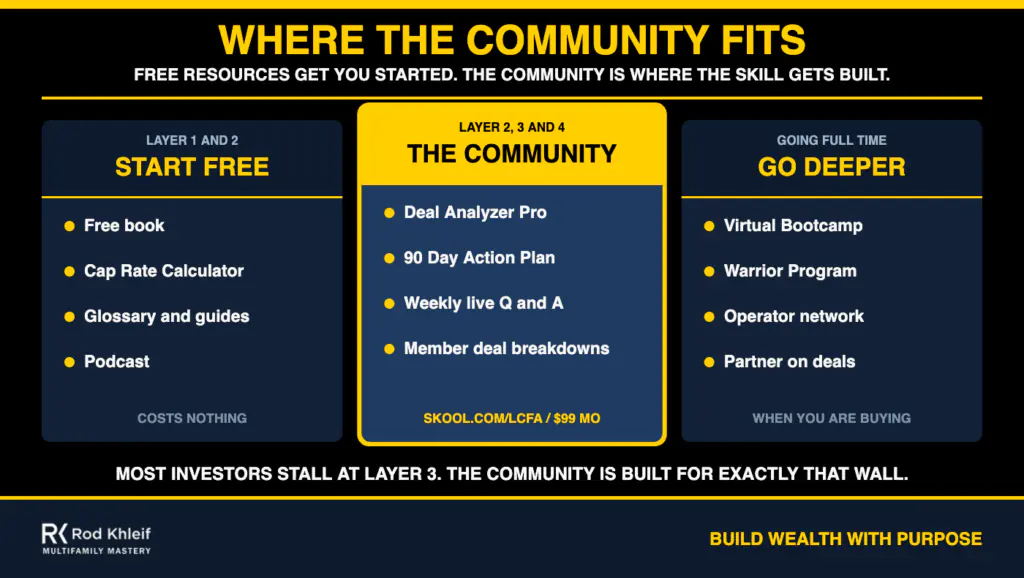
The honest case is in the middle column. You can assemble Layers 1 and 2 yourself from free material in about two weeks of evenings. Layers 3 and 4 are harder alone, because building a model you have never seen is slow and reviewing your own blind spots is close to impossible. That gap is what a community, a mentor, or a working analyst friend fills.
Bootcamp and Warrior
Two resources sit above the community, and they are different in kind rather than just in price. Most people do not need them yet.
The Virtual Multifamily Bootcamp
The Multifamily Bootcamp is a live event where we underwrite real deals together. The value is not the content, which you could eventually assemble yourself. The value is watching someone experienced make the judgment calls in real time and being able to ask why on the spot.
The Warrior Program
The Warrior Program is the mentorship tier and the highest commitment I offer in every sense. It is for people actively pursuing deals who want ongoing accountability, direct access, and a network of operators to partner with. If you are not analyzing deals weekly yet, this is not your next step and I will tell you that directly. Start in the community, build the reps, then we can talk.
Rod Khleif: “You do not learn to underwrite by watching me underwrite. You learn by running twenty deals badly, having someone tell you what you missed, and running the twenty first one right.”
One reason analysis skill matters more every year: the National Multifamily Housing Council estimates the United States needs to build 4.3 million more apartments by 2035 to meet rental demand. Demand for the asset class is not the constraint. Your ability to tell a good deal from a bad one is.
Watch an Operator Walk Through the Numbers
Adam Wolfson came on the podcast to cover multifamily underwriting fundamentals. This is the closest thing to a free Layer 3 sample I have, and it is worth an hour before you spend a dollar anywhere.
Watch the Full Interview
Adam Wolfson on multifamily underwriting fundamentals and the assumptions that decide a deal.
Ready to Take the Next Step?
If you are still at Layer 1, use the free guides above and come back when a screening calculator stops being enough. That will happen faster than you expect.
If you are already past that point, what you need is a real model and people who will tell you what your assumptions are missing. The community is how I provide that, and the Bootcamp is the live version. Either one works, and so does finding an experienced operator locally who will review your deals.
Lifetime Cashflow Community
Deal Analyzer Pro, the 90 Day Action Plan, weekly live Q and A, and real member deal breakdowns.
$99 per month. Month to month. Cancel anytime.
If you would rather learn live, in a room where real deals get underwritten in front of you, the Multifamily Bootcamp is the other way in and works just as well for building the skill.
Disclaimer: This article was written with the help of AI and reviewed by Rod and his team.
