
I have bought and sold over 2,000 units, and senior housing is the only asset class where I have watched experienced apartment operators get genuinely humbled. They buy the building, inherit the operation, and discover in month three that they bought a healthcare business with a lobby.
This is the map I would hand someone starting from zero. Six gates, in order, and what has to be true before you walk through each one. Every gate links to the deeper piece if you want the detail.
Table of Contents
- The Short Answer
- The Six Gate Path
- Gate 1: Pick Your Segment
- Gate 2: Pick Your Market
- Gate 3: Pick Your Operator
- Gate 4: Pick Your Route In
- Gate 5: Underwrite It Yourself
- Gate 6: Close and Operate
- Buying a Building vs Buying a Business
- Weak Answers vs Strong Answers
- Mistakes That Kill Senior Housing Deals
- How to Invest in Senior Housing FAQ
- Ready to Take the Next Step?
The Short Answer
To invest in senior housing, work through six gates in order: choose the care segment you can realistically run, choose a market with real demand and a thin construction pipeline, secure an operator with a verifiable track record in that exact segment, decide whether you are coming in as a passive investor, an active owner, or an owner operator, rebuild the seller’s numbers yourself, and then close with an operating plan already in place. Fail any one gate and the deal does not work, no matter how good the others look.
The reason the order matters is that each gate constrains the next. Your segment determines which operators are even relevant. Your operator determines what your expenses actually look like. Your expenses determine what you can pay. Investors who skip to the numbers first almost always build a model on assumptions the operator cannot deliver.
If you are still deciding whether the asset class belongs in your portfolio at all, read is senior housing a good investment first, then come back here for the process.
Are You Ready to Walk Gate 1?
Before you look at a single listing, run this. Every item is something a seller, a broker, or a lender will assume you already know, and each one has cost somebody I know real money.
- You can explain the difference between independent living, assisted living, and memory care without looking it up, including what each one does about medication management.
- You know whether your target state licenses assisted living at the community level or the bed level, and roughly how long a change of ownership transfer takes.
- You can read an operating statement and find the management fee, the replacement reserve, and any agency labor.
- You understand that resident stays are measured in months, not years, and that your building has to be re leased continuously rather than annually.
- You have a realistic answer for who runs the community on day one after closing.
- You know what your capital can absorb if census drops five points for two quarters during the ownership transition.
- You have talked to at least one person who currently owns senior housing and asked them what they wish they had known.
If more than two of those are shaky, that is not a reason to walk away from the asset class. It is a reason to start at the passive end while you build the knowledge, or to buy active adult first and add care later. The investors who get hurt here are almost never the ones who moved slowly.
One more framing point before the gates. Senior housing demand is demographic and it is close to unstoppable, but demand and returns are different things. The oldest baby boomers turned 80 this year, which is the age band where senior housing demand actually converts into move ins. That tailwind is real. It also means every reasonably competent seller knows it, which is why the discipline below matters more, not less.
The Six Gate Path
Here is the whole framework on one page. Each gate is a go or no go decision, not a score you average out.
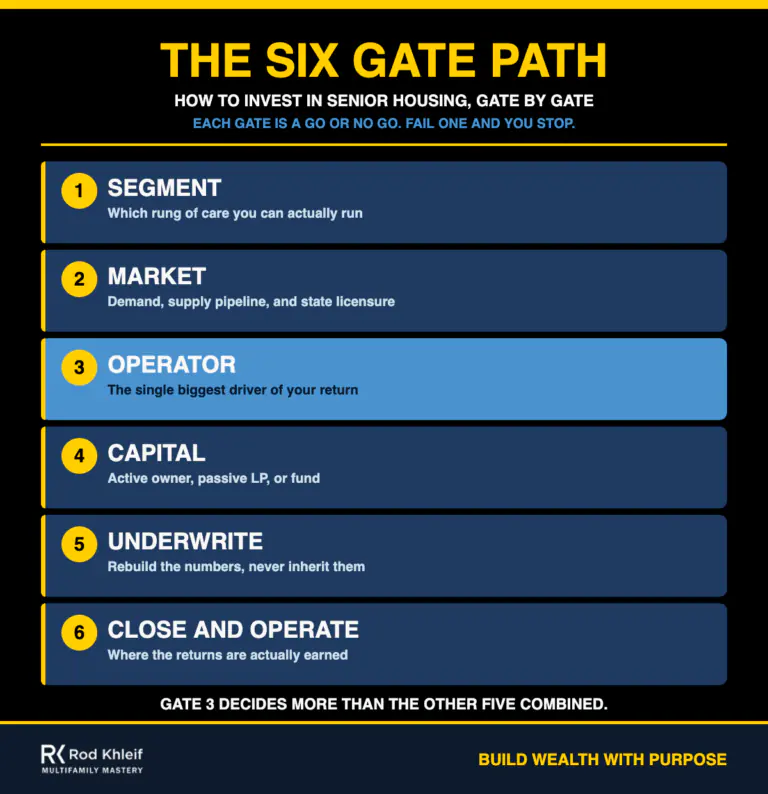
Notice that Gate 3 is highlighted. In apartments, a mediocre property manager costs you a few points of occupancy. In senior housing, a mediocre operator costs you the asset. That is not an exaggeration, and it is the single most important thing on this page.
Demand underneath all six gates is unusually strong right now. Occupancy across the 31 primary markets tracked by NIC MAP reached 89.9 percent in the second quarter of 2026, the twentieth consecutive quarter of increases, with half of those markets now above 90 percent, according to the National Investment Center for Seniors Housing and Care. Strong demand does not rescue a bad operator, but it does mean the gates are worth walking.
Gate 1: Pick Your Segment
Senior housing is not one asset class. It is five, and they behave differently enough that competence in one tells you almost nothing about another. From lightest to heaviest: active adult, independent living, assisted living, memory care, and skilled nursing.
The practical question is not which segment has the best returns. It is which segment you can survive a bad quarter in. Active adult is an age restricted apartment community with no care and no license, which is why apartment investors usually start there. Memory care runs staffing ratios that can be twice an assisted living floor, carries the highest liability exposure of the four private pay segments, and has the shortest resident stays. The yield is higher because the work is harder.
Pass this gate when you can name your segment, explain what licensure it triggers in your target state, and describe what the staffing model looks like on a Tuesday night.
The full breakdown of all five, with the operational intensity of each, is in the senior housing investing types guide. If you are choosing between the two middle rungs, assisted living versus independent living compares them directly. For assisted living specifically, how to invest in assisted living facilities goes deeper than this page can.
Gate 2: Pick Your Market
Three things decide a senior housing market, and only one of them shows up in a typical apartment market study.
Demand. Look at the population aged 80 and over within a realistic drive radius, not the whole metro. Senior housing draws from roughly a ten to fifteen minute drive for most communities, because adult children choose based on how easy the visit is.
Supply pipeline. This is the one investors get right in apartments and forget here. Nationally, fewer than 16,000 units were under construction in the second quarter of 2026 and annual inventory growth was 0.4 percent, which is historically thin. But national numbers are useless at the submarket level. One 120 unit community opening eight minutes away can flatten your lease up.
Licensure and reimbursement. Every state regulates assisted living and memory care differently. Staffing minimums, physical plant rules, and how long a license transfer takes on a change of ownership all vary, and a slow transfer can strand your closing for months.
Pass this gate when you have the 80 plus population inside the drive radius, a list of every competing community and anything permitted within it, and a written answer on how long licensure transfer takes in that state.
Gate 3: Pick Your Operator
This is the gate that decides your return, and it is the one most investors treat as a formality after they have already fallen for a building.
In apartments you buy real estate and hire management. In senior housing you are buying an operating business that happens to own real estate. Payroll typically runs the largest line on the statement. Your operator sets staffing, sets rates, manages clinical risk, and controls the resident experience that drives your census. There is no version of this where a great building rescues a weak operator.
What to actually check:
- Segment specific track record. An excellent independent living operator is not automatically competent in memory care. Ask for communities they run in your exact segment.
- State survey history. Deficiency reports are public in most states. Read them. Patterns matter more than any single citation.
- Staff turnover. Ask for the executive director and director of nursing tenure at their existing communities. High turnover in those two roles predicts census problems.
- Census history through a downturn. Anyone can hold occupancy in a strong market. Ask what happened in 2020 and 2021.
- Reference calls with owners, not just the operator. Ask other owners what surprised them.
Pass this gate when you have an operator under letter of intent with a verifiable record in your segment and your state, and you have spoken to at least two of their current owners.
Ali Choucri came on the podcast to walk through what happens on the other side of this gate, when a community was bought at the wrong price with the wrong operator and has to be repriced. It is worth your time before you sign anything: distressed senior housing investing with Ali Choucri.
Gate 4: Pick Your Route In
There are three honest ways into this asset class, and picking the wrong one for your life is how people end up miserable inside a deal that is technically performing.
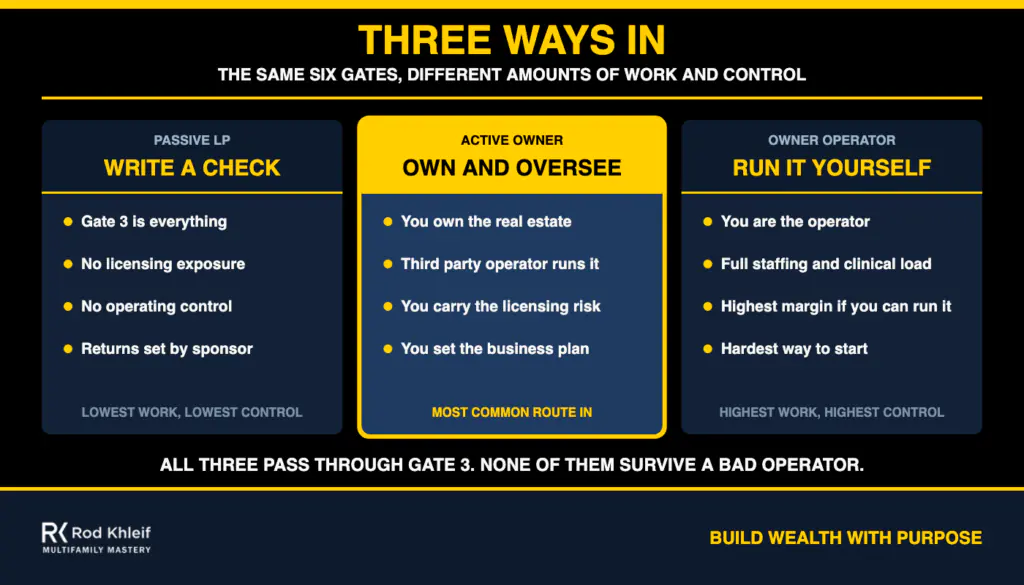
Passive limited partner. You write a check into someone else’s deal. No licensing exposure, no operating control, and your entire return rests on the sponsor and their operator. Gate 3 is not less important here, it is more important, because it is the only gate you control.
Active owner. You own the real estate and contract a third party operator. You set the business plan, you carry the licensing relationship, and you oversee rather than execute. This is the most common route for apartment investors crossing over, and it is the one this guide is mostly written for.
Owner operator. You are the operator. Highest margin, highest control, and by a wide margin the hardest way to start. Unless you come from healthcare operations, this is not a first deal.
On financing, senior housing has its own lending landscape, including agency debt through Fannie Mae and Freddie Mac senior housing programs, HUD, and bridge lenders who specialize in lease up. The general mechanics of structuring the debt are covered in the multifamily financing guide, with the caveat that senior housing lenders will underwrite your operator as hard as they underwrite you.
Pass this gate when you can state your route in one sentence and you know where the equity and the debt are coming from.
Gate 5: Underwrite It Yourself
Never inherit a seller’s numbers. In senior housing the gap between the offering memorandum and reality is wider than any other asset class I work in, because so much of the expense load is discretionary in the short term and catastrophic in the long term.
The lines that are most often wrong:
- Agency labor backed out as a one time item. If the community is running contract nurses, that cost stays until staffing is provably fixed. Do not remove it because the broker did.
- Management fee missing or below market. Owner operated communities often show no fee. Load a real third party fee.
- Care revenue assumed to keep climbing. Rising acuity raises revenue and raises cost. Hold it flat unless the care model is actually changing.
- No replacement reserve. Fund it per unit per year, every year.
- Census taken from the best month. Use the trailing twelve month average.
Then price it. Cap rates vary widely by segment, from roughly 5.3 percent for active adult to 8.0 percent for memory care in core markets, per the CBRE Senior Housing and Care Investor Survey. Applying one blended rate to a mixed care building is one of the most expensive mistakes available to you. The full segment by segment numbers are in senior housing cap rates by property type, and the mechanics of building the model are in how to underwrite senior housing deals.
Pass this gate when you have rebuilt revenue and expenses from source documents, blended your cap rates by NOI contribution, and set an exit 50 to 75 basis points wider than your entry.
Gate 6: Close and Operate
Senior housing closings have moving parts apartments do not. Licensure transfer or an interim management agreement has to be sequenced with the closing date. Resident agreements transfer. Staff have to be retained or rehired, and the executive director is the single most important person to keep through the transition.
The first 90 days set the trajectory. Census is fragile during an ownership change because families notice everything, and a departing executive director can take a dozen referral relationships with them. Plan the first 90 days before you close, not after.
Pass this gate when you have a licensure plan, a retention plan for key staff, and a written 90 day operating plan agreed with your operator.
What can go wrong at each stage, and how to spot it early, is covered in senior housing investment risks and opportunities.
Buying a Building vs Buying a Business
Weak Answers vs Strong Answers
Use this as a self test. Walk each gate and see which column your answer actually falls in. If you land in the left column on any gate, that is your next piece of work.
Mistakes That Kill Senior Housing Deals
I have watched all of these happen to people who were good at apartments.
- Choosing the building before the operator. The building is the easy part to replace. Reverse the order.
- Using one cap rate on a mixed care community. Blend by NOI contribution or you will overpay for the heaviest care units.
- Underwriting national supply numbers. Your competition is inside a fifteen minute drive, not the metro.
- Treating agency labor as temporary. If staffing were easy to fix, the seller would have fixed it and sold for more.
- Ignoring licensure timing. A slow state transfer can leave you paying carry on a community you cannot legally operate yet.
- Letting the executive director walk. They carry the referral relationships that fill your building.
- Assuming rising acuity is free revenue. More care means more staff hours, and the staff hours arrive before the rate increase does.
Development is not the easy escape from these either. CBRE reports senior housing development costs have climbed 23.6 percent since 2023 to roughly $388,830 per unit, which is a large part of why so little new supply is being built.
Hear It From Someone Who Runs These
Ryan Byrne came on the Lifetime Cash Flow podcast to explain what the operating reality looks like behind the returns investors see on paper. If you only do one thing before your first senior housing deal, watch this.
Watch the Full Interview
Ryan Byrne on why senior housing rewards operators and punishes passive assumptions.
Rod Khleif: “In apartments you buy a building and hire a manager. In senior housing you buy a business and inherit its reputation. Get that backwards and the spreadsheet will not save you.”
Before you go further, the free book covers the underwriting and pricing mistakes that cost buyers the most money across every asset class, senior housing included. Click the cover to download it.

Download the free book on the mistakes most apartment buyers make →
How to Invest in Senior Housing FAQ
Q: How do I start investing in senior housing with no experience?
A: Start passive or start light. Either invest as a limited partner in an experienced sponsor’s deal, or buy active adult, which is an age restricted apartment community with no care component and no health license. Both let you learn the asset class without carrying clinical and licensure risk on your first deal. Do not start with memory care.
Q: How much money do I need to invest in senior housing?
A: As a passive limited partner, sponsor minimums commonly start in the tens of thousands. As an active owner, a stabilized community typically requires equity in the low seven figures once you account for down payment, closing costs, licensure timing, and working capital for the transition. Budget operating reserves separately, because census can dip during an ownership change.
Q: What is the most important factor in a senior housing deal?
A: The operator. Senior housing is an operating business that owns real estate, and payroll is usually the largest expense line. A strong operator can carry an average building, but a great building cannot rescue a weak operator. Vet segment specific track record, state survey history, and executive director tenure before you commit to a property.
Q: Is senior housing more profitable than apartments?
A: Cap rates are higher, which means the going in yield is higher, but that spread is compensation for operating risk rather than free money. Senior housing carries payroll, licensure, clinical liability, and resident turnover measured in months. The returns are real for operators who can run the business and punishing for those who cannot.
Q: Do I need a license to own a senior housing facility?
A: In most states the license attaches to the operator rather than the owner, which is why the active owner route with a third party operator is common. That said, licensure transfer is triggered by a change of ownership, timing varies widely by state, and it has to be sequenced with your closing. Confirm the process in your target state before you go under contract.
Q: How do I find senior housing deals?
A: Most transactions run through brokers who specialize in seniors housing rather than general commercial brokerages. Relationships with operators are the other major source, because operators often know which owners are tiring before anything is listed. Choose your segment and market first so you can tell brokers something specific.
Q: What cap rate should I expect on senior housing?
A: It depends entirely on segment. In core markets, active adult prices near 5.3 percent, independent living near 5.9 percent, assisted living near 6.5 percent, and memory care near 8.0 percent. Add roughly 60 basis points outside core markets. Blend rates by NOI contribution on any mixed care community.
Q: What is the difference between senior housing and skilled nursing?
A: Senior housing generally refers to private pay segments where residents pay from their own resources. Skilled nursing provides medical care and depends heavily on Medicare and Medicaid reimbursement, which adds government reimbursement risk on top of clinical and staffing risk. That is why skilled nursing prices far wider than the private pay segments.
Q: Can I invest in senior housing through a REIT?
A: Yes. Several publicly traded REITs hold senior housing portfolios, and that is the most liquid and most passive route in. You give up control and property level upside, and your return tracks the REIT rather than a specific community. It is a reasonable way to get exposure while you learn the operating side.
Q: How long does it take to close a senior housing deal?
A: Longer than an apartment deal, largely because of licensure. Due diligence includes clinical records, survey history, staffing review, and resident agreements alongside the usual property work. Licensure transfer or an interim management agreement has to be arranged in parallel, and in slower states that step alone can add months.
Ready to Take the Next Step?
Senior housing rewards investors who respect the operating side and punishes the ones who treat it like apartments with a nurse. If you want to build the underwriting skill on real deals alongside people who have done it, the Bootcamp is where those reps happen.
Join the next Multifamily Bootcamp →
More conversations with operators and investors, including several on senior housing specifically, are in the Lifetime Cash Flow podcast library.
Disclaimer: This article was written with the help of AI and reviewed by Rod and his team.
