
Quick Answer: Multifamily syndication is a partnership structure where multiple investors pool their capital to purchase apartment buildings they couldn’t afford individually. One or more General Partners (GPs) manage the investment while Limited Partners (LPs) provide funding and receive passive returns, typically ranging from 15-25% average annual returns.
Multifamily Syndication for Beginners: Multifamily syndication for beginners is the simplest way to own apartments without buying one alone. You invest passively as a Limited Partner alongside an experienced operator, then earn a share of the rental income and the profit at sale while the General Partner finds, finances, and manages the property.
Simple Definition
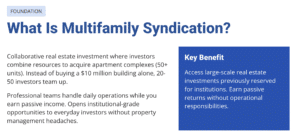
Multifamily syndication is a collaborative real estate investment strategy where a group of investors combines their financial resources to acquire and operate apartment complexes (typically 50+ units) that would be too expensive for any single investor to purchase alone.
Think of it like this: Instead of trying to buy a $10 million apartment building by yourself, you team up with 20-50 other investors. Together, you raise the capital needed, and a professional team (the General Partners) handles all the day-to-day operations while you earn passive income.
The beauty of syndication is that it opens up institutional-grade real estate opportunities to everyday investors who want the benefits of apartment ownership without the headaches of property management.
How Multifamily Syndication Works: Step-by-Step
Understanding the syndication process helps investors know what to expect. Here’s the typical timeline from deal identification to investor returns:
Step 1: Deal Identification and Analysis
The General Partners (GPs) identify a promising apartment complex. They conduct extensive due diligence including market analysis, property inspections, financial underwriting, and risk assessment. The team evaluates hundreds of potential deals before selecting one that meets their investment criteria.
Key evaluation factors include:
- Market fundamentals (job growth, population trends, rent growth)
- Property condition and value-add potential
- Current and projected cash flow
- Exit strategy and timing
- Risk-adjusted return potential
Step 2: Securing the Property
Once a property passes initial screening, the GPs place it under contract with an earnest money deposit (typically 1-3% of purchase price). This begins the due diligence period, usually 30-60 days, during which the team conducts detailed inspections, reviews financials, and finalizes the business plan.
Step 3: Capital Raising
The sponsor team creates an offering memorandum detailing the investment opportunity, projected returns, risks, and business plan. They present this to their investor network,the Limited Partners (LPs),who decide whether to invest. Most syndications require a minimum investment of $50,000-$100,000, though some allow smaller amounts.
The capital structure typically looks like this:
- 70-80% financing (bank loan or agency debt)
- 20-30% equity from investor syndication
- GPs typically invest 5-10% of required equity
Step 4: Closing and Acquisition
Once capital is raised and due diligence is complete, the syndication closes on the property. The legal entity (usually an LLC) officially takes ownership. Investors receive their ownership percentage based on their capital contribution, and the business plan implementation begins immediately.
Step 5: Asset Management and Value Creation
The GP team executes the business plan over the typical 3-7 year hold period. This usually involves:
- Property improvements (renovated units, amenity upgrades, exterior improvements)
- Operational optimization (reducing expenses, improving management)
- Rent growth through market appreciation and value-add improvements
- Regular investor communications (monthly/quarterly updates)
Step 6: Investor Distributions
Limited Partners receive passive income through quarterly cash flow distributions (typically 5-8% annually) plus a share of appreciation at sale. Most syndications target 15-25% average annual returns combining both income and appreciation.
Step 7: Exit Strategy
After executing the business plan and achieving the projected value increase, the property is sold to a new buyer. Proceeds are distributed to investors after paying off the loan. Investors receive their original investment back plus profits from appreciation, typically achieving a 1.5x-2.5x equity multiple over the hold period.
General Partner (GP) vs Limited Partner (LP) Explained
Every multifamily syndication has two distinct groups of participants, each with different roles, responsibilities, and compensation structures:
General Partners (GPs) The Active Operators
General Partners are the experienced operators who find, acquire, manage, and ultimately sell the property. They’re the ones doing all the work and bearing the highest risk.
GP Responsibilities:
- Identifying and analyzing potential deals
- Negotiating purchase terms and securing financing
- Raising capital from Limited Partners
- Overseeing property management and operations
- Making major decisions (refinancing, capital improvements, sale timing)
- Regular investor reporting and communication
- Legal compliance and regulatory requirements
GP Compensation:
- Acquisition Fee: 1-3% of purchase price (covers deal costs)
- Asset Management Fee: 1-2% annually of collected revenue
- Disposition Fee: 1-2% at sale
- Profit Share (Promote): Typically 20-35% of profits after LP preferred return
Limited Partners (LPs) The Passive Investors
Limited Partners are the capital providers who invest money but take no active role in operations. They benefit from professional management and passive real estate returns.
LP Rights and Benefits:
- Ownership share proportional to investment amount
- Quarterly cash flow distributions
- Share of profits at sale
- Regular performance updates
- Tax benefits (depreciation, mortgage interest deductions)
- Limited liability protection
LP Responsibilities:
- Provide capital when called
- Review investment materials and conduct personal due diligence
- Sign legal documents
- Monitor performance through reports (no active management required)
GP vs LP Comparison Table
| Characteristic | General Partner (GP) | Limited Partner (LP) |
| Role | Active operator and decision-maker | Passive investor |
| Time Commitment | Full-time commitment throughout hold period | Minimal (review updates only) |
| Capital Required | 5-10% of equity (plus sweat equity) | $50K-$100K+ minimum typically |
| Liability | Unlimited liability exposure | Limited to investment amount only |
| Decision Authority | Full control over operations and strategy | No operational control |
| Returns | Fees + 20-35% profit share (promote) | Preferred return + 65-80% profit share |
| Experience Required | Extensive real estate and operations expertise | None required (accredited investor status typically needed) |
Understanding the Capital Stack
The capital stack shows how a multifamily syndication is financed. Understanding this structure is crucial for evaluating risk and potential returns.
Real-World Example: $10 Million Apartment Complex
Let’s break down a typical deal structure:
Total Purchase Price: $10,000,000
- Senior Debt (First Position) — 75% ($7,500,000)
- Source: Bank or agency loan (Fannie Mae, Freddie Mac)
- Interest Rate: 5.5% – 6.5%
- Terms: Fixed rate, 5-10 year term, 25-30 year amortization
- Risk Level: Lowest (first to be repaid)
- Return: Fixed interest payments
- Preferred Equity (Optional Middle Layer) — 0-10% ($0-$1,000,000)
- Source: Institutional or high-net-worth investors
- Expected Return: 10-14% preferred return
- Risk Level: Medium (paid before common equity)
- Common in larger deals or when additional capital needed
- Common Equity (LP Investment) — 22.5% ($2,250,000)
- Source: Limited Partner investors
- Expected Return: 8% preferred return + 70% profit share
- Risk Level: Higher (last to be repaid, first to absorb losses)
- Upside: Unlimited profit potential from appreciation
- GP Equity Investment — 2.5% ($250,000)
- Source: General Partners’ capital
- Return: Same preferred return as LPs + 30% profit share (promote)
- Ensures GP skin in the game and alignment with investors
The Waterfall Distribution:
When the property generates cash flow or is sold, distributions follow this priority:
Tier 1: Senior debt service (mortgage payment)
Tier 2: Preferred equity return (if applicable)
Tier 3: Return of LP and GP capital
Tier 4: Preferred return to LP and GP (typically 8% annually)
Tier 5: Remaining profits split (typically 70% LP / 30% GP)
Risk Factors in Multifamily Syndication
While multifamily syndication offers attractive returns, investors must understand the inherent risks. Here are the primary risk factors to evaluate:
1. Market Risk
Local economic conditions can significantly impact property performance. Job losses, population decline, or oversupply of apartments can reduce occupancy and rental rates. Economic recessions affect tenant ability to pay rent and can decrease property values.
Mitigation strategies:
- Invest in markets with diverse economies and job growth
- Focus on landlord-friendly states with strong population trends
- Conservative underwriting that stress-tests economic downturn scenarios
2. Operator Risk
The General Partners’ experience and competence directly determine investment success. Inexperienced operators may miscalculate renovations costs, mismanage operations, or make poor strategic decisions that erode returns.
Due diligence checklist:
- Verify GP track record and references from previous investors
- Review past deals’ actual vs projected performance
- Assess team depth and specialization (acquisitions, operations, finance)
- Ensure GPs have personal capital invested
3. Illiquidity Risk
Multifamily syndications are long-term, illiquid investments. Unlike stocks, you cannot sell your position easily. Your capital is typically locked up for 3-7 years with limited options to exit early except under specific circumstances defined in the operating agreement.
Investor considerations:
- Only invest money you won’t need for 5+ years
- Maintain adequate liquid reserves for emergencies
- Diversify across multiple syndications to manage liquidity needs
4. Leverage Risk
Most syndications use 70-80% debt financing, which amplifies both gains and losses. If property performance declines, debt service obligations remain constant, potentially consuming all cash flow and even requiring capital calls from investors.
Risk assessment:
- Review debt service coverage ratio (should be 1.25x or higher)
- Understand refinance risk if using short-term bridge debt
- Verify adequate operating reserves (6-12 months)
5. Execution Risk
Value-add business plans depend on successful execution of renovations, rent increases, and operational improvements. Renovation costs can exceed budgets, timelines can extend, or market rents may not support projected increases.
Warning signs:
- Overly aggressive rent growth projections (>8% annually)
- Unrealistic renovation timelines or costs
- Lack of contingency reserves (should be 10-15% of renovation budget)
6. Regulatory and Tax Risk
Changes in tax laws, zoning regulations, rent control policies, or local ordinances can impact property values and cash flow. Some markets have introduced rent control or restrictive eviction policies that limit operators’ ability to optimize revenue.
Investment Returns Explained
Understanding how returns are calculated and distributed is crucial for evaluating syndication opportunities. Multifamily syndications provide returns through two primary mechanisms:
Cash Flow Distributions (Passive Income)
Quarterly distributions from operational cash flow after debt service and operating expenses. Typical range: 5-8% annual cash-on-cash return.
Example: $100,000 investment receiving 6% cash-on-cash would generate $6,000 annually ($1,500 per quarter) in passive income.
Appreciation and Profit at Sale
The larger portion of returns comes from value appreciation when the property is sold. Value-add syndications increase property value through renovations, improved operations, and market appreciation.
Key Return Metrics:
- Preferred Return (Pref): The minimum return LPs receive before GPs participate in profits. Standard is 8% annually, calculated cumulatively. If not paid in a given year due to low cash flow, it accrues and must be paid before profit splits occur.
- Equity Multiple: Total return as a multiple of original investment. Example: 2.0x equity multiple means you receive $2 for every $1 invested (doubling your money). Target range for 5-year holds: 1.8x – 2.5x.
- Internal Rate of Return (IRR): Annualized return accounting for timing of cash flows. Considers when distributions occur, not just total amount. Target IRR for value-add deals: 15-25% annually.
- Cash-on-Cash Return (CoC): Annual cash flow distributed divided by total investment. Measures annual passive income yield. Typical range: 5-8%.
Complete Return Example:
Investment: $100,000
Hold Period: 5 years
Cash Flow Distributions: $30,000 total ($6,000/year average)
Profit at Sale (after return of capital): $120,000
Total Return: $150,000
Equity Multiple: 2.5x
Average Annual Return (IRR): ~20%
Frequently Asked Questions (FAQ)
Question 1: How much money do I need to invest in a multifamily syndication?
Minimum investments typically range from $50,000 to $100,000, though some syndications accept lower amounts ($25,000) or require higher minimums ($250,000+) depending on the deal size and sponsor. The minimum is set to ensure the syndication can efficiently manage investor communications while raising sufficient capital. Most sponsors recommend having a net worth of at least $500,000 and annual income of $200,000+ to comfortably participate, as you must also qualify as an accredited investor under SEC regulations.
Question 2: What does ‘accredited investor’ mean and do I need to be one?
An accredited investor meets specific SEC financial criteria: either $200,000+ annual income ($300,000 jointly) for the past two years with expectation to continue, or $1 million+ net worth excluding primary residence. Most syndications are structured as 506(b) or 506(c) offerings requiring accredited status. This requirement exists because these are private securities offerings with less regulatory oversight than public investments. Some sponsors offer 506(b) deals allowing up to 35 sophisticated but non-accredited investors, but this is less common due to increased regulatory burden.
Question 3: How long will my money be invested?
The typical hold period is 3-7 years, with 5 years being most common for value-add business plans. The exact timeline depends on the business plan, market conditions, and optimal exit timing. Your capital remains invested until the property sells—there is no liquid secondary market to sell your shares early. Some operating agreements allow transfers with GP approval, but this is rare in practice. Plan to have your capital fully committed for at least 5 years, and only invest funds you won’t need for emergencies or other financial obligations.
Question 4: What happens if the property underperforms?
If the property generates lower cash flow than projected, quarterly distributions may be reduced or suspended entirely. The GP team will typically implement corrective measures: reducing expenses, adjusting the business plan, or in severe cases, considering an early sale even if below original projections. In worst-case scenarios, you could lose some or all of your investment if the property value declines significantly or debt cannot be refinanced. This is why thorough due diligence on both the operator and the specific deal is crucial. Conservative underwriting with built-in buffers and experienced operators significantly reduce this risk.
Question 5: How are multifamily syndications taxed?
Syndication investors receive K-1 tax forms annually showing their share of income, expenses, and depreciation. The depreciation deduction often shelters most or all cash flow distributions from taxation in early years—you receive cash but may owe minimal taxes. When the property sells, profits are taxed as capital gains (typically 15-20% federal rate for long-term holdings). Depreciation recapture applies to the amount previously deducted. Tax benefits are significant: many investors receive $5,000-$10,000 in annual depreciation deductions per $100,000 invested. Consult a CPA familiar with real estate to understand your specific tax situation, as benefits vary by individual circumstances.
Question 6: Can I invest using my self-directed IRA or 401(k)?
Yes, many investors use self-directed retirement accounts to invest in syndications. This requires establishing a self-directed IRA (SDIRA) or self-directed 401(k) through a specialized custodian that allows alternative investments. Benefits include tax-deferred or tax-free growth (Roth), though you also lose the current tax benefits of depreciation deductions. Be aware of UDFI (Unrelated Debt-Financed Income) and UBIT (Unrelated Business Income Tax) implications if the property uses leverage. Not all syndications accept retirement account investors due to additional administrative requirements. Work with a custodian experienced in real estate syndications and consult a tax professional before proceeding.
Question 7: What’s the difference between a syndication and a REIT?
REITs (Real Estate Investment Trusts) are publicly traded securities owning diversified property portfolios, while syndications are private investments in specific properties. REITs offer liquidity (can sell shares anytime) but lower returns (typically 3-8% annually) and no tax benefits since depreciation stays with the REIT. Syndications are illiquid but offer higher returns (15-25% target), significant tax advantages through depreciation pass-through, and direct ownership in specific properties you can evaluate. REITs are passive with no control or transparency into specific properties. Syndications provide regular updates on your specific asset. REITs require no accreditation and accept investments as low as one share price. Both have roles in diversified portfolios—REITs for liquidity, syndications for higher returns and tax benefits.
Question 8: How do I evaluate and choose the right syndication sponsor?
Start by requesting the sponsor’s track record, actual results from past deals, not just projections. Verify they’ve successfully navigated full market cycles including downturns. Review their investor portal showing historical performance transparency. Check how many deals they’ve completed, total units under management (ideally 1,000+ units), and capital raised. Speak with current investors about communication quality and whether distributions match projections. Evaluate their investment strategy alignment with your goals—some focus on cash flow, others on appreciation. Assess their market expertise and local boots-on-ground presence. Verify they have personal capital invested in every deal. Strong sponsors provide detailed investment memorandums, proactively communicate challenges, and have institutional-quality reporting. Trust and transparency are paramount—if anything feels rushed or unclear, walk away.
Learn More About Multifamily Investing
Ready to dive deeper? Here are essential resources to continue your multifamily education:
- First Steps to Becoming a Multifamily Syndicator: Ready to move past passive investing and lead your own deals? Follow the step-by-step path to becoming the syndicator.
- How to Raise Capital Legally: Understand SEC regulations, 506(b) vs 506(c) offerings, and compliance requirements for raising investor capital.
- Underwriting Multifamily Deals: Master the financial analysis process, from evaluating NOI and cap rates to stress-testing your assumptions.
- Warrior Program: Join Rod Khleif’s comprehensive training program where 300,000+ units have been acquired by program participants. Learn the complete syndication process from deal-finding through exit.
Final Thoughts
Multifamily syndication democratizes access to institutional-quality real estate investments. For Limited Partners, it offers passive income, tax advantages, portfolio diversification, and returns that historically outpace traditional stock and bond investments—all without the demands of property management.
For General Partners, syndication provides the leverage to scale operations beyond personal capital limitations while building wealth through fees, profit participation, and portfolio growth.
Success in multifamily syndication requires education, careful operator selection, thorough due diligence, and realistic return expectations. This guide provides the foundation, but continuous learning and market awareness are essential as you build your real estate investment portfolio.
The opportunity is real. The returns are achievable. The time to start is now.
Ready to Master Multifamily Syndication?
Join 10,000+ students who have collectively acquired over 300,000 apartment units
Whether you want to become a General Partner leading deals or a Limited Partner investing passively, the Warrior Program gives you the complete roadmap to multifamily success.
What you’ll learn:
- ✓ How to find and analyze profitable multifamily deals
- ✓ Complete underwriting and due diligence processes
- ✓ Strategies to raise capital from investors legally
- ✓ Asset management and value-add execution
- ✓ Exit strategies and maximizing returns
Limited spots available.
Disclaimer: This article was written with the help of AI and reviewed by Rod’s team.
Related reading: Real Estate Syndication Waterfall: How Profits Split
Related reading: Best Multifamily Investment Training (2026) compares the top bootcamps, courses, and mentorships and gives you a simple framework to choose the right fit.
Related reading: building an investor list for your first raise.
