
I have seen brilliant operators leave six and seven figures of tax savings on the table because they treated opportunity zones for multifamily like a fad instead of a tool. The structure is real, the math is enormous, and 2026 is the most consequential year the program has ever had. If you have a capital gain coming or a deferred gain already running, you cannot afford to wing this one.
This guide walks you through how the program works under current law, what changed when the One Big Beautiful Bill Act made the incentive permanent, why multifamily is the ideal asset class to capture it, and exactly how to evaluate a deal so you do not end up holding a tax bill instead of a windfall.
Table of Contents
- Why Most Multifamily Investors Misread Opportunity Zones
- What Is a Qualified Opportunity Zone
- The QOZ Multifamily Wealth Stack
- How Opportunity Zones for Multifamily Actually Work
- Why Multifamily Fits the QOZ Structure Better Than Any Other Asset
- The Three Paths Into a QOZ Multifamily Deal
- The After Tax Math: A Worked Example
- The Risks Every Investor Must Understand
- What Changed in 2026 and What Is Coming Next
- How to Evaluate a QOZ Multifamily Sponsor
- QOZ vs 1031 Exchange: Which Belongs in Your Portfolio
- How to Invest in a QOZ Multifamily Deal Step by Step
- Warrior Story: Tax Sophistication as a Compounding Skill
- Opportunity Zones for Multifamily FAQ
- Ready to Take the Next Step
Why Most Multifamily Investors Misread Opportunity Zones
Opportunity zones for multifamily are not a tax loophole and they are not a giveaway. They are a wealth compounding structure that lets you defer the capital gains tax on a sale, double the basis of a property through value add execution, and pay zero federal tax on the appreciation if you hold for ten years. The asset class matters more than the address.
Investors trip up on this program for one of three reasons. They read about it during the 2018 hype cycle, assumed the basis step ups still exist, and never updated their mental model. Or they conflate opportunity zones with low income housing tax credits and assume the operating math is the same. Or they ignore the program entirely because the deferral end date felt far away. None of those are good positions to be in heading into 2026.
Signs You Are Misreading the QOZ Opportunity
Read this short list. If you check more than two boxes, your QOZ mental model needs a refresh before you commit a dollar of gain.
- You still think the seven year basis step up is available.
- You believe a property qualifies just because it sits inside a designated census tract.
- You assume you need real estate gains to invest. You can use any eligible capital gain.
- You think the program ends on December 31, 2026. The investment incentive is permanent now.
- You have a deferred gain sitting in a QOF and have not modeled the 2026 inclusion tax bill.
- You assume the “substantial improvement” rule applies to the whole property including land. It does not.
What Is a Qualified Opportunity Zone
A qualified opportunity zone is a census tract that the governor of a state nominated and the U.S. Treasury certified as an economically distressed community eligible for special tax treatment. The program was created by the 2017 Tax Cuts and Jobs Act to channel private capital into roughly 8,700 designated tracts nationwide. The mechanism is elegant: investors get powerful tax benefits, the community gets long term capital, and the Treasury collects deferred tax revenue later rather than now.
Three core benefits exist under the original law that governs investments made through December 31, 2026. You defer the tax on the capital gain you roll into a Qualified Opportunity Fund until the earlier of an inclusion event or that 2026 deadline. The basis step up benefits that reduced 10 percent or 15 percent of the original gain were tied to five year and seven year holding periods, and both of those windows closed years ago for new investors. The third benefit is the one that does all the heavy lifting: if you hold your QOF interest for at least ten years, every dollar of appreciation on the QOZ investment is excluded from federal tax when you sell.
Compare this to a 1031 exchange, which only defers tax and only works for real estate to real estate transitions. Opportunity zones work for any eligible capital gain, including a stock sale, a business sale, a crypto exit, or a prior real estate disposition. The exclusion of future appreciation is what makes the structure so powerful. You are not deferring a future tax. You are eliminating it.
The QOZ Multifamily Wealth Stack
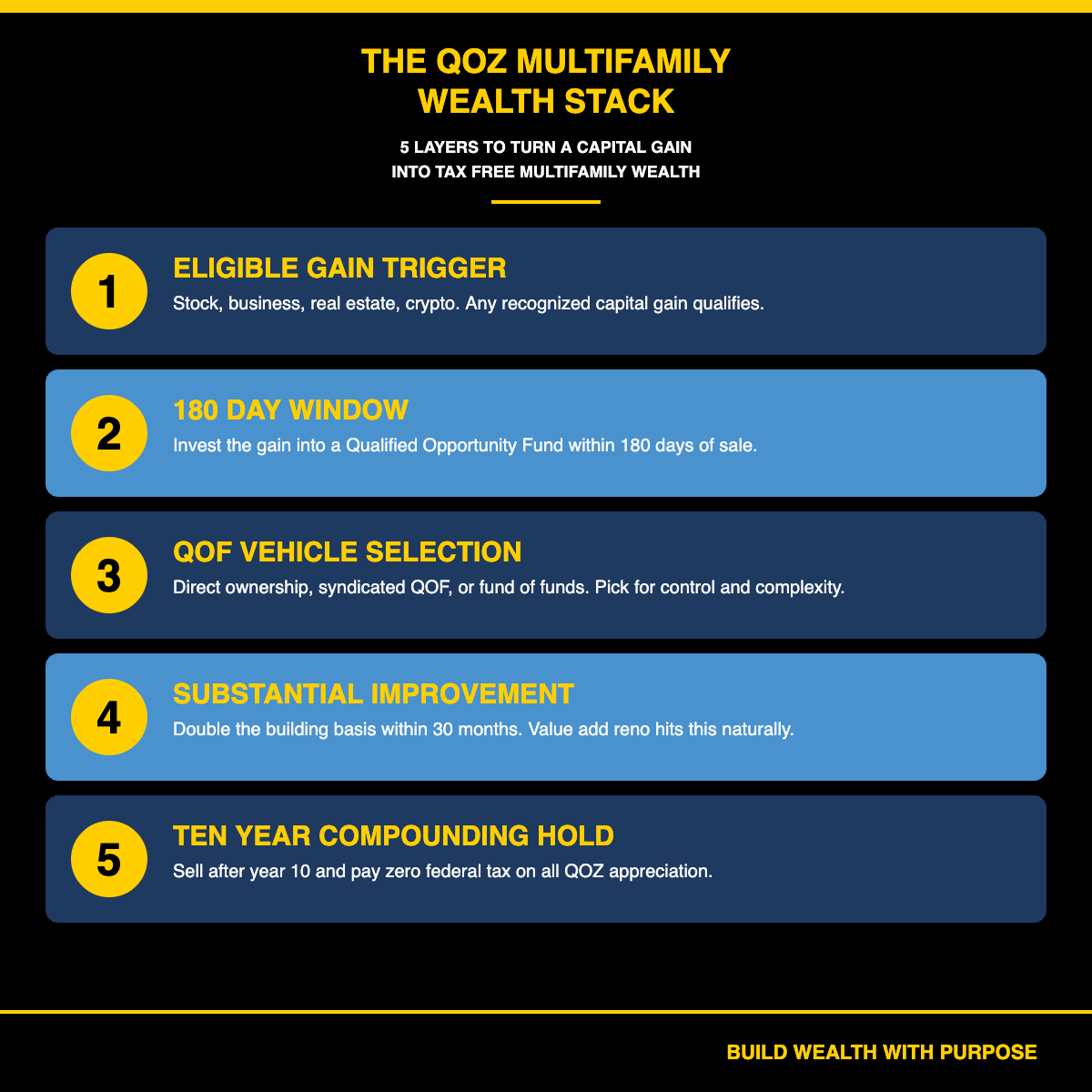
I built the QOZ Multifamily Wealth Stack to keep new investors from skipping a layer and torching the entire benefit. Most QOZ failures I have seen came from rushing one of these five layers. Stack them in order, get each one right, and the math takes care of itself. Use the workbook at the bottom of the post to run the framework against your own deal.
Want personal coaching on tax efficient multifamily structures? Apply to the Warrior Program →
Layer 1: Eligible Gain Trigger
The structure starts the moment you realize an eligible capital gain. Stocks, business equity, real estate, crypto, collectibles. Short term or long term, the gain qualifies. If you do not have a recognized gain on the books, you cannot use this tool. So step one is honest. Do you have a gain, or are you trying to fit a strategy you read about to a situation that does not call for it.
Layer 2: The 180 Day Window
From the date of the sale you have 180 days to invest the gain into a Qualified Opportunity Fund. Miss the window and the tax is due on next year’s return. Partnership and S corp K 1 gains have flexible start dates, which is why CPAs love this layer when clients sell businesses. Calendar this deadline the minute the closing date hits.
Layer 3: QOF Vehicle Selection
The capital has to flow into a Qualified Opportunity Fund, not directly into a property. The fund is the legal wrapper that holds the QOZ business or QOZ property. You can form your own QOF for a single asset, invest passively into a syndicated QOF run by an experienced sponsor, or buy into a fund of funds. The right vehicle depends on how much control you want, how much complexity you can absorb, and how diversified you want to be across markets.
Layer 4: Substantial Improvement Execution
The QOZ statute requires the fund to either start a new business in the zone or “substantially improve” an existing property. Substantial improvement means doubling the adjusted basis of the building (not the land) within 30 months of acquisition. This is the rule that makes value add multifamily a near perfect match. Buy a tired property, pour capex into kitchens, baths, common areas, HVAC, exteriors, and amenities, and you naturally hit the basis doubling test. If the sponsor cannot show you a substantial improvement schedule with line item costs, walk away.
Layer 5: Ten Year Compounding Hold
The exclusion benefit only triggers if you hold the QOF interest for at least ten years and sell or step up basis through the program’s election. Pull out at year seven and you collect cash flow but lose the appreciation exclusion. The ten year horizon also gives the value add business plan time to play out: lease up, stabilization, refinance, and a long enough operating window for inflation and rent growth to compound. Build the hold period into your liquidity plan up front.
How Opportunity Zones for Multifamily Actually Work
Once the framework is in your head, the mechanics are simple. The sequence below is what you would actually do, in order, after a triggering sale. Use this as a checklist, not a substitute for legal and tax counsel.
The investor sells an asset and generates a capital gain. The investor wires the gain (just the gain, not the basis) to a Qualified Opportunity Fund within 180 days. The fund deploys the capital into a Qualified Opportunity Zone property or business inside one of the certified tracts. The fund either acquires raw land plus new construction or buys an existing structure and substantially improves it within 30 months. The investor reports the deferral on Form 8949 and the QOF reports on Form 8997 every year the investment is held. The investor recognizes the deferred gain on December 31, 2026 (under the original law) or on the new five year anniversary trigger under the OZ 2.0 rules for investments made after that date. After year ten, the investor elects to step up basis to fair market value on sale, paying zero federal tax on the appreciation.
The 30 month substantial improvement clock is the operational pressure point. Sponsors who underestimate construction timelines, permitting friction, or labor and supply chain risk can blow the test and forfeit the entire QOZ benefit. Underwriting that schedule honestly is non negotiable, which is one reason I rank sponsor track record higher than market thesis when I vet a deal. See our multifamily underwriting guide for the full process I use.
Why Multifamily Fits the QOZ Structure Better Than Any Other Asset
You can run a QOZ play in industrial, retail, hospitality, or office. Multifamily wins on five separate dimensions, and the wins compound on each other.
First, the substantial improvement test aligns naturally with value add renovation budgets. A typical 1980s vintage Class B or C apartment building costs roughly half land and half improvements, and a $10 to $20 thousand per unit interior and exterior reno program will routinely double the building basis within the 30 month window. According to the National Multifamily Housing Council, the United States needs to build 4.3 million additional apartments by 2035 to meet demand. The undersupplied workforce housing tier that most QOZ tracts target is exactly where that need is concentrated.
Second, many designated tracts sit in the path of growth in metros that are already adding population and jobs. Not every zone gentrifies, but the ones that do reward patient capital handsomely.
Third, the long hold period required to capture the appreciation exclusion matches the natural multifamily cycle. Cash flow during years one through ten covers the inclusion tax bill on the deferred gain, the value add lifts net operating income, refinance proceeds return capital, and the eventual sale captures appreciation tax free at the federal level.
Fourth, you can stack tax benefits. The QOZ appreciation exclusion sits on top of normal multifamily depreciation, which can be accelerated with a cost segregation study at acquisition. Bonus depreciation rules let you front load deductions in year one. The combined effect can drive your effective tax rate on cash flow toward zero for the first several years while the appreciation benefit ripens in the background.
Fifth, multifamily operations are forgiving. Hospitality and retail QOZ deals are more sensitive to economic cycles. Workforce housing is what people downgrade into during a recession, not out of. For more on building cycle resilient portfolios see our guide to recession proof multifamily strategy.
The Three Paths Into a QOZ Multifamily Deal
You can participate in this structure three different ways. Each path has its own risk and control profile, and the right one depends on your check size, your tax sophistication, and how much time you want to spend on compliance.
The first path is direct ownership through a QOF you form yourself. You hire counsel, file the self certification, control acquisition, and run the asset. The control is total. The complexity is also total. Annual fund certifications, semi annual 90 percent asset tests, K 1 distribution mechanics, and ongoing IRS reporting are all on you. This path makes sense for investors with at least $2 million of gain to deploy and an existing operating team.
The second path is a syndicated QOF run by an experienced multifamily sponsor. This is the most common route for investors with $100 thousand to $1 million of gain. You become a limited partner alongside other accredited investors. The sponsor handles QOZ compliance, the substantial improvement schedule, and operations. You receive K 1s and quarterly reports. Our guide to multifamily syndication walks through the structure end to end, and our piece on what a general partner does covers the operator side.
The third path is a QOZ focused fund of funds. You invest in a sponsor whose entire business is allocating capital across multiple QOFs. The advantage is diversification across markets and operators. The cost is layered fees, since the fund of funds charges on top of the underlying QOF fees. Fees can absorb a meaningful chunk of return, so the diversification value has to be real.
The After Tax Math: A Worked Example
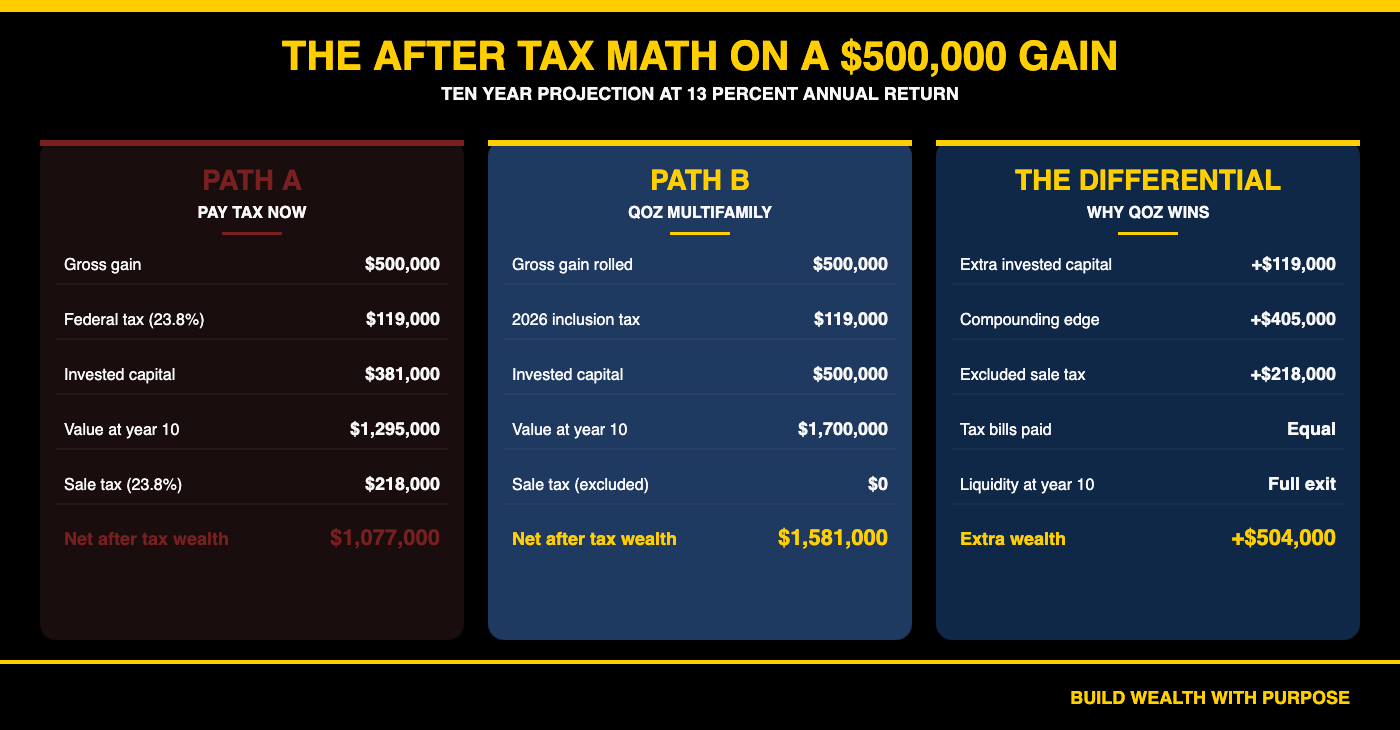
The cleanest way to see the QOZ advantage is to run two paths side by side on the same starting gain. Consider an investor with a $500,000 long term capital gain from a stock sale who is in the top federal bracket and subject to NIIT.
Path A pays the tax now. At the 20 percent federal long term rate plus the 3.8 percent NIIT, the all in federal hit is roughly 23.8 percent, or about $119,000. The investor has approximately $381,000 left to invest in a standard non QOZ multifamily syndication. Assume the deal hits a 13 percent average annual return over ten years. Future value of $381,000 at 13 percent for ten years is approximately $1,295,000. Sale generates roughly $914,000 of additional gain, taxed at 23.8 percent, costing another $218,000. Net after tax value at year ten is approximately $1,077,000.
Path B rolls the full $500,000 of gain into a QOZ multifamily QOF. The investor pays the 2026 inclusion tax of about $119,000 from outside savings (or from interim cash distributions from the QOF). The QOF capital compounds at the same 13 percent for ten years, growing to roughly $1,700,000. At year ten the investor sells with the basis step up election, and the appreciation of approximately $1,200,000 is excluded from federal tax. After accounting for the $119,000 already paid on the original gain, the investor’s net after tax wealth is approximately $1,581,000.
The differential is approximately $500,000 of additional after tax wealth on a $500,000 gain. That is not a marketing number. It is what the math says when you compare apples to apples on the same return assumption. Returns depend on deal execution, market dynamics, financing terms, and tax law remaining stable. The point is not the exact figure. The point is the magnitude.
The Risks Every Investor Must Understand
I have not met a sophisticated investor who lost money on a great deal. I have met plenty who lost money on a good idea executed by the wrong operator. QOZ structures carry six risks specifically.
Location risk. By definition every zone is economically distressed. Some are improving. Some have been improving for decades and have nearly stabilized. Some will never improve. The address alone tells you nothing. The submarket trajectory, employer base, school quality, and infrastructure investment trajectory tell you everything.
Illiquidity. The ten year minimum hold is a hard requirement to capture the appreciation exclusion. There is no early exit that preserves the full benefit. If you might need the capital in years five through nine, this is the wrong structure.
Sponsor risk. QOZ compliance is more complex than standard multifamily syndication. A sponsor who botches the substantial improvement test, the 90 percent asset test, or the K 1 reporting can cost you the entire tax benefit even if the property itself performs.
Legislative risk. Congress passed the One Big Beautiful Bill Act in 2025, which made the program permanent and changed the benefit structure for investments made after December 31, 2026. Future legislation could change it again. Investors with deferred gains already running have already absorbed one structural reset on the basis step up benefits.
Substantial improvement execution risk. If the fund fails to double the building basis within 30 months, the property loses QOZ status and you lose the appreciation exclusion. Construction delays, supply chain issues, and budget overruns are not theoretical risks in 2026.
Operational risk. Workforce housing operations require specialized management. Resident turnover, collections, fair housing compliance, and capex sequencing are all harder in the Class B and C tier where most QOZ multifamily lives. Our due diligence checklist covers what to verify before committing.
What Changed in 2026 and What Is Coming Next
The single biggest legislative event in this program’s history happened in 2025 when Congress passed and the President signed the One Big Beautiful Bill Act. According to the Economic Innovation Group, which co created the original concept, the OBBBA made the opportunity zone incentive permanent. The sunset that was originally scheduled for December 31, 2026 is gone. The next decennial QOZ designations take effect January 1, 2027 on a rolling ten year cycle.
For investors who deferred gains before December 31, 2026, the original rules still govern. The deferred gain comes onto the 2026 tax return and the tax is due by April 15, 2027. Many early investors are facing five and six figure tax bills on gains they have not yet liquidated, so cash planning for that April 2027 bill needs to happen now. The IRS still requires Form 8949 to report the deferral and Form 8997 to track the QOF investment each year.
For investments made on or after January 1, 2027, OZ 2.0 changes the structure. The deferral period becomes a rolling five years rather than tied to a fixed sunset date. A permanent 10 percent basis step up returns at the five year mark, and a 30 percent step up applies to Qualified Rural Opportunity Funds. The income tests for tract qualification tighten from 80 percent of area median to 70 percent, which means fewer tracts will qualify and the ones that do will skew toward more distressed communities. The blanket Puerto Rico designation goes away. The contiguous tract rule disappears.
The practical takeaway: if you have a recognized gain in 2026, the original OZ 1.0 rules apply to your investment. If you have a gain in 2027 or later, plan around OZ 2.0. Either way the program is now a permanent feature of the code, which finally removes the policy uncertainty that made some investors hesitate during 2023 and 2024.
How to Evaluate a QOZ Multifamily Sponsor
Picking the right sponsor is more important in a QOZ deal than in a standard syndication because the tax benefit you came for can be destroyed by a compliance miss that has nothing to do with operating performance. Use these criteria as the floor, not the ceiling.
Demand a multifamily operating track record that predates their QOZ work. Lots of sponsors learned QOZ structuring before they learned how to run apartments. The combination is rare and worth paying for. Ask for the QOF legal structure, the tax opinion from outside counsel, and a copy of the substantial improvement budget with line items. Verify the market thesis with third party data on population, employment, and rent trends. Confirm the hold period assumptions match the QOZ timeline (no balloon exits at year seven). Read the fee schedule end to end. Acquisition fees, asset management fees, refinance fees, and promote structure should all add up to a sponsor incentive that aligns with your timeline. Walk away if anything feels rushed or evasive.
Our piece on how to buy an apartment building covers the operational diligence layer in more detail. Pair that with QOZ specific tax counsel from a CPA who has signed at least a dozen Form 8996s and you have a defensible underwriting process.
QOZ vs 1031 Exchange: Which Belongs in Your Portfolio
I get asked weekly which tool is better. The honest answer is both, applied to different situations. The comparison table below is the cheat sheet I share with Warriors.
The right mental model is a portfolio one. Use 1031 exchanges to keep real estate basis rolling forward when you are moving from one property to a larger one. Use opportunity zones to convert non real estate gains into multifamily exposure while permanently shielding the future appreciation. Read our deep dive on the 1031 exchange rules for the companion piece.
How to Invest in a QOZ Multifamily Deal Step by Step
Use this six step sequence as your operating checklist whenever a new eligible gain crosses your desk. None of these steps is optional. Skipping one is how investors blow the benefit.
- Confirm the eligible gain. Pull your closing statement, K 1, or 1099. Identify the gain amount, the recognition date, and whether the gain is short term or long term. The 180 day clock starts from the date of recognition, not the date you decide to invest.
- Assemble the advisory team. Engage a CPA with QOZ experience and a securities attorney before you wire money. A QOZ tax memo costs a fraction of the tax benefit at stake and protects you in audit.
- Vet the sponsor and the QOF structure. Read the private placement memorandum, the operating agreement, and the QOF tax opinion. Stress test the substantial improvement schedule. Confirm the sponsor has W2 employees on the asset management team, not just at the GP entity.
- Model the after tax math honestly. Build a year by year cash flow with the 2026 inclusion tax bill, the operating distributions, the refinance event, and the year ten sale at the basis step up. Stress the assumptions down 25 percent.
- Execute the wire and document the deferral election. The QOF must receive the gain within 180 days. File Form 8949 with the deferral election on your next return. The QOF files Form 8996 for fund certification.
- Maintain compliance for 10 years. File Form 8997 every year you hold the investment. Track your QOF basis. When the 2026 inclusion event triggers, plan the cash to pay the resulting federal tax in April 2027. After year ten, elect the basis step up on sale and pay zero federal tax on the appreciation.
Warrior Story: Tax Sophistication as a Compounding Skill
I have watched dozens of Warriors transform their results in real estate, and the pattern is consistent. The investors who learn the tax structures move faster, take smarter risks, and compound wealth more rapidly than the ones who ignore them. Anthony Metzger went from teaching grade school to raising millions in multifamily capital. The leverage was not just deal flow. It was tax sophistication paired with relentless execution. When you understand how QOZs, cost segregation, bonus depreciation, and 1031 exchanges fit together, every deal you bring to a passive investor becomes more compelling. That is what scaling looks like.
Watch the Full Interview
Anthony walks through the leap from teacher to multifamily syndicator on the Lifetime Cash Flow Podcast.
Rod Khleif: “Tax law is not a side note in multifamily. It is the difference between building wealth and renting it from the IRS. Learn the structures, surround yourself with operators who already use them, and the compounding takes care of itself.”
Opportunity Zones for Multifamily FAQ
Q: Can I use any capital gain for a QOZ investment, or only real estate gains?
A: Any eligible capital gain qualifies. Stocks, business equity, crypto, collectibles, prior real estate exits, and partnership K 1 gains all work. Short term and long term gains are both eligible. The flexibility on capital source is one of the biggest advantages over a 1031 exchange, which is restricted to real estate gains only.
Q: What happens if I sell my QOF investment before the 10 year mark?
A: You forfeit the appreciation exclusion. The deferred original gain still comes due, and you owe federal tax on any gain inside the QOF since investment. The structure is built around the ten year hold, so plan your liquidity around it. Selling at year seven captures only the deferral benefit, not the wealth creation benefit.
Q: Do I still get depreciation deductions in a QOZ multifamily deal?
A: Yes. Depreciation runs normally on top of the QOZ benefits. Many sponsors layer a cost segregation study at acquisition to accelerate deductions, which means you can shelter cash flow in the early years while the appreciation exclusion ripens in the background. The stack is one of the most efficient tax shelters in the code.
Q: Can a QOF use leverage on a multifamily property?
A: Yes. Standard agency and bridge debt are allowed, and most sponsors leverage between 60 and 75 percent loan to cost. The leverage does not impact QOZ eligibility as long as the substantial improvement test is met on the building basis. Be cautious of QOFs that lever above 80 percent on workforce housing assets.
Q: What is the minimum investment for a QOZ multifamily syndication?
A: Most syndicated QOFs accept minimums between $50,000 and $250,000 from accredited investors. Direct ownership of a single asset QOF typically requires at least $1 million of gain to make the legal and compliance costs worthwhile. Fund of funds vehicles sometimes accept smaller checks but layer additional fees on top.
Q: Are QOZ benefits available in every state?
A: The federal benefits apply uniformly because the program is federal. State conformity varies. Most states follow federal treatment automatically, but California, Massachusetts, North Carolina, and a few others have decoupled or partially decoupled. Confirm state treatment with your CPA before assuming you avoid state level capital gains tax.
Q: What happens after December 31, 2026 under the new law?
A: The opportunity zone program is permanent under the One Big Beautiful Bill Act. Investments made on or after January 1, 2027 follow OZ 2.0 rules with a rolling five year deferral, a 10 percent basis step up at five years, and tightened income tests for qualifying tracts. Pre 2027 investments continue under the original rules.
Q: How does the 2026 deferred gain recognition affect me?
A: If you deferred a gain into a QOF before December 31, 2026, the deferred amount becomes taxable on your 2026 return. Tax is due by April 15, 2027. Many investors face six figure tax bills with no liquidity from the investment, so cash planning for that bill is critical. Talk to your CPA now.
Q: Can I roll a QOZ investment into another QOZ at year ten?
A: No, the appreciation exclusion happens at the sale, and the proceeds are no longer gain so they cannot be rolled. You can, however, generate a new eligible gain through another transaction and roll that new gain into a new QOF. The QOZ benefit is per gain, not perpetual.
Q: Is a QOZ multifamily fund a good fit for retirement accounts?
A: Generally no. Retirement accounts do not generate capital gains the same way taxable accounts do, so the QOZ structure offers no benefit inside an IRA or 401(k). Use QOZ structures for taxable account gains only. Self directed IRAs can hold multifamily, but you would not use the QOZ wrapper.
If you are still building your foundation before diving into a QOZ syndication, start with my free book. It walks through the multifamily fundamentals every investor needs before they evaluate sophisticated tax structures like opportunity zones. Click the cover below to download the full PDF and use it as your daily reference.

Download the free Lifetime Cashflow Academy ebook →
Ready to Take the Next Step
Opportunity zones for multifamily are one of the most powerful wealth structures left in the code, and 2026 is the year the program transitions from a one shot incentive into a permanent feature. If you have a capital gain on the horizon, the right path is not to figure this out alone. It is to surround yourself with operators and educators who already use these structures every day.
The Warrior Program is where serious multifamily investors learn how to source, underwrite, raise capital for, and operate value add deals at scale. Apply to the Warrior Program if you are ready to build a portfolio that uses every tax structure in the code.
If you are earlier in the journey, start with the free guide. Download the Lifetime Cash Flow Academy ebook for the foundational principles I teach every Warrior in week one.
Disclaimer: This article was written with the help of AI and reviewed by Rod and his team. It is educational only and does not constitute tax, legal, or investment advice. Consult a qualified CPA and securities attorney before making any QOZ investment.
