
LOI stands for Letter of Intent, and I use one on every single multifamily deal I pursue. An LOI is non-binding, but it’s your chance to lock in the key terms before you spend thousands on due diligence. Here’s what I’ve discovered: a poorly written LOI costs you leverage, and a well-crafted one gives you room to negotiate later when problems show up. Most investors underestimate the LOI’s power because they rush it to get to the exciting part of deal-making. Let me teach you how to write LOIs that protect your interests and set you up for success.
If you’re making an offer on an apartment building, the first document you’ll send isn’t a contract. It’s a Letter of Intent, and how you write it can determine whether a seller takes you seriously or tosses your offer aside.
In 40+ years of buying multifamily properties, I’ve sent and received hundreds of LOIs. In this guide, I’ll walk you through exactly what a real estate LOI is, what to include in it, how to write one that gets results, and I’ll give you a free template you can use on your next deal.
“The LOI is where the deal really starts. Get it right and the rest of the process is smoother. Get it wrong and you’ll either lose the deal or create problems that haunt you all the way to closing.” — Rod Khleif
Quick Answer: What Is a Letter of Intent in Real Estate?
A real estate letter of intent (LOI) is a short, non-binding document. A buyer sends it to a seller. It outlines the key terms of a proposed deal. These include the purchase price, due diligence period, closing timeline, and financing. This happens before drafting a formal purchase and sale agreement.
Most LOIs are 1-2 pages. They’re not contracts. But they show serious intent, begin the negotiation, and protect your right to inspect. You can also walk away if the property doesn’t check out.
Why Use a Letter of Intent? (And Why Skipping It Is Risky)
Some investors try to skip the LOI and go straight to a Purchase and Sale Agreement. That’s a mistake. Here’s why the LOI matters:
- Saves legal fees. Hammering out the big points in a simple LOI costs almost nothing. Drafting a full PSA for a deal that falls apart wastes thousands in attorney time.
- Creates a negotiating framework. Once both parties sign an LOI, it becomes the blueprint for the PSA. Surprises are much less likely.
- Secures your due diligence window. A good LOI locks in exclusivity; the seller can’t keep shopping the deal while you’re doing inspections.
- Shows you’re a serious buyer. Brokers and sellers can tell the difference between a real investor and a tire-kicker. A clean, professional LOI signals credibility.
- Protects you on multifamily deals. Commercial real estate, especially apartment buildings, involves complexity that residential deals don’t. Lease assignments, rent rolls, deferred maintenance, and financing contingencies all need to be addressed upfront.
What to Include in a Real Estate Letter of Intent
A strong multifamily LOI covers 12 core elements. Here’s each one explained:
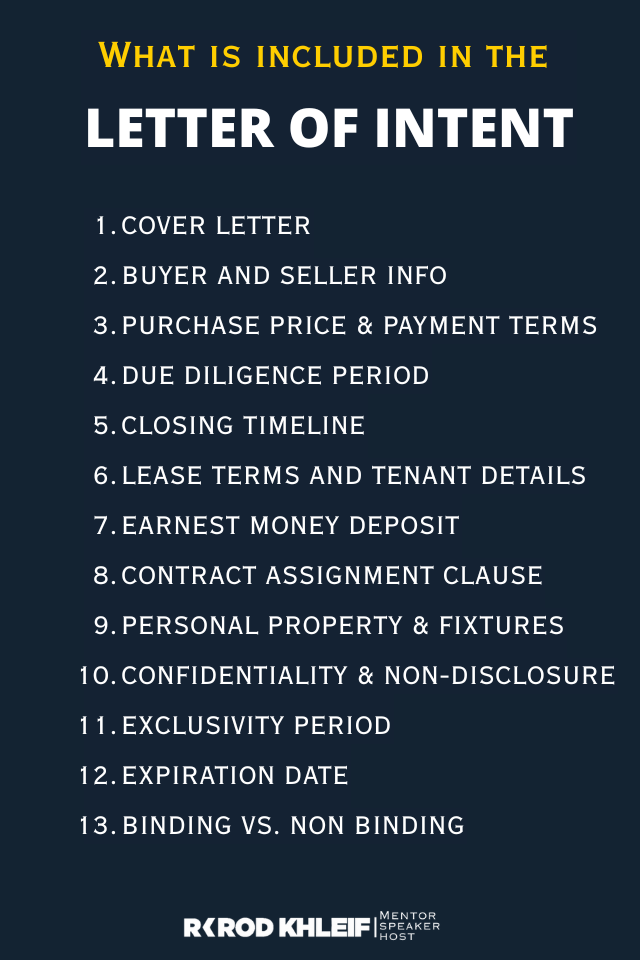
1. Property Identification
The full legal address and APN (Assessor’s Parcel Number) of the property. Don’t be vague. If there are multiple parcels, list them all.
2. Buyer and Seller Information
- Full legal names (individual or entity)
- Entity type: LLC, trust, corporation, partnership
- Contact information and legal representatives
3. Purchase Price and Payment Terms
- Total proposed purchase price
- Cash vs. financed breakdown
- Financing contingency (yes or no: be specific)
- Earnest money deposit amount and how it applies to the purchase price
- Any creative terms: seller financing, debt assumption, 1031 exchange
Rod’s tip: On multifamily deals, always state your price as a function of actuals, not pro forma. If the seller projects future rents, your LOI should state the price is based on verified current income. It should not rely on rosy projections.
4. Earnest Money Deposit (EMD)
- Amount (typically 1-3% of purchase price on commercial deals)
- When it’s deposited (commonly within 3-5 business days of LOI acceptance)
- Escrow holder and account details
- Hard vs. soft: when does it go non-refundable?
5. Due Diligence Period
This is one of the most important sections. Your due diligence period is your protection. Don’t shortchange it.
- Duration: commonly 15-45 days for multifamily, depending on property size
- Start date: upon LOI acceptance, PSA execution, or receipt of documents — specify clearly
- Access rights: to all leases, rent rolls, financials, inspection reports, utility bills, and vendor contracts
- Right to terminate: you must be able to walk away for any reason within the due diligence window
6. Closing Timeline
- Time from LOI acceptance to executed PSA (commonly 5-10 business days)
- Time from PSA execution to closing (commonly 30-60 days)
- Conditions for extensions and who pays
7. Financing Contingency
Clearly state whether this deal is contingent on financing. If you’re syndicating or using a bridge loan, say so. Sellers deserve to know how the deal is being funded, and it affects their confidence in you as a buyer.
8. Lease Terms and Tenant Details
- Summary of existing lease obligations
- Delivery of current rent rolls, estoppel certificates, and payment history
- Whether leases are assigned to the buyer or terminate at closing
9. Contract Assignment Clause
If you plan to take this deal into syndication, you need assignment rights. Specify that the LOI and later PSA can be assigned to an affiliated entity. This may be your LLC or syndication vehicle. This assignment will not require the seller’s consent.
10. Exclusivity Period
- The seller agrees not to solicit or accept other offers during this window
- Typically 14-30 days from LOI acceptance
- This is what gives you a real due diligence window without fear of being shopped
11. Confidentiality
Neither party shares deal terms, financial details, or due diligence findings with third parties (other than advisors, attorneys, and lenders). Protect yourself and the seller.
12. Expiration Date
The LOI should expire if the seller doesn’t sign within a defined window; typically 2-5 business days. This creates urgency without being aggressive.
Is a Letter of Intent Legally Binding?
This is one of the most common questions I get, and the answer matters.
Most of the LOI is non-binding. The purchase price, timeline, and intent to buy are expressions of interest, not legal obligations. Either party can walk away before the PSA is signed.
However, certain clauses in a well-drafted LOI are binding, even without a PSA:
- Confidentiality and NDA provisions
- Exclusivity / no-shop clause
- Dispute resolution and governing law
Always label your LOI clearly. Somewhere near the top, it should say: “This Letter of Intent is not binding. Only the terms on confidentiality, exclusivity, and governing law apply.” If you’re not sure, have your attorney review it.
Important: Never use a LOI to lock in a seller on terms you don’t intend to honor. I’ve seen investors use LOIs as fishing tools, submitting 10 at a time with no intention of closing. Brokers talk. Your reputation in a market is everything.
Letter of Intent vs. Purchase and Sale Agreement: What’s the Difference?
| Letter of Intent (LOI) | Purchase & Sale Agreement (PSA) | |
| Legally binding? | Mostly no (some clauses yes) | Yes; fully binding |
| Length | 1-2 pages | 10-30+ pages |
| Attorney required? | Recommended but not required | Always use an attorney |
| Cost to prepare | Low | High |
| Purpose | Start negotiations, lock due diligence window | Finalize deal terms, trigger closing |
| When used | Before formal offer | After LOI is agreed upon |
Real Estate Letter of Intent Template (Free Sample)
Below is a simplified LOI template you can adapt for your next multifamily deal. For the full version with seller-carry and creative financing clauses, download the free PDF at the end of this article.
LETTER OF INTENT TO PURCHASE REAL PROPERTY
Date: [Date]
To: [Seller Name / Entity]
Re: [Property Address, City, State, ZIP]
Dear [Seller Name],
This Letter of Intent (“LOI”) is submitted by [Buyer Name / Entity] (“Buyer”) regarding the potential acquisition of the above-referenced property (“Property”). This LOI is non-binding except as to the provisions regarding Confidentiality, Exclusivity, and Governing Law.
- PURCHASE PRICE: Buyer proposes to purchase the Property for $[Amount], subject to verification of income and expense statements during the due diligence period.
- EARNEST MONEY DEPOSIT: Buyer will deposit $[Amount] into escrow within [3] business days of mutual execution of a Purchase and Sale Agreement (PSA). The deposit shall be [fully refundable / hard after X days].
- DUE DILIGENCE: Buyer shall have [30] days from PSA execution to conduct inspections, review financials, leases, rent rolls, and all property records. Buyer may terminate for any reason during this period and receive a full refund of the deposit.
- CLOSING: Closing shall occur [30] days after expiration of the due diligence period, subject to financing and standard closing conditions.
- FINANCING: This offer is [contingent / not contingent] upon Buyer obtaining financing. Buyer intends to [describe: conventional loan / bridge loan / syndication equity].
- EXCLUSIVITY: Seller agrees not to negotiate with or accept offers from any other party for [21] days from execution of this LOI.
- CONFIDENTIALITY: Both parties agree to keep the terms of this LOI confidential.
- ASSIGNMENT: Buyer reserves the right to assign this LOI and any resulting PSA to an affiliated entity.
- EXPIRATION: This LOI expires if not countersigned by Seller by [Date, Time, Timezone].
Respectfully submitted,
[Buyer Signature]
[Printed Name]
[Entity Name]
[Phone / Email]
Acknowledged and Accepted:
[Seller Signature] _______________________ Date: __________
Download a Free Sample LOI Template
(including seller-carry and creative financing clauses)
👉 Get Your Free LOI Sample Here

5 Common LOI Mistakes That Kill Deals
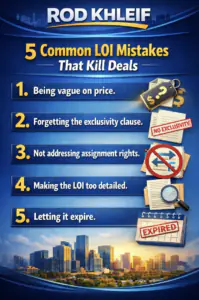
I’ve seen all of these. Don’t let them happen to you.
- Being vague on price.
If you write “$2M subject to review,” the seller has nothing to work with. Give a real number, even if it’s subject to due diligence adjustment. You can always renegotiate after inspections.
- Forgetting the exclusivity clause.
Without it, the seller can keep showing the property while you’re spending money on inspections and attorneys. Always include an exclusivity window.
- Not addressing assignment rights.
If you plan to syndicate the deal, you need to be able to assign the contract to your entity. Don’t assume — spell it out.
- Making the LOI too detailed.
An LOI that reads like a full PSA signals either inexperience or distrust. Keep it high-level. Save the detail for the contract.
- Letting it expire.
Put an expiration date on every LOI. “Subject to acceptance within 3 business days” creates urgency and gives you a clean out if the seller doesn’t respond. Open-ended LOIs create ambiguity.
LOI Tips Specific to Multifamily and Commercial Deals
A residential LOI and a multifamily LOI are not the same document. Here’s what’s different on the commercial side:
- Income verification matters. Your price should be tied to verified NOI, not broker projections. State this clearly.
- Lease review is critical. Request delivery of all leases, rent rolls, and estoppel certificates as a condition of your due diligence.
- Cap rate language helps. Some investors include the implied cap rate in the LOI (“price reflects a X% cap rate based on current NOI”). This protects you if the seller tries to renegotiate after due diligence reveals weaker income.
- Sellers are often entities. Make sure your LOI is addressed to the proper legal entity — not just an individual’s name.
- Bridge loan/syndication timelines are longer. If you’re syndicating or using a bridge lender, your closing timeline may need to be 60–90 days. Be honest about this upfront. Sellers who accept a 30-day LOI and then get a 90-day PSA feel misled.
Frequently Asked Questions
What is a letter of intent in real estate?
A letter of intent (LOI) in real estate is a short document a buyer sends to a seller. It is mostly non-binding. It outlines key proposed deal terms, price, due diligence, timeline, and financing. This happens before a formal purchase contract is drafted.
Is a real estate letter of intent legally binding?
Most LOIs are non-binding, meaning either party can walk away before a PSA is signed. However, specific clauses, confidentiality, exclusivity, and governing law are typically binding even in a non-binding LOI. Always label your LOI clearly.
What should be included in a real estate LOI?
A strong LOI includes the property details and purchase price. It also includes earnest money terms and the due diligence period. It covers due diligence rights and the closing timeline. It includes a financing contingency and an exclusivity clause. It also includes assignment rights and an expiration date.
What is the difference between an LOI and a purchase agreement?
An LOI is a short, mostly non-binding outline of deal terms used to begin negotiations. A Purchase and Sale Agreement (PSA) is a detailed, legally binding contract. The LOI comes first; the PSA follows once both parties agree on the key terms.
Who writes the LOI in a real estate transaction?
Typically the buyer or the buyer’s broker writes the initial LOI. For commercial and multifamily deals, having a real estate attorney review or draft the LOI is strongly recommended.
How long should a letter of intent be?
For most commercial and multifamily real estate deals, an LOI should be 1–2 pages. Long enough to cover the key terms clearly; short enough to not feel like a contract.
Can you back out of a letter of intent?
Yes. A non-binding LOI allows either party to walk away before a PSA is executed. Only the binding provisions (confidentiality, exclusivity) have legal force. That said, backing out of an LOI without a good reason can damage your reputation with brokers and sellers.
What is an LOI in commercial real estate?
In commercial real estate, an LOI serves the same purpose. It is a non-binding summary of proposed deal terms. It is sent before drafting a formal contract. On commercial deals like apartment buildings, LOIs often add clauses for lease reviews and rent rolls. They may also cover estoppel certificates and income checks.
Ready to Write Your First LOI?
The best LOI is the one that gets the deal moving. Don’t overthink it. Start with the template above, customize it to your deal, and get it in front of the seller.
If you want to learn the full deal acquisition process, we can help. We teach how to find properties and submit LOIs. We also teach how to raise capital and close deals. You’ll learn this in the Warrior Program and at my Multifamily Bootcamp.
- 📥 Download the free LOI template
- 📘 Download Rod’s free multifamily book
- 🏟️ Join the next Multifamily Bootcamp
- 🤝 Apply for the Warrior Program
