
In commercial real estate investing, few concepts matter more for long-term success than Capital Expenditure, or CapEx. Whether you manage a small multifamily property or a large commercial portfolio, CapEx is key. It helps maintain property value, stay competitive, and deliver strong investor returns. Yet despite its importance, CapEx is often misunderstood, underbudgeted, or improperly planned, leading to deferred maintenance crises, tenant dissatisfaction, and diminished property values.
This comprehensive guide explores everything you need to know about CapEx: what it is, how it differs from operating expenses, why proper budgeting is essential, and how to implement a strategic CapEx plan that protects and enhances your real estate investments.
What Is Capital Expenditure (CapEx)?
Capital Expenditure refers to funds spent on significant property improvements that either extend the useful life of the property or its major components, or add substantial value to the asset. Unlike routine operating expenses that maintain day-to-day functionality, CapEx investments represent substantial improvements that will benefit the property for years to come.
Common examples of CapEx include:
- Roof replacement or major roof repairs
- HVAC system replacement or major upgrades
- Parking lot resurfacing or replacement
- Major plumbing or electrical system overhauls
- Elevator replacements or modernization
- Unit renovations (kitchens, bathrooms, flooring)
- Common area upgrades (lobbies, fitness centers, amenities)
- Window replacement programs
- Foundation repairs or structural improvements
- Building envelope work (siding, exterior walls)
The defining characteristic of CapEx is that these improvements provide benefits extending well beyond the current fiscal year. A new roof might last 20-30 years, a HVAC system 15-20 years, and renovated units can command premium rents for many years. This long-term benefit is what distinguishes CapEx from operating expenses.
CapEx vs. Operating Expenses: Understanding the Critical Difference
One of the most important distinctions in property accounting is the difference between Capital Expenditures and Operating Expenses (OpEx). This distinction matters enormously for tax purposes, financial reporting, property valuation, and investment analysis.
Operating Expenses (OpEx)
Operating expenses are the day-to-day costs of running a property. These are recurring expenses that maintain the property in its current condition without significantly extending its useful life or adding value. OpEx items are fully deductible in the year they occur and include:
- Property management fees
- Routine repairs and maintenance
- Utilities (water, electric, gas)
- Property taxes
- Insurance premiums
- Landscaping and grounds maintenance
- Pest control
- Snow removal
- Marketing and leasing costs
Capital Expenditures (CapEx)
In contrast, CapEx represents significant improvements that provide lasting value. These expenses are capitalized on the balance sheet and depreciated over their useful life according to IRS schedules. Rather than being immediately deductible, CapEx costs are recovered through depreciation deductions over many years.
This accounting treatment has several important implications:
- Tax Impact: OpEx provides immediate tax benefits while CapEx benefits are spread over time
- Cash Flow: Large CapEx projects can significantly impact short-term cash flow even though depreciation spreads the tax benefit
- Property Value: CapEx improvements typically increase property value while OpEx does not
- NOI Calculation: Operating expenses reduce Net Operating Income (NOI) while CapEx does not, affecting property valuations
Why Proper CapEx Budgeting Is Critical
Insufficient CapEx planning is one of the most common mistakes in commercial real estate investment, often with devastating consequences. Properties that lack adequate capital reserves inevitably face a cascade of problems that compound over time.
The Deferred Maintenance Death Spiral
When CapEx is deferred, properties enter what industry professionals call the ‘deferred maintenance death spiral.’ It begins innocently enough—perhaps postponing a roof replacement for another year or delaying HVAC upgrades. However, deferred maintenance rarely stays deferred; it typically escalates into more expensive emergencies.
A roof that needed replacement at $200,000 eventually fails, requiring emergency repairs plus interior damage remediation, potentially costing $350,000 or more. An aging HVAC system that could have been systematically replaced breaks down during peak summer, requiring emergency replacement at premium pricing while angry tenants withhold rent or break leases.
Competitive Positioning
Properties compete in their local markets based on condition, amenities, and perceived value. Adequate CapEx investment ensures your property remains competitive. When comparable properties undergo renovations—updated units, modern amenities, fresh common areas—properties that defer CapEx fall behind in tenant appeal and rental rates.
This competitive disadvantage manifests in multiple ways: higher vacancy rates, lower achievable rents, longer time-to-lease, lower quality tenants, and increased concessions needed to attract tenants. The cumulative effect on property income and value can be substantial.
Investor Confidence and Exit Strategy
For syndicated deals and institutional investments, demonstrating proper CapEx planning is essential for investor confidence. Limited partners want assurance that their capital is being protected through appropriate reserves and strategic improvements. Properties with well-maintained CapEx programs command higher valuations at sale, while properties with obvious deferred maintenance face buyer scrutiny, lower offers, and difficulty securing financing.
Creating an Effective CapEx Budget
Developing a comprehensive CapEx budget requires both immediate assessment and long-term planning. The process begins with a thorough property condition assessment, typically conducted by specialized engineering firms who evaluate every major building system and component.
The Property Condition Assessment
A professional Property Condition Assessment (PCA) evaluates the current condition and remaining useful life of all major building components. This assessment generates a detailed report estimating when each component will need replacement and the projected cost, creating a capital needs roadmap for the next 12-20 years.
Immediate vs. Long-Term Needs
Effective CapEx budgeting separates immediate needs from long-term reserves. Immediate CapEx addresses critical issues requiring attention within 12 months—safety concerns, code violations, or systems at imminent failure. Long-term reserves fund predictable future replacements based on remaining useful life.
Industry standards suggest annual CapEx reserves of $250-$500 per unit for multifamily properties, though this varies dramatically based on property age, condition, and local market factors. Older properties or those in harsh climates typically require reserves at the higher end of this range or beyond.
Value-Add vs. Replacement CapEx
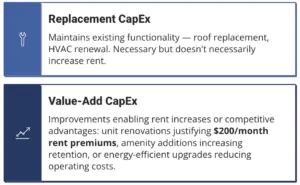
Strategic CapEx budgets distinguish between replacement CapEx (maintaining existing functionality) and value-add CapEx (improving property income or competitiveness). Replacement CapEx includes items like roof replacement or HVAC system renewal—necessary expenses that maintain property condition but don’t necessarily increase rent.
Value-add CapEx targets improvements that enable rent increases or competitive advantages: unit renovations that justify $200/month rent premiums, amenity additions that increase tenant retention, or energy-efficient upgrades that reduce operating costs while appealing to environmentally conscious tenants.
CapEx and Property Valuation
Understanding CapEx’s relationship to property value is crucial for investors. Commercial real estate is typically valued using the income approach, where property value equals Net Operating Income (NOI) divided by the capitalization rate. Since CapEx doesn’t reduce NOI, some investors mistakenly assume it doesn’t affect value.
However, sophisticated buyers and lenders carefully scrutinize CapEx needs. Properties with significant deferred maintenance face value reductions as buyers discount the price by estimated catch-up CapEx costs plus a premium for risk and hassle. A property needing $2 million in deferred CapEx might see its value reduced by $2.5-3 million to account for buyer risk and opportunity cost.
Conversely, properties with well-maintained building systems, recent strategic CapEx investments, and adequate reserves command premium valuations. Buyers pay more for properties requiring less immediate capital investment and reduced near-term risk.
Best Practices for CapEx Management
Successful property operators implement systematic approaches to CapEx planning and execution:
- Maintain detailed asset registers: Track installation dates, expected lifespans, and replacement costs for all major building components
- Conduct annual property inspections: Regular professional assessments identify emerging issues before they become emergencies
- Update CapEx plans annually: Revise budgets based on actual conditions, market changes, and completed projects
- Separate CapEx reserves: Maintain dedicated reserve accounts preventing raids on CapEx funds for operating shortfalls
- Prioritize preventive maintenance: Aggressive preventive maintenance extends component life and reduces CapEx needs
- Document everything: Maintain comprehensive records of all CapEx projects, costs, and warranties
- Obtain multiple bids: Competitive bidding ensures fair pricing and reveals market rates for major projects
- Consider lifecycle costs: Sometimes higher upfront CapEx (premium materials, better systems) reduces long-term costs
Frequently Asked Questions About CapEx
Q: How much should I budget for CapEx annually?
A: Industry guidelines suggest $250-$500 per unit annually for multifamily properties, but this varies significantly based on property age, condition, location, and construction quality. Properties built in the 1960s-1970s often require higher reserves due to building system age and less durable construction methods. Properties in harsh climates (extreme heat, cold, or coastal areas) typically need higher reserves. A professional Property Condition Assessment provides the most accurate estimate for your specific property.
Q: What happens if I run out of CapEx reserves?
A: Insufficient CapEx reserves create several problems. You may need to defer necessary improvements, risking property deterioration and competitive position. Emergency situations may require expensive short-term financing or capital calls from investors. In extreme cases, insufficient reserves can trigger loan covenant violations if lenders require minimum reserve levels. The best approach is maintaining adequate reserves and treating CapEx funding as non-negotiable rather than discretionary.
Q: Can I reduce operating expenses by increasing CapEx?
A: Yes, strategic CapEx investments often reduce operating expenses. Energy-efficient HVAC systems, LED lighting conversions, low-flow plumbing fixtures, and improved insulation all require upfront CapEx but reduce ongoing utility costs. Water-efficient landscaping requires CapEx for installation but reduces water bills. High-efficiency appliances cost more initially but reduce utility costs in master-metered buildings. When evaluating such projects, calculate the payback period and return on investment to ensure the CapEx makes economic sense.
Q: How do lenders view CapEx in loan underwriting?
A: Commercial real estate lenders scrutinize CapEx carefully during loan underwriting. Most lenders require borrowers to escrow monthly CapEx reserves, typically $250-$300+ per unit, held in lender-controlled accounts. Lenders review Property Condition Assessments to identify immediate or short-term CapEx needs, which may be required as conditions of loan approval. Properties with significant deferred maintenance may receive lower loan-to-value ratios or higher interest rates. Demonstrating adequate CapEx planning and reserves generally improves loan terms.
Q: Should I always choose the cheapest CapEx option?
A: No. Effective CapEx decision-making considers lifecycle costs, not just initial price. A $50,000 roof might last 15 years while a $75,000 roof lasts 25 years—the premium option costs less per year of useful life. Similarly, commercial-grade building systems typically cost more initially but require less maintenance and last longer than residential-grade equivalents. Consider factors beyond price: warranty coverage, energy efficiency, maintenance requirements, and tenant impact. The lowest initial cost often leads to higher total cost of ownership.
Q: How does CapEx differ for different property types?
A: CapEx priorities and amounts vary significantly by property type. Multifamily properties focus heavily on unit turnover CapEx (flooring, appliances, countertops), building systems (HVAC, plumbing, roofing), and amenities. Office buildings emphasize mechanical systems, elevator maintenance, parking facilities, and periodic common area refreshes. Retail properties prioritize parking lot maintenance, storefront improvements, and signage. Industrial properties focus on roof maintenance, HVAC systems, and loading dock infrastructure. Each property type has unique CapEx considerations based on tenant expectations and building use.
Q: What is a capital needs assessment and when should I get one?
A: A capital needs assessment (also called Property Condition Assessment or PCA) is a comprehensive professional evaluation of all major building systems and components, estimating remaining useful life and replacement costs. You should obtain a PCA when acquiring a property (due diligence), when securing or refinancing a loan (lender requirement), every 3-5 years for long-term holdings (planning updates), or when considering major renovations (strategic planning). These assessments typically cost $2,000-10,000 depending on property size and complexity, but provide invaluable planning information that far exceeds their cost.
Q: Can I defer CapEx if cash flow is tight?
A: While technically possible, deferring CapEx is highly risky and almost always more expensive long-term. Deferred maintenance compounds—a $20,000 repair deferred becomes a $50,000 emergency. Properties with deferred CapEx face competitive disadvantages, higher vacancy, lower rents, and tenant dissatisfaction. If cash flow is genuinely insufficient to fund necessary CapEx, this signals deeper problems requiring immediate attention: revenue enhancement strategies, expense reduction initiatives, or consideration of sale. Chronic inability to fund CapEx indicates a property that may be underwater or inappropriately financed.
Q: How do I prioritize multiple CapEx needs with limited funds?
A: Prioritize CapEx projects using this framework: First, address life-safety issues and code violations (no exceptions). Second, complete repairs preventing further property damage (roof leaks, water intrusion, structural issues). Third, invest in systems at imminent failure risk. Fourth, focus on projects with strong ROI through rent increases or expense reduction. Fifth, address competitive positioning and amenity improvements. Maintain a written multi-year CapEx plan showing priority rankings, estimated costs, and planned timing, updated annually as circumstances change.
Conclusion: CapEx as Strategic Investment
Capital Expenditure represents far more than necessary maintenance costs—it is strategic investment in your property’s future competitiveness, value, and income-generating potential. Properties with well-planned, adequately funded CapEx programs outperform competitors, command premium valuations, attract quality tenants, and deliver superior returns to investors.
The most successful real estate investors recognize that CapEx planning is not optional but fundamental to property investment strategy. By understanding the distinction between CapEx and operating expenses, implementing comprehensive budgeting and reserve programs, and maintaining detailed long-term capital plans, property owners protect their investments while positioning their assets for maximum performance.
Whether you are acquiring your first property or managing a sophisticated portfolio, treating CapEx as the strategic investment it is—rather than a discretionary expense to be minimized—will serve as the foundation for long-term real estate success. The properties that thrive over decades are those whose owners recognized that proper CapEx planning and execution is not a cost center, but a value driver that separates exceptional properties from mediocre ones.
