
Every investor I coach hits the same wall. They learn to underwrite, they get their financing lined up, they build the team, and then they sit there with nothing to underwrite. Deal flow is the constraint, and it is the part nobody teaches because it is unglamorous and it is mostly rejection.
I have bought and sold over 2,000 units, and almost none of them came off a public listing. Here are the ten channels that actually produce, ranked roughly from lowest effort to highest, along with what to say when you get someone on the phone.
Table of Contents
- The Short Answer
- The Deal Flow Ladder
- The 10 Ways to Find Multifamily Deals
- Where the Deals Actually Come From
- Waiting on Listings vs Going Direct
- What to Actually Say
- Why Most Investors Have No Deal Flow
- How to Find Multifamily Deals FAQ
- Ready to Take the Next Step?
The Short Answer
To find multifamily deals, work two channels consistently rather than ten occasionally. The highest yielding are broker relationships that mature into pocket listings, direct outreach to owners through mail and for rent ads, stale listings that have sat past their marketing window, and bank owned inventory. Public listing sites are where you learn the market, not where you find your edge, because every other buyer sees the same page you do.
The uncomfortable truth is that deal flow is a volume game with a long lag. The mailer you send in March produces a call in September. The broker who ignored you for six months sends you something the week after you finally stopped chasing. Investors who quit at week three conclude the channel does not work, when what actually happened is they left before the lag played out.
Is Your Deal Flow Actually Broken?
Run this before you add another channel. If three or more describe you, the problem is not the channel mix.
- You look at listing sites daily but have not contacted an owner directly in the last month.
- You cannot name five brokers in your target market who would recognise your name.
- You have never followed up with an owner who said no.
- Your buying criteria is broad enough that a broker could not screen for it in one sentence.
- You have sent one mailer and concluded direct mail does not work.
- You have no system for tracking who you contacted and when to contact them again.
- You analyse fewer than five properties a month.
That last one is the tell. Deal flow and analysis capacity are the same muscle. If you are not analysing regularly you will not recognise a good deal fast enough to act on it, and the ones worth having move quickly. The mechanics of getting fast at that are in the complete guide to underwriting a multifamily deal.
The Deal Flow Ladder
I think about sourcing as a ladder. The lower rungs are easy to access and crowded with competition. The higher rungs take real work, which is precisely why fewer people are standing there.

Most investors never leave the bottom rung. They refresh LoopNet, they wait for broker blasts, and they wonder why every deal they see is priced for a buyer with a lower return threshold than theirs. The deals worth having are found by people willing to do the parts that do not scale.
The 10 Ways to Find Multifamily Deals
1. Build Real Relationships With Brokers
This is the highest yielding channel in the business and the one most investors do badly. Brokers do not send their best inventory to the biggest email list. They send it to the two or three buyers they believe will actually close.
Becoming one of those buyers takes a specific kind of behaviour. Give a one sentence buy box that a broker can screen against without thinking: unit count, market, class, and price range. Respond to everything they send, including the deals you reject, and tell them why you rejected it so they calibrate. Never retrade without a genuine discovery in due diligence, because that reputation travels faster than any other in this industry.
2. Get Into Pocket Listings
Pocket listings are properties a broker knows are for sale but has not marketed. Sellers want discretion, or the broker wants a quiet transaction with a buyer who will not waste the seller’s time.
You do not ask for pocket listings. You earn them by being the buyer from item one for six to twelve months. When a broker finally says “I have something that is not on the market yet,” that is the entire payoff for every unglamorous follow up call you made.
3. Work the Listing Sites Properly
LoopNet, Crexi and the rest are worth your time for a reason most investors miss. They are not where you find your edge, because everyone sees them. They are how you learn what your market is actually trading at, so that when a broker sends you something off market you can price it in ten minutes instead of ten days.
Use them to build market knowledge and to identify owners. A listing tells you who is selling. An expired listing tells you who wanted to sell and could not.
4. Chase Stale and Expired Listings
A property that has sat on the market for six months has a motivated seller and no competition. Something is wrong with it: the price, the story, the condition, or the broker. Sometimes what is wrong is fixable and mispriced, which is exactly the situation you want.
Filter for days on market and call on everything past 120 days. Ask the broker directly what feedback they have had from other buyers. They will usually tell you, because at that point they want the listing gone.
5. Mine Craigslist and Rental Listings
Owners advertising units for rent are telling you something useful: they are operating the property themselves, and they are dealing with vacancy right now. Both correlate with willingness to hear an offer.
Look for the same phone number across multiple listings. That is a small portfolio owner, and small portfolio owners are the single most approachable seller type in this business.
6. Call For Rent Ads and Ask the Real Question
This is the cheapest channel that works and almost nobody does it, because it involves a phone call with a stranger. Call about the unit, ask a couple of genuine questions about it, then ask whether they have ever considered selling the building.
Most say no. Some say not right now, which is the answer you are actually farming for, because “not right now” is a lead with a date on it. Write it down and call back in six months.
7. Send Direct Mail, Then Send It Again
Direct mail works and it works slowly. Response rates on a first touch are low enough that a single mailer tells you nothing. The compounding happens on touches four through eight, when your name has become familiar rather than intrusive.
Pull an owner list by property type and unit count in your target submarket, then commit to mailing the same list quarterly for at least a year. Investors who treat direct mail as a campaign fail. Investors who treat it as a subscription succeed.
8. Follow Up With Everyone Who Said No
This is not really a channel. It is the multiplier on every other channel, and it is where most deal flow is actually lost.
An owner who says no today is telling you about today. Circumstances change: partnerships dissolve, a capital call arrives, a property manager quits, someone turns 70 and wants out. The investor who called every six months for three years gets that deal without competition. Keep a simple database with a next contact date on every owner you have ever spoken to.
9. Contact Banks and Special Servicers About REO
Bank owned inventory is unglamorous and often genuinely distressed, but it comes with a motivated institutional seller who has no emotional attachment and a regulatory reason to move the asset.
Build relationships with the special assets departments at regional and community banks rather than national institutions, where the process is more automated and more competitive. For loans that were securitised, the special servicer controls the outcome and is worth knowing.
10. Work With Wholesalers and Birddogs
Wholesalers put properties under contract and assign the contract for a fee. The quality varies enormously and you will see a lot of junk, so treat the relationship as a filter you train over time rather than a firehose you accept.
Be explicit about your buy box, close quickly when something fits, and pay what you agreed. Wholesalers talk to each other, and a reputation for closing gets you first look at the next one.
Where the Deals Actually Come From
Grouping those ten by effort makes the tradeoff obvious. Effort and competition move in opposite directions, which is the entire reason the harder channels are worth working.
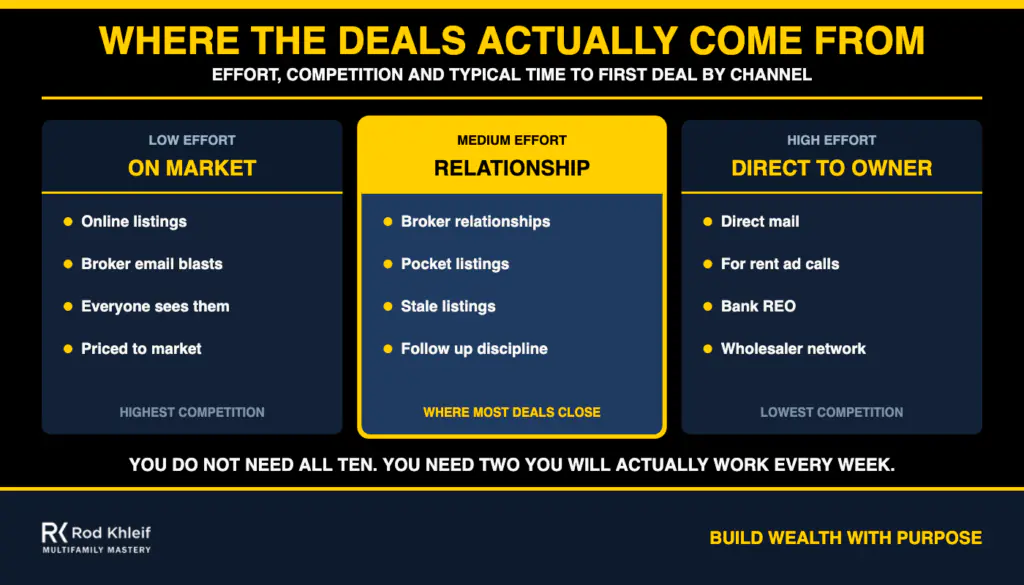
If you are starting from nothing, pick one relationship channel and one direct channel. Brokers plus direct mail is the combination I would choose, because the first builds a pipeline that compounds and the second gives you something to do on the weeks the pipeline is quiet.
Waiting on Listings vs Going Direct
What to Actually Say
The reason most people avoid the direct channels is not strategy. It is that they do not know what to say when someone picks up. Here is roughly how I handle each.
Calling a for rent ad. Ask about the unit like a normal prospective tenant, because you genuinely want to know the rent, the condition, and how long it has been vacant. Then: “I should be upfront, I am actually an investor who buys apartment buildings in this area. Have you ever thought about selling this one?” Most say no. Thank them, ask if you can check back in six months, and write the date down.
Calling a broker for the first time. Do not ask what they have available, because that marks you as one of a hundred. Instead give them your buy box in one sentence and ask what they are seeing in that range. You are trying to become a screening filter in their head, not extract a listing on the first call.
Calling about a stale listing. “I noticed this has been on the market a while. What feedback have you had from buyers who passed?” Brokers answer this honestly more often than you would expect, and the answer tells you whether the problem is fixable.
Following up on a no. “You mentioned last spring that selling was not on the cards. I am still buying in the area, so I wanted to check whether anything has changed.” No pitch, no pressure. You are simply the person who was still there.
None of this requires being a natural salesperson. It requires being willing to make the call and being organised enough to make it again later. If terminology in these conversations is unfamiliar, the multifamily glossary covers it, and if you are new to the asset class entirely, start with the complete beginner’s guide to multifamily investing.
Why Most Investors Have No Deal Flow
- They work ten channels badly instead of two well. Every channel here compounds, and compounding requires you to still be doing it in month six.
- Their buy box is too vague to be useful. “Anything that cash flows” cannot be screened against. Give a unit count, a market, and a price range.
- They treat a no as final. The follow up is the business. Everything else is prospecting for follow ups.
- They cannot analyse fast enough to act. Off market deals come with a short window. If underwriting takes you two weeks, you will lose every one of them.
- They have no system. A spreadsheet with owner, date contacted, response, and next contact date beats any software you will not maintain.
- They wait to feel ready. Nobody feels ready to cold call a stranger about their building. You do it badly for a month and then you are fine.
Rod Khleif: “Deal flow is not something you find. It is something you build, and it takes about six months longer than you want it to. The people who win are just the ones who were still making calls when everyone else stopped.”
Getting fast at analysis is the other half of this. Once the calls produce something, you have days rather than weeks to decide, and that is a learnable skill. The structured version of it, with a real model and people to check your work, is what the multifamily investment training is built around. If your plan involves raising outside capital for these deals, the complete guide to multifamily syndication covers how that structure works.
The free book below covers the mistakes that cost apartment buyers the most money once a deal is actually in front of them. Click the cover to download it.

Download the free book on the mistakes most apartment buyers make →
How to Find Multifamily Deals FAQ
Q: What is the best way to find multifamily deals?
A: Broker relationships that mature into pocket listings produce the most deals for most investors, because brokers route their best inventory to buyers they trust to close. The catch is that it takes six to twelve months of consistent, useful contact before that trust exists. Pair it with one direct to owner channel so you have deal flow while the broker relationships mature.
Q: How do I find off market multifamily properties?
A: Four channels reliably produce off market deals: direct mail to owners in your target submarket, calling for rent ads to reach self managing landlords, pocket listings from brokers who know you, and bank owned inventory through special assets departments. All four require repeated contact over months rather than a single push.
Q: Does direct mail still work for finding apartment deals?
A: Yes, but not as a one off. Response on a first mailer is low enough to look like failure. The results come from touches four through eight, when your name is familiar. Pull a list by property type and unit count, mail it quarterly for at least a year, and judge it at month twelve rather than month two.
Q: How do I get brokers to send me deals?
A: Give them a buy box they can screen against in one sentence, covering unit count, market, class, and price range. Respond to everything they send including rejections, and tell them why you passed so they calibrate. Close what you put under contract and never retrade without a real due diligence finding. Reputation for closing is the entire currency.
Q: How many deals should I analyse to find one worth buying?
A: The commonly cited ratio is that you analyse a hundred, offer on ten, and close one. The exact numbers matter less than the implication: if you are analysing five properties a year you will not buy anything. Analysis volume and deal flow are the same problem, which is why getting fast at underwriting matters as much as sourcing.
Q: Is LoopNet worth using to find multifamily deals?
A: Worth using, not worth relying on. Public listing sites are where you learn what your market trades at, which is what lets you price an off market deal quickly. They are a poor source of edge because every competing buyer sees the identical listing on the identical day.
Q: How long does it take to find a first multifamily deal?
A: For most investors working consistently, six to twelve months from starting outreach to closing. The lag is the hardest part psychologically, because the work you do in month one produces results in month six, and most people quit in month three having concluded the channel does not work.
Q: Should I use a wholesaler to find apartment deals?
A: They can be a useful channel, with the caveat that quality varies enormously and you will screen a lot of unsuitable properties. Be explicit about your criteria, respond quickly when something fits, and honour what you agreed. Wholesalers route repeat business to buyers who actually close.
Q: What should I say when I call a property owner?
A: Be direct about who you are early, ask a genuine question about the property, then ask whether they have considered selling. Expect most to say no. The goal of the call is not to buy the building today, it is to find out whether they might sell eventually and to earn permission to check back.
Q: Do I need a real estate license to find multifamily deals?
A: No. You do not need a license to buy property for your own account, and none of the ten channels here require one. A license gives you MLS access and lets you collect commissions, which some investors find useful, but it also creates disclosure obligations. Most active multifamily investors operate without one.
Ready to Take the Next Step?
Deal flow rewards consistency more than cleverness. Pick two channels, work them every week for six months, and get fast enough at underwriting that you can act when something comes back.
If you want to build the underwriting speed alongside people who are actively buying, that is what the training is for.
See the multifamily investment training options →
More conversations with investors about how they actually found their deals are in the Lifetime Cash Flow podcast library, including the episode on finding multifamily deals.
Disclaimer: This article was written with the help of AI and reviewed by Rod and his team.
