
Multifamily apartments are widely considered one of the most reliable inflation hedges in real estate because their leases reset to market roughly every 12 months, the cost to replace them keeps climbing, and fixed-rate debt gets quietly repaid in cheaper dollars. Over full market cycles that combination has helped apartment owners grow income and value faster than prices rise. But 2026 is a useful reality check: a record wave of new supply has pushed rent growth below inflation in many markets, proving the hedge is structural, not automatic. This guide breaks down how the hedge actually works, where it fails, and how to underwrite so you capture it.
In this guide
Is Multifamily a Good Inflation Hedge? The Short Answer
Yes, over a full cycle. An inflation hedge is any asset whose income and value tend to rise at least as fast as the general price level, protecting your purchasing power. Multifamily does this better than most asset classes because its revenue is repriced almost continuously while a large chunk of its cost, the mortgage, is locked in.
The key word is tend. Inflation is the tailwind that can lift apartment rents and values, but it only shows up in your returns when demand outpaces new supply and when you have financed the deal so that inflation works for you instead of against you. When Washington’s 2% inflation target gives way to 4% or 6% inflation, well-structured apartment portfolios have historically been among the first real assets to catch up. The rest of this guide is about the difference between the theory and the payoff.
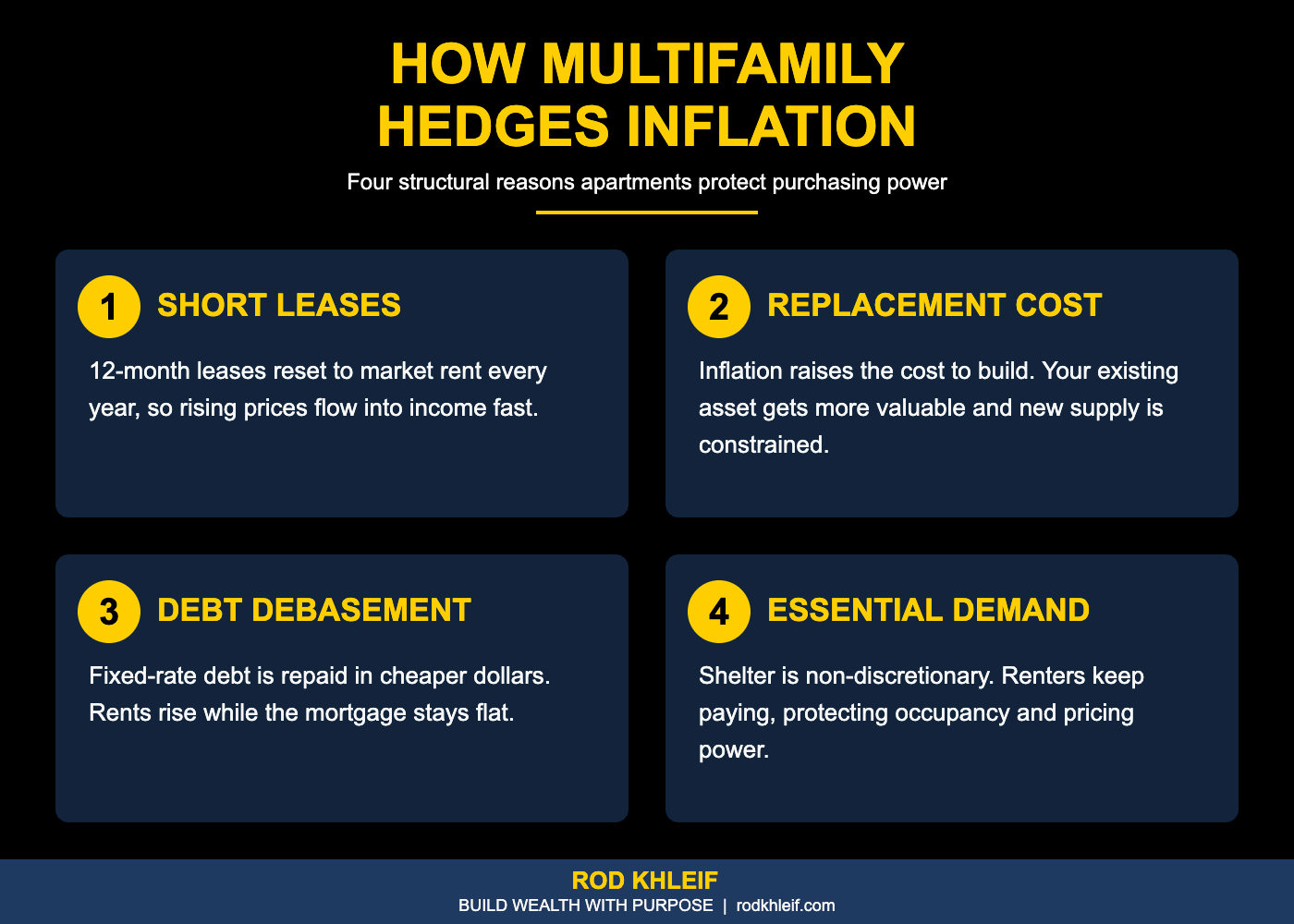
Why Multifamily Beats Inflation: The Four Mechanisms
The inflation-hedging power of apartments is not one feature. It is four reinforcing mechanisms that compound.
1. Short leases reset to market every year
This is the single biggest reason apartments hedge inflation so well. Most residential leases run just 12 months, so a landlord can reset roughly one-twelfth of the rent roll to current market rents every month. When inflation lifts wages and prices, apartment income can follow within a year.
Contrast that with an office or retail landlord who signed a tenant to a 10-year lease with fixed or modest escalations. If inflation spikes, that owner is locked into below-market rent for years. Short leases are why apartments and other short-duration property types repriced fastest during the 2021 to 2023 inflation surge.
2. Replacement cost keeps climbing
Inflation raises the price of the land, lumber, steel, concrete, and labor needed to build a competing apartment. In 2026, hard construction costs for mid-rise multifamily commonly run in the $200 to $450 per square foot range depending on the market. As that replacement cost rises, two things happen: the existing building you already own becomes more valuable relative to new construction, and fewer new deals pencil, which constrains future supply and supports rents on standing assets.
3. Fixed-rate debt gets debased
Here is the mechanism most investors underrate. If you finance an apartment with long-term, fixed-rate debt, inflation erodes the real value of that debt over time. Your rents rise with inflation, your property value rises with inflation, but your mortgage payment stays flat, and you repay the loan in progressively cheaper dollars. Inflation is effectively transferring wealth from the lender to the leveraged real asset owner. This is why prudent leverage, not zero leverage, is part of the hedge.
4. Housing is non-discretionary demand
People can delay buying a car or eating out, but they cannot stop paying for shelter. That inelastic demand means apartment operators retain more pricing power through inflationary periods than owners of discretionary-spend property types, which supports occupancy even when household budgets are squeezed.
The Historical Track Record
The inflation-hedge argument is not just theory. Since the National Council of Real Estate Investment Fiduciaries (NCREIF) began tracking private commercial real estate returns in 1978, the NCREIF Property Index has exceeded inflation in 32 of 38 years. During the last comparable inflation shock, from 1977 to 1981, private real estate delivered total annual returns of roughly 17.8% while inflation averaged about 10.7%, giving owners a meaningful real return while cash and bonds lost purchasing power.
Within commercial real estate, apartments have historically shown one of the tightest links between income and inflation of any property type, precisely because of the short-lease mechanism above. That is the empirical backbone of the phrase “multifamily is a great inflation hedge.” Past performance does not guarantee future results, but the structural reasons behind those numbers are still in place today.
The 2026 Reality Check: When the Hedge Breaks
Here is the honest part most promotional articles skip. In 2026, apartment rent growth is running below inflation across much of the country. Headline CPI was about 3.4% for the 12 months ending July 2026, yet Yardi Matrix projects national advertised asking rents will grow only around 0.5% for the full year, and Apartment List measured year-over-year rents slightly negative through mid-2026. So what happened to the hedge?
The answer is supply. The industry delivered the largest wave of new apartments in roughly four decades, and that fresh inventory is competing for renters through concessions and give-backs. When new supply outruns demand, landlords lose the pricing power that makes the reset-to-market mechanism work. Inflation is still the tailwind, but a supply headwind is currently stronger in many Sun Belt markets.
The lesson is not that multifamily stopped hedging inflation. It is that the hedge is realized only when three conditions line up:
- Demand outpaces new supply in your specific submarket, so market rents actually rise.
- Your financing is structured for inflation — fixed-rate or well-hedged, with enough runway that you never become a forced seller.
- You bought at a basis that leaves room for rents to grow into your underwriting rather than requiring aggressive growth on day one.
Miss any one of those and inflation can arrive without lifting your returns, or worse, pair with high floating-rate debt to squeeze you. Supply waves are cyclical and eventually get absorbed as new construction starts fall; the investors who underwrote conservatively are positioned to benefit when they do.
How to Actually Capture the Inflation Hedge
Turning the theory into realized returns comes down to five disciplines.
The Inflation-Resilient Multifamily Playbook
- Finance with fixed-rate or capped debt. Floating-rate debt turns rising rates into a margin call. Fixed-rate financing is what lets inflation debase your loan instead of your cash flow.
- Buy below replacement cost. If you own for less than it would cost to build the same asset today, rising construction costs work in your favor and limit competing supply.
- Underwrite supply, not just the market. Check the construction pipeline in your specific submarket. A national inflation tailwind will not save you from a local oversupply.
- Protect occupancy with essential, workforce-priced product. Class B and workforce housing hold demand better than the top of the market when budgets tighten.
- Force appreciation through operations. Value-add improvements and expense discipline raise net operating income regardless of what inflation does, and higher NOI is what drives value at any cap rate.
None of this works without disciplined numbers. If you are not sure your deal captures the hedge, walk it through a full multifamily underwriting model and stress-test it against flat rents, higher rates, and a wave of new competing units.
Multifamily vs. Other Inflation Hedges
No single asset is a perfect hedge. Here is how apartments stack up against the alternatives investors most often compare them to.
| Asset | Inflation-hedge strength | Key limitation |
|---|---|---|
| Multifamily apartments | Strong: income resets yearly, replacement cost rises, fixed debt debases | Local oversupply and floating-rate debt can break the hedge short term |
| Long-lease commercial (office, retail) | Weaker: rents locked for years unless leases have CPI escalators | Below-market rents during inflation spikes; sector-specific demand risk |
| Gold / commodities | Moderate: often rises with inflation fear | Produces no income and no cash flow; purely price speculation |
| Stocks (broad equities) | Mixed: pricing power varies by company | High inflation often compresses valuations near term; volatile |
| Cash / long bonds | Poor: fixed nominal value | Inflation directly erodes real value; guaranteed loss of purchasing power |
The through-line: apartments hedge inflation because they combine a real, essential, income-producing asset with the ability to reprice that income quickly and to finance it with debt that inflation erodes. Few other asset classes offer all three at once. For a wider look at how Fed policy and inflation move property values, see our breakdown of the 2% inflation target and what it means for real estate and how the Fed funds rate relates to cap rates.
Frequently Asked Questions
Is real estate really a good hedge against inflation?
Historically, yes. Private real estate has beaten inflation in the large majority of years since 1978, and apartments in particular tend to track inflation closely because their leases reprice annually. The caveat is that the hedge is realized over full cycles and depends on supply, demand, and how the deal is financed, not on inflation alone.
Why do short leases make apartments a better inflation hedge than office buildings?
A 12-month apartment lease can be reset to current market rent every year, so rising prices flow into income quickly. An office landlord locked into a 10-year lease with fixed escalations cannot raise rent to match a sudden inflation spike, so its income lags for years.
If multifamily is such a good hedge, why are rents falling in 2026?
Because a historic wave of new apartment supply is competing for renters faster than demand can absorb it, which temporarily overwhelms the inflation tailwind. This is a supply cycle, not a failure of the hedge. As new construction starts slow and supply is absorbed, the reset-to-market mechanism is expected to reassert itself.
Does using a mortgage make the inflation hedge stronger?
Prudent, fixed-rate leverage strengthens the hedge because inflation erodes the real value of the loan while your rents and property value rise. Floating-rate leverage does the opposite, exposing you to rising payments, so the type of debt matters as much as the amount.
What is the biggest mistake investors make when relying on inflation?
Assuming inflation alone will bail out an aggressive purchase. Overpaying, using floating-rate debt, or ignoring the local construction pipeline can wipe out the hedge. The protection comes from buying below replacement cost, financing conservatively, and underwriting for supply.
Position Your Portfolio for the Next Inflation Cycle
Inflation will keep testing every asset class, and multifamily remains one of the few that can grow income, appreciate, and quietly shrink its debt at the same time, when it is bought and financed correctly. If you want to learn the underwriting and financing discipline that turns the inflation hedge from theory into cash flow, start with our complete beginner’s guide to multifamily investing or explore the Multifamily Boardroom and coaching programs to go deeper with a community of active investors.
This article is for educational purposes only and is not investment, tax, or financial advice. Real estate investments carry risk, including loss of principal. Market data referenced reflects conditions as of 2026 and will change. Consult qualified professionals before making investment decisions.
