
The 2 percent inflation target shows up in every headline about the economy, and most investors assume it came from some deep mathematical model. It did not. It started as a fairly arbitrary choice in New Zealand in the late 1980s and spread around the world. That history is a fun story, but here is what actually matters if you own or buy real estate: that single number quietly sets your interest rates, your cap rates, and the return on every deal you touch. This guide covers where the target came from and, far more important, what it means for you as an investor.
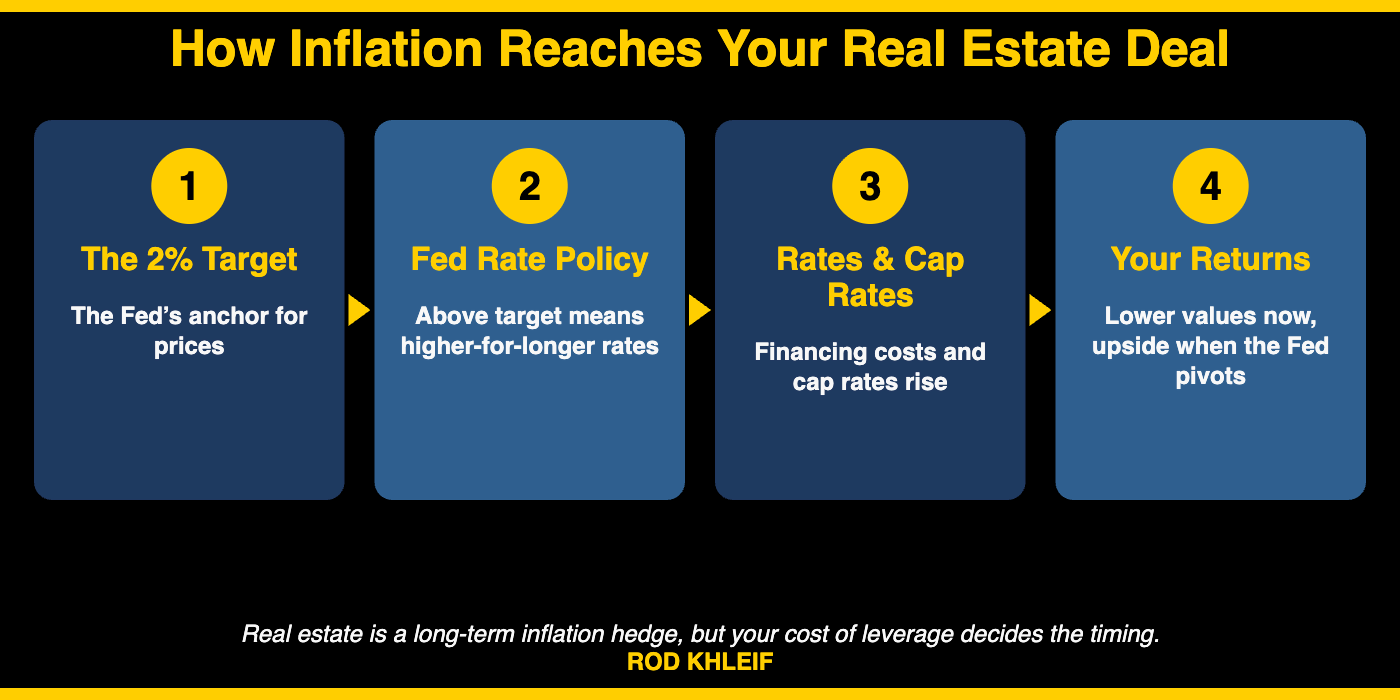
The 2 percent inflation target is the number the Federal Reserve tries to hit, and it drives the interest rate decisions that flow straight into real estate. When inflation runs above 2 percent, the Fed tends to hold rates higher for longer, which raises borrowing costs and pushes cap rates up and values down. When inflation returns to target, rates fall and the pressure reverses. Real estate is a long-term hedge against inflation, but your cost of leverage decides the timing.
What is in this guide
- Where the 2 percent target actually came from
- Why the 2 percent target matters to real estate investors
- Where things stand in 2026
- How the target flows into rates and cap rates
- Is real estate a good inflation hedge?
- The Inflation Playbook: how to position
- Frequently asked questions
- Ready to take the next step?
Where the 2 percent target actually came from
The number was not handed down by supercomputers or economic theory. New Zealand pioneered formal inflation targeting with a 1989 central bank law designed to lock in the bank’s independence. The law was strict enough that missing the target could be grounds to remove the head of the central bank, and a target near 2 percent became the anchor, chosen because it felt about right rather than because a model produced it.
The idea spread fast. In the United States, Alan Greenspan leaned toward something closer to zero to 1 percent, while Janet Yellen argued for a higher number, warning that entering a recession with very low inflation risks tipping into outright deflation. The U.S. target drifted up through the 2000s, and after the 2008 financial crisis Ben Bernanke formally adopted 2 percent in 2012, where it has stayed ever since. If you enjoy the full history, the Federal Reserve Bank of Atlanta lays out the origins in detail.
Why the 2 percent target matters to real estate investors
Here is why this is not just trivia. The Federal Reserve adjusts short-term interest rates to steer inflation toward that 2 percent goal. Those rate moves set the tone for the entire debt market, including the loans that fund apartment buildings, retail centers, and warehouses. So a number chosen in Wellington in 1989 is, in a very real sense, baked into your mortgage.
Once you see that chain, Fed headlines stop being background noise and become a leading indicator for your financing costs and your property values. The direction of the target versus actual inflation tells you which way rates are likely to lean, and rates are the single biggest outside force on real estate returns. We break the mechanics down further in our guide on the Fed rate versus cap rates.
Where things stand in 2026
As of 2026, the Federal Reserve is holding its policy rate in a range of about 3.50 to 3.75 percent and has kept it there for much of the year. Inflation is still running above target. Core PCE, the Fed’s preferred measure, has been forecast near 3.3 percent for 2026 before gradually easing back toward 2 percent over the following couple of years, partly on higher global energy prices. The Fed has reaffirmed its commitment to the 2 percent objective and is running a broad review of how it makes and communicates its decisions.
The practical read for investors is simple. This is a higher-for-longer environment, and you should not underwrite deals on the assumption that big rate cuts are right around the corner. Plan for today’s rates, and treat any future cuts as upside rather than as the thing that makes your deal work. The Fed publishes its current stance directly in its FOMC statements.
How the target flows into rates and cap rates
Walk the chain one link at a time. The Fed’s short-term rate influences the cost of the debt you borrow and the yields investors demand elsewhere. When rates are high, your borrowing cost rises, and buyers require higher cap rates to make a deal pencil, which pushes property values down. That is exactly why cap rates drifted up across most asset classes as rates climbed.
The flip side is where the opportunity hides. When inflation eventually settles back toward 2 percent and the Fed cuts rates, borrowing gets cheaper and cap rates tend to compress, which lifts values. Investors who bought and financed sensibly during the high-rate stretch are the ones positioned to benefit when the cycle turns. If you want to sharpen this skill, start with what counts as a good cap rate for multifamily, and remember that a cap rate only means something next to your net operating income and your cost of capital.
Is real estate a good inflation hedge?
Real estate is one of the classic hedges against inflation. It is a hard asset, replacement costs rise as prices rise, and rents tend to climb over time, which lifts both your income and your value. Multifamily is especially responsive because leases are short, so owners can reprice to the market quickly instead of being locked into a decade-long rate.
The catch is leverage. Inflation helps the asset, but the Fed’s response to inflation, which is higher interest rates, raises your financing cost and can hurt in the short run, especially on floating-rate debt. So real estate hedges inflation over a full cycle, but only if you finance it in a way that survives the high-rate part of that cycle. That single idea separates investors who use inflation to build wealth from the ones who get caught by it.
The Inflation Playbook: how to position
You cannot set the target or move the Fed, but you can decide how you buy and how you finance. Here is the Inflation Playbook I teach investors, five moves that let you use inflation instead of getting run over by it.
- Underwrite to today’s rates, not to hoped-for cuts. If a deal only works when the Fed cuts, it is not a deal, it is a bet on the Fed.
- Favor assets with pricing power. Short-lease assets like multifamily reprice with inflation quickly, while a long single-tenant lease can leave you stuck below market for years.
- Control your debt. Lock fixed-rate financing where you can, and buy a rate cap on floating-rate loans so a spike in rates cannot force a distressed sale.
- Protect NOI through operations. When rate cuts are not coming to rescue the deal, expense control and added income sources are what carry it.
- Keep dry powder for the pivot. Some of the best buying happens late in a high-rate cycle, right before the Fed turns. Be ready with capital and relationships.
Rod Khleif: “You cannot control the Fed, and you cannot control inflation. What you can control is how you buy and how you finance. Underwrite to the world as it is, not the one you are hoping for, and inflation becomes a tailwind instead of the thing that sinks you.”
Frequently asked questions
Where did the 2 percent inflation target come from?
New Zealand pioneered formal inflation targeting with a 1989 central bank law, and a target near 2 percent became the anchor because it felt about right rather than because a model produced it. The idea spread worldwide, and the U.S. Federal Reserve formally adopted 2 percent in 2012.
Why does the Fed target 2 percent inflation instead of zero?
A small, steady amount of inflation gives the economy a cushion. Aiming for zero risks tipping into deflation during a downturn, which is hard to escape, so 2 percent is treated as low enough to keep prices stable while leaving room to cut rates in a recession.
How does the 2 percent inflation target affect real estate?
The Fed raises or lowers interest rates to steer inflation toward 2 percent, and those rates set borrowing costs and influence cap rates. Above-target inflation tends to mean higher-for-longer rates, which raises financing costs and pushes values down, while a return to target eventually brings rate relief.
Is real estate a good hedge against inflation?
Over a full cycle, yes. Real estate is a hard asset whose replacement cost and rents tend to rise with inflation, and short-lease assets like apartments reprice fastest. The caveat is financing, because the higher rates that come with inflation can hurt in the short run, especially on floating-rate debt.
What is the Fed’s inflation target and rate in 2026?
The target remains 2 percent. As of 2026 the Fed’s policy rate sits around 3.50 to 3.75 percent, with inflation still running above target and expected to ease back toward 2 percent over the next couple of years.
Ready to take the next step?
Understanding the Fed is useful only if you turn it into better deals. New to apartments? Start with the complete beginner guide to multifamily investing, then grab the free Lifetime CashFlow ebook and join my Multifamily Bootcamp, where I teach investors how to underwrite and finance deals in any rate environment.
This article is for educational purposes only and is not financial, investment, or economic advice. Interest rates, inflation data, and Fed policy change frequently, and the figures here reflect conditions as of mid-2026. Verify current data and your own numbers with qualified professionals before investing. Sources include the Federal Reserve and the Federal Reserve Bank of Atlanta.
