
The first time I helped a newer operator raise capital, the deal was solid and the investors were ready. What almost sank it was one line on a compliance form: the wrong Regulation D exemption. Choosing between 506(b) and 506(c) is not paperwork you rush through. It decides who you can raise from, whether you can market the deal in public, and exactly what you have to prove about every investor before you take a dollar.
Quick answer: 506(b) and 506(c) are the two Regulation D exemptions that nearly every multifamily syndication uses. 506(b) lets you raise from people you already know and bars public advertising, but it can include a handful of non-accredited investors. 506(c) lets you advertise openly, but every single investor must be verified accredited. You choose based on how you plan to find your investors.
Table of Contents
- What Is Regulation D? 506(b) and 506(c) Explained
- 506(b) vs 506(c): Side by Side
- Rule 506(b): The Relationship Raise
- Rule 506(c): The Public Raise
- Which One Should You Use? The Reg D Fit Test
- Costly 506 Mistakes Syndicators Make
- How to Set Up Your Raise the Right Way
- 506(b) vs 506(c) FAQ
- Ready to Raise Capital the Right Way?
What Is Regulation D? 506(b) and 506(c) Explained
When you raise money from investors for an apartment deal, you are selling a security. That means you either register with the SEC, which is slow and expensive, or you use an exemption. Regulation D is the set of exemptions almost every private real estate syndication relies on, and Rule 506 is the workhorse inside it because there is no cap on how much you can raise.
Rule 506 splits into two lanes. 506(b) is the older, relationship-based path. 506(c), created under the JOBS Act, traded the ban on advertising for a stricter rule on who can invest. Same parent regulation, two very different sets of rules for how you build a list, talk about a deal, and close investors. Get the lane right up front and everything downstream gets easier. Get it wrong and you can blow the exemption, which puts your whole raise and your track record at risk.
If you are still early in the journey, start with the basics of how multifamily syndication works, then come back here to choose your exemption.
506(b) vs 506(c): Side by Side
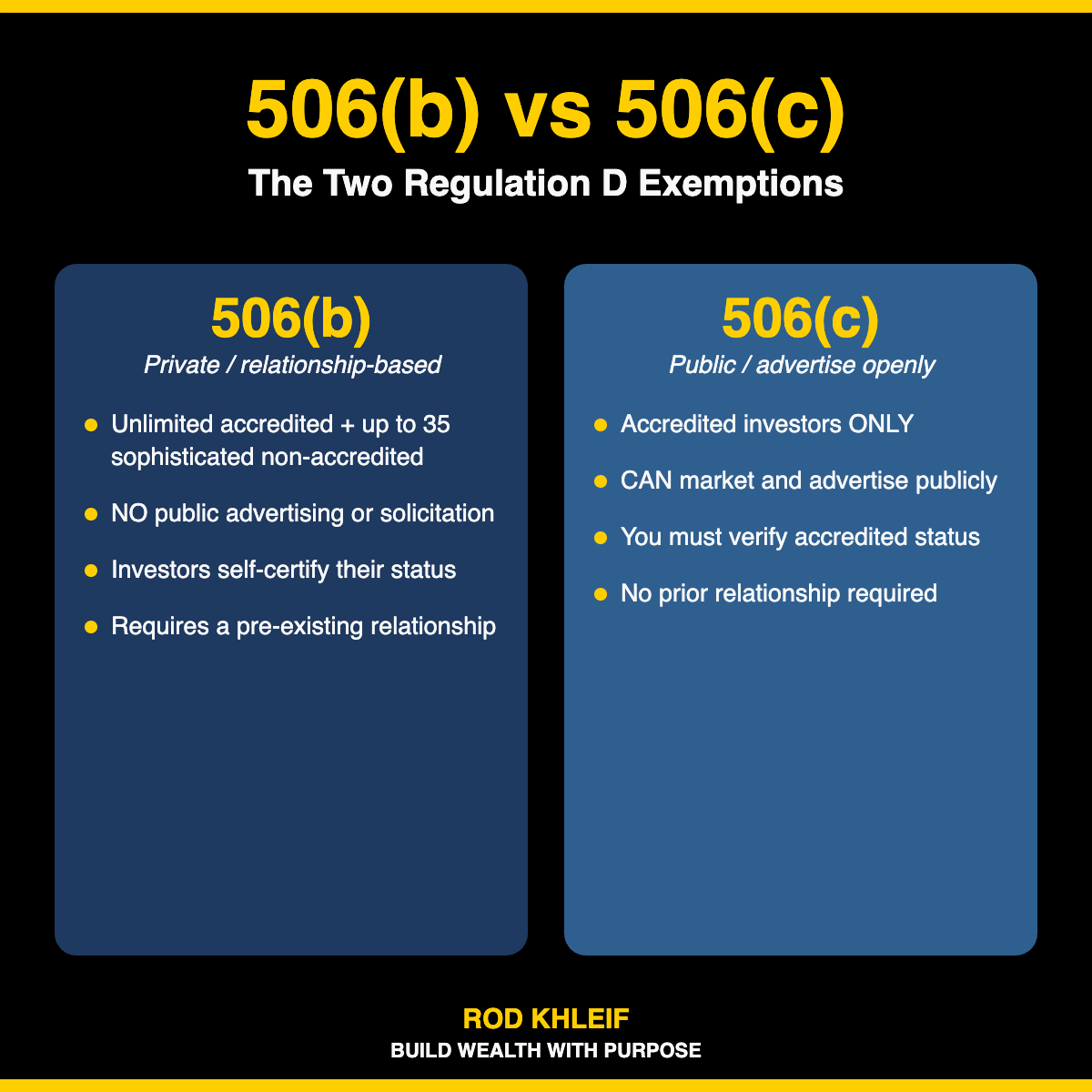
Here is the whole decision in one view. Read the infographic first, then use the table below it to confirm the details before you talk to your attorney.
| Factor | Rule 506(b) | Rule 506(c) |
|---|---|---|
| Public advertising | Not allowed | Allowed |
| Who can invest | Accredited, plus up to 35 sophisticated non-accredited | Accredited investors only |
| Proof of accreditation | Investor self-certifies | You must verify (docs or a third party) |
| Pre-existing relationship | Required before you show the deal | Not required |
| Amount you can raise | Unlimited | Unlimited |
| Best fit | Warm network and referrals | Content, webinars, and paid ads |
Notice what is the same: both let you raise an unlimited amount, both are federal exemptions, and both still require real disclosure documents. The differences are all about how you attract investors and what you must prove about them.
Rule 506(b): The Relationship Raise
506(b) is how most operators raise their first few deals. You can bring in an unlimited number of accredited investors and up to 35 non-accredited but sophisticated investors, which matters when your early believers are family, friends, and colleagues who are not yet accredited.
The trade is that you cannot advertise. No public posts about the specific offering, no cold outreach to strangers, no ads. You can only raise from people with whom you have a genuine, pre-existing relationship established before you show them the deal. In practice that means you build the relationship first and the deal comes later, which is exactly why smart syndicators build their investor list long before they have anything to sell.
Under 506(b), investors self-certify that they are accredited or sophisticated. You still collect the paperwork, but you are not required to independently verify it the way 506(c) demands. Lighter verification, heavier restriction on marketing. That is the 506(b) bargain.
Rule 506(c): The Public Raise
506(c) is built for operators who market in the open. You can post about your offering, run webinars, speak on podcasts, and buy ads. For a syndicator building a brand and a public audience, that freedom is the whole game, and it is how many modern capital raisers scale past their personal network.
The price of that freedom is strict: every investor must be accredited, and you cannot take their word for it. You must take reasonable steps to verify accredited status, either by reviewing financial documents like W-2s, tax returns, and account statements, or by using a third-party verification service or a letter from their CPA or attorney. No non-accredited investors, ever, and no self-certification.
That verification step also protects you. If a deal underperforms and an investor claims they should never have been allowed in, documented verification is your evidence that you followed the rule. When your raise depends on public marketing, pair it with a strong system for turning that attention into commitments, which is what raising money for real estate deals and syndication marketing are really about.
Which One Should You Use? The Reg D Fit Test
Do not pick based on which sounds easier. Pick based on how you actually raise. I use a simple three-question filter I call the Reg D Fit Test:
- Who are you raising from? Warm network points to 506(b). Strangers who find you online point to 506(c).
- Will you advertise the deal publicly? If yes, you are in 506(c) whether you meant to be or not. A single public post about the offering can force your hand.
- Can you verify every investor is accredited? If you need room for a few non-accredited believers, you need 506(b).
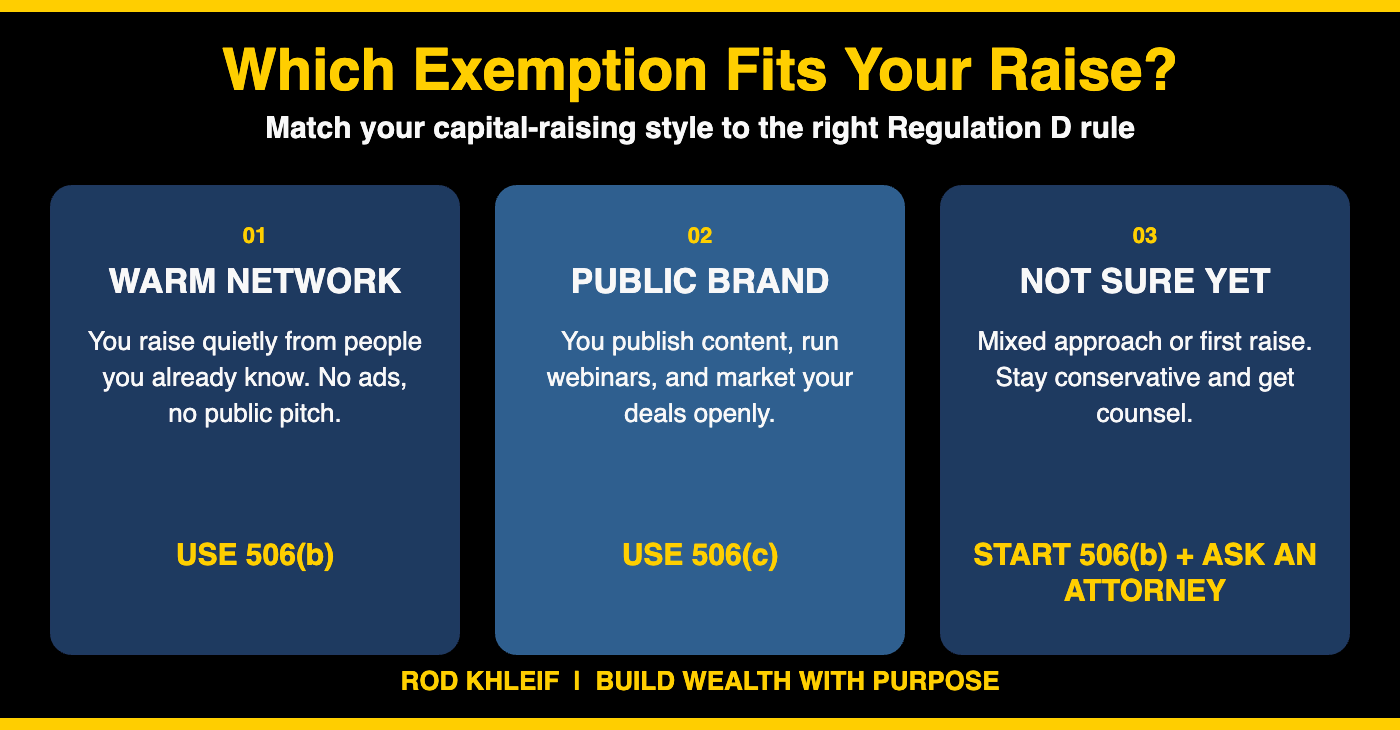
Most first-time syndicators land on 506(b) because they are raising from people they know and want room for a non-accredited partner or two. As you build a public brand, 506(c) starts to make sense. Some operators run 506(b) for one fund and 506(c) for the next. What you cannot do is treat one deal as both.
Costly 506 Mistakes Syndicators Make
- Advertising a 506(b) deal. One public post about the specific offering can blow the exemption. If you want to market openly, choose 506(c) from the start.
- Skipping verification on 506(c). Self-certification does not satisfy 506(c). Reasonable steps to verify are mandatory.
- Faking the pre-existing relationship. Meeting someone and pitching them a deal the same week is not a relationship. Regulators look at substance, not a checkbox.
- Forgetting the Form D filing. Both exemptions require filing a Form D with the SEC, generally within 15 days of your first sale, plus any state notice filings.
How to Set Up Your Raise the Right Way
Once you know your lane, the setup follows a clear path. This is the order I coach operators through:
- Pick your exemption before you talk to anyone. Run the Reg D Fit Test and commit. Your marketing plan and your investor list both flow from this choice.
- Hire a securities attorney. This is not the place to save money with a template. A good attorney drafts your Private Placement Memorandum, operating agreement, and subscription docs to match your exemption.
- Build your investor pipeline the compliant way. For 506(b), nurture real relationships first. For 506(c), build public content and a verification workflow.
- Verify or document, based on your lane. 506(c) means reasonable-steps verification on every investor. 506(b) means collecting self-certification and keeping clean records.
- File your Form D. Submit to the SEC, generally within 15 days of your first sale, and handle state blue-sky notice filings.
- Keep records for the life of the deal. Accreditation proof, your relationship trail, and every investor communication protect you if anyone ever questions the raise.
Rod Khleif: “The best syndicators treat compliance as part of the offer, not an afterthought. When you can show an investor you run a tight, by-the-book raise, you are not just following the law, you are earning the trust that gets the check written.”
506(b) vs 506(c) FAQ
Is 506(c) better than 506(b)? Neither is better. 506(c) is better if you raise from the public and everyone is accredited. 506(b) is better if you raise from your network and want room for a few non-accredited investors.
Can I switch from 506(b) to 506(c)? Not mid-raise for the same offering. You can, however, choose a different exemption for your next deal.
Can non-accredited investors join a 506(c) deal? No. 506(c) is accredited-only, with verification required. If you need non-accredited investors, use 506(b).
What counts as advertising under 506(b)? Any general solicitation about the specific offering: public social posts, ads, mass emails to strangers, or pitching people you just met. When in doubt, treat it as advertising.
What does reasonable-steps verification mean for 506(c)? Reviewing income or net-worth documents, or accepting a letter from the investor’s CPA, attorney, or a third-party verification service. A checkbox is not enough.
Do both exemptions require a Form D? Yes. Both require filing a Form D with the SEC, generally within 15 days of the first sale, plus applicable state filings.
How much can I raise under Rule 506? There is no dollar cap under either 506(b) or 506(c). The limits are on how you market and who can invest, not the amount.
Do I still need a PPM? Yes. Whichever exemption you choose, a proper Private Placement Memorandum and subscription documents drafted by a securities attorney are essential.
Ready to Raise Capital the Right Way?
Choosing between 506(b) and 506(c) is one decision inside a much bigger skill: raising capital with confidence and staying compliant while you scale. That is exactly what my Warrior Program is built to teach, with the frameworks, the network, and the accountability to help you close your first or next syndication. I have watched Warriors go from zero investors to millions in committed capital by getting the fundamentals right, starting with compliance.
Want to go deeper first? Map out the full path in the first steps to becoming a multifamily syndicator, hear real operator stories on the Lifetime Cash Flow podcast, and grab the free Lifetime CashFlow ebook to get started today.
Disclaimer: This article is for educational purposes only and is not legal, tax, or investment advice. Securities laws are complex and change over time. Always consult a qualified securities attorney and CPA before structuring or marketing any offering. This article was written with the help of AI and reviewed by Rod and his team.
