
The first time I looked at an apartment building as a serious investment, the broker said one sentence that I did not understand: “It is trading at a seven cap.” I nodded like I knew what that meant. I did not. So if you have ever wondered what are cap rates and why everyone in real estate keeps throwing that number around, you are exactly where I was years ago, and I am going to fix that for you right now.
Once I finally understood the cap rate, deal analysis stopped feeling like a guessing game. I could look at a property, run one quick number in my head, and know within seconds whether it was worth a second look or a hard pass. That one metric has helped me and my students avoid overpaying on deals that looked great on the surface and pursue deals that other people walked right past.
Here is what we will cover:
- What Are Cap Rates? A Plain English Definition
- The 4-Lens Cap Rate Check
- The Cap Rate Formula and Why NOI Is Everything
- How to Calculate and Use a Cap Rate Step by Step
- Reactive Buyer vs Cap Rate Driven Investor
- Guessing at Value vs Using the Cap Rate Formula
- Common Cap Rate Mistakes That Cost Investors Money
- Real Investors Who Learned to Read the Numbers
- What Are Cap Rates FAQ
- Ready to Take the Next Step?
What Are Cap Rates? A Plain English Definition
What are cap rates? A cap rate, short for capitalization rate, is the percentage you get when you divide a property’s yearly net operating income by its price. It tells you the unleveraged annual return a property produces and lets you compare deals and markets fast, without the distortion of financing.
Let me translate that into everyday language. Net operating income, or NOI, is the money left over each year after you pay all the operating expenses but before you pay the mortgage. The cap rate takes that income and expresses it as a percent of the purchase price. A property that produces 100,000 dollars of NOI and sells for one million dollars is trading at a 10 percent cap rate, because 100,000 divided by 1,000,000 equals 0.10.
Here is the part that trips people up. A higher cap rate is not automatically better, and a lower cap rate is not automatically worse. The cap rate is a trade off between price and risk. A low cap rate means buyers are paying a high price for every dollar of income, usually because they believe the income is safe and the area is strong. A high cap rate means the property is cheaper for every dollar of income, usually because there is more perceived risk. The number is a story about how the market feels about that income.
Signs You Are Misreading Cap Rates
Before we go further, run yourself through this quick self check. If any of these sound like you, the cap rate is working against you instead of for you:
- You think a higher cap rate always means a better deal, with no thought about why the number is high.
- You compare a cap rate in one city to a cap rate in another city as if they mean the same thing.
- You include the mortgage payment when you calculate NOI, which is not how the math works.
- You trust the cap rate a broker hands you without rebuilding the income and expenses yourself.
- You cannot explain, in one sentence, what a six cap versus a nine cap is telling you about risk.
If you checked even one box, do not worry. By the end of this article you will read cap rates the way a seasoned operator does, and you will know exactly when to lean in and when to walk away.
The 4-Lens Cap Rate Check
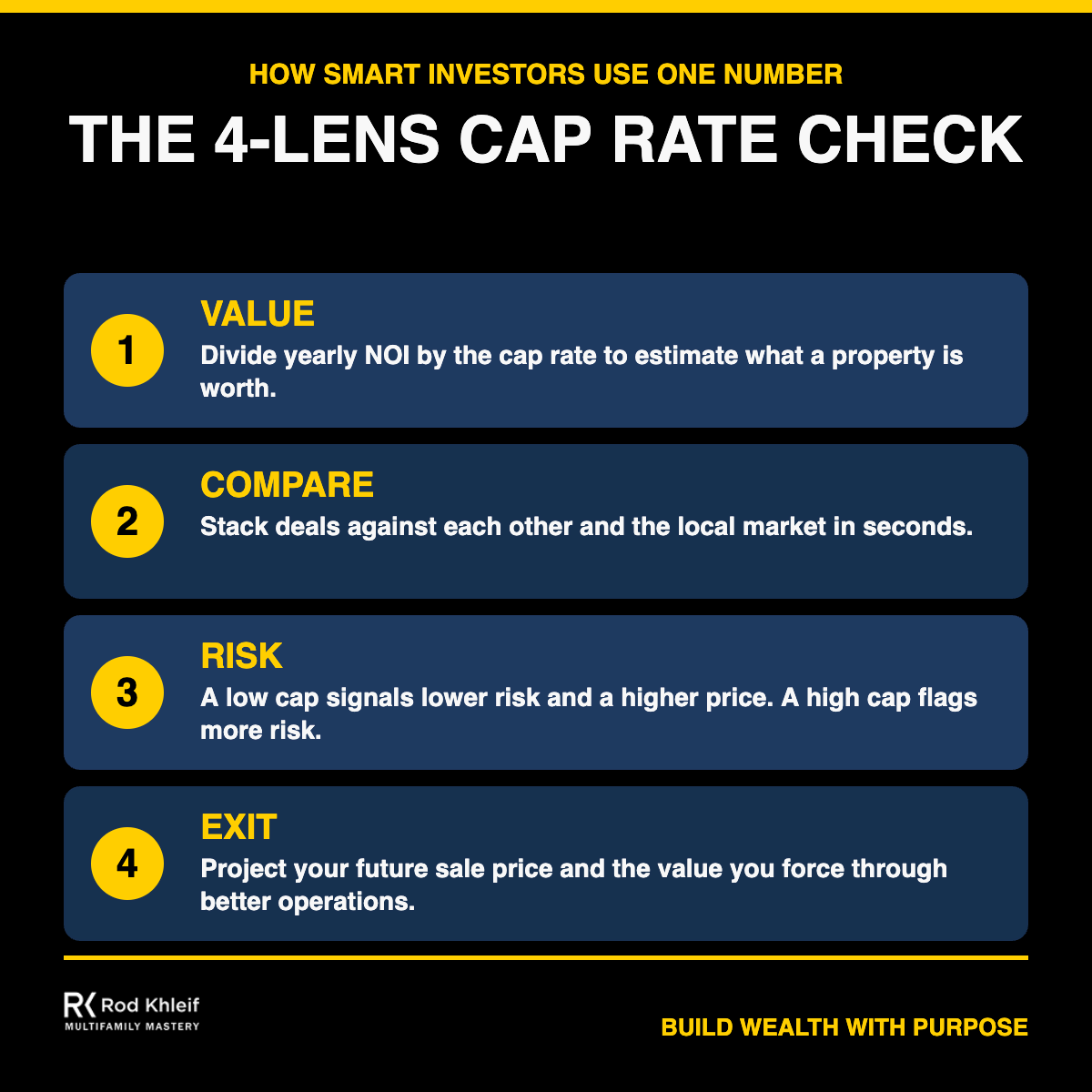
Over years of buying apartments and coaching investors, I boiled the cap rate down to a simple framework I call the 4-Lens Cap Rate Check. Instead of treating the cap rate as one number to memorize, you use it as four different lenses on the same deal. Want to run the math instantly? Use the free Rod Khleif Cap Rate Calculator while you read.
Want to practice this on real deals with live coaching? Join the free Multifamily Bootcamp →
The cap rate is not abstract theory. It is the single fastest tool you have for sizing up an apartment deal in the real world, and the four lenses below are how you put it to work. Each lens answers a different question, and together they turn one percentage into a complete read on a property.
Lens 1: Value the Property
The first lens is valuation. When you know the NOI and the market cap rate, you can estimate what a property is worth by dividing the income by the cap rate. If a building produces 100,000 dollars of NOI and similar properties in that area trade at a seven percent cap rate, the implied value is about 1,428,000 dollars, because 100,000 divided by 0.07 lands there. This is the same logic appraisers and lenders use, so when you think this way, you think like the people who decide whether a deal funds.
Lens 2: Compare Deals and Markets
The second lens is comparison. Price alone tells you almost nothing. A one million dollar building and a three million dollar building are impossible to compare until you express them as cap rates. Once you do, you can line up five deals on a spreadsheet and instantly see which ones are priced aggressively and which ones leave room. Just remember that cap rates are local, so you compare a property to others in the same submarket, not to a property a thousand miles away.
Lens 3: Read the Risk
The third lens is risk. This is the lens most beginners skip, and it is the most important one. A low cap rate usually signals a stable, in demand location where buyers accept a lower return for more safety. A high cap rate usually signals more risk, whether that is an older asset, a softer market, or income that is harder to keep. When a deal shows a cap rate far above the local norm, that is not a gift. That is the market pricing in a problem, and your job is to find out what it is.
Lens 4: Plan the Exit
The fourth lens is the exit. Cap rates do not just value a property today, they project what it could sell for tomorrow. If you raise the NOI through better management and the market cap rate holds, the value climbs. That is forced appreciation, and it is the heart of how multifamily investors build wealth. When you raise NOI by 50,000 dollars in a market that values income at a seven percent cap, you have created roughly 714,000 dollars of value, no matter what the broader market does.
The Cap Rate Formula and Why NOI Is Everything
The cap rate formula is simple: cap rate equals net operating income divided by current market value or price. Flip it around and value equals NOI divided by cap rate. Because the formula leans entirely on NOI, the quality of your cap rate depends completely on the quality of your income number. Garbage in, garbage out.
This is where discipline pays off. Brokers often present a cap rate built on optimistic income and understated expenses, which makes the deal look better than it is. Smart investors rebuild the NOI from the ground up using real numbers: actual rents, real vacancy, taxes that reflect the new assessed value after a sale, insurance, repairs, management, and reserves. According to the National Multifamily Housing Council, roughly a third of American households rent, so demand for well run apartments is durable, but that demand only shows up in your returns if your underwriting is honest.
One more discipline point. Never put the mortgage in your NOI. The cap rate is meant to measure a property’s performance independent of how you finance it, which is exactly what makes it useful for comparing deals. Financing is personal to you. The building’s income is not.
Here is a habit that will speed you up. Once you have an honest NOI, memorize a few quick conversions so you can read deals in your head. At a five percent cap rate, every 10,000 dollars of yearly NOI is worth about 200,000 dollars of value. At a seven percent cap rate, that same 10,000 dollars is worth roughly 143,000 dollars, and at a ten percent cap rate it is worth 100,000 dollars. When you internalize those anchors, you can hear a broker quote income and price and know almost instantly whether the deal is in the right neighborhood or wildly off. That speed is what lets you act before slower buyers even finish their spreadsheets.
If you want a simple, printable companion for this, my free book lays out the fundamentals of multifamily underwriting in plain language. It is the resource I wish I had when that broker first said “seven cap” to me. Click the cover below to download the full PDF and keep it next to you while you analyze your next deal.

Download the free Lifetime Cash Flow book →
How to Calculate and Use a Cap Rate Step by Step
Here is the exact process I run on every deal. It takes about ten minutes once you have the numbers, and it keeps you from falling in love with a property before you understand it.
- Gather the real income. Pull the actual rent roll and trailing twelve months of income, not the proforma. Confirm what tenants are truly paying today.
- Rebuild the operating expenses. List every cost to run the building: taxes reassessed at the likely new value, insurance, utilities, repairs, management, and reserves. Leave out the mortgage.
- Calculate the NOI. Subtract those operating expenses from the income. The result is your net operating income, the engine of the whole calculation.
- Find the local market cap rate. Ask brokers and check recent comparable sales in that submarket to learn what cap rate similar properties trade at right now.
- Run the value and the risk read. Divide your NOI by the market cap rate to estimate value, then compare the asking price to that number and ask why any gap exists before you make an offer.
Authoritative market data helps you calibrate step four. The Federal Reserve sets the interest rate environment that pushes cap rates up and down across cycles, so when rates move, expect cap rates to drift with them. That relationship is why a “good” cap rate is always a moving target rather than a fixed rule. For a deeper walkthrough of the mechanics with examples, see how cap rates work with examples, and to benchmark what a strong number looks like in today’s market, read our guide on what is a good cap rate for multifamily.
Three Worked Scenarios
Numbers make this real. Below is one building producing 100,000 dollars of NOI, priced in three different markets at three different cap rates. Watch how the same income carries three very different price tags, and notice what each cap rate is telling you about risk.
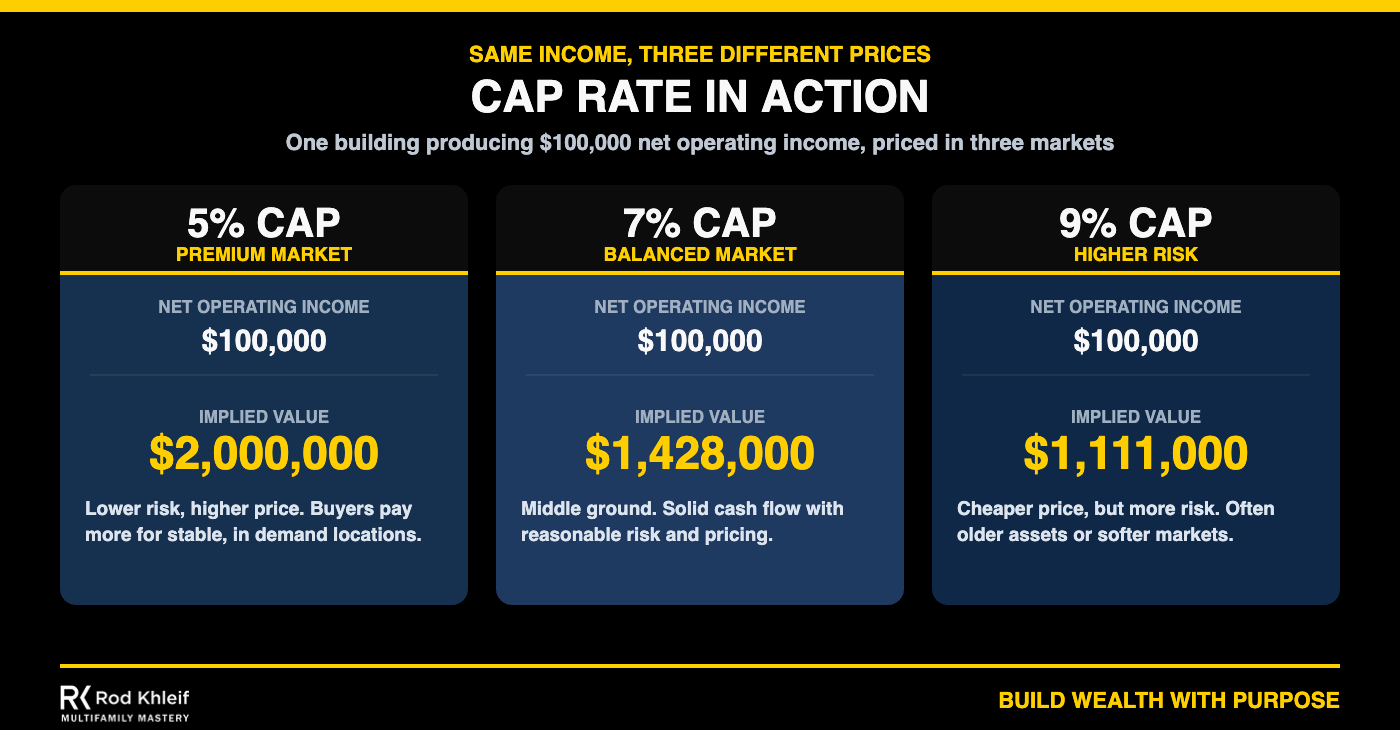
At a five percent cap rate, that income is worth about two million dollars. The market is telling you this is a premium, lower risk location where buyers pay up for stability. At a seven percent cap rate, the same income is worth about 1,428,000 dollars, a balanced market with solid cash flow and reasonable risk. At a nine percent cap rate, the building drops to roughly 1,111,000 dollars. The cheaper price is not free money. It is the market warning you that something here, the age of the asset, the strength of the local economy, or the durability of the rents, carries more risk. Your job is to decide whether you can manage that risk for the discount you are getting.
Reactive Buyer vs Cap Rate Driven Investor
The difference between people who lose money in real estate and people who build lasting wealth often comes down to how they treat the cap rate. Here is the contrast at each stage of evaluating a deal.
Guessing at Value vs Using the Cap Rate Formula
You can buy real estate on a hunch, and plenty of people do. But hope is not a strategy, and the cap rate formula is the difference between guessing and knowing. Here is how the two approaches play out across the deal.
Common Cap Rate Mistakes That Cost Investors Money
Once you know what a cap rate is, the next job is to avoid the traps that catch most beginners. I have watched smart, capable people lose real money not because they could not do the math, but because they let one of these mistakes slip past them. Learn them now so you never pay tuition for them later.
The first mistake is trusting the seller’s cap rate. Every listing wants to look like a winner, so brokers tend to present the highest cap rate the numbers can support, often by using rosy income and trimming expenses that you will absolutely face once you own the building. When you accept that number, you are letting the seller set your purchase price. Always rebuild the income and expenses yourself, then calculate your own cap rate on real figures.
The second mistake is forgetting that taxes get reassessed. In many markets, once a property changes hands, the local authority reassesses it at the new sale price, which can send the property tax bill up sharply. If you use the seller’s old, lower tax figure in your NOI, your cap rate looks better than reality, and you discover the truth only after closing when the new tax bill arrives. Build in the reassessed tax number before you make an offer.
The third mistake is ignoring capital expenses. A cap rate built on net operating income does not capture the roof you will replace in three years, the parking lot that needs resurfacing, or the units that need full renovations. Two buildings can show the same cap rate while one quietly hides a quarter million dollars of looming repairs. The cap rate is a starting point for value, not the final word, so always pair it with a clear eyed look at the physical condition of the asset.
The fourth mistake is treating the cap rate as a crystal ball. The cap rate reflects today’s income and today’s market. It does not promise that rents will rise, that expenses will stay flat, or that the market cap rate will hold when you sell. The investors who last build conservative assumptions into every projection and never bet the whole deal on the market staying kind. Respect the number, but never worship it.
Real Investors Who Learned to Read the Numbers
I want you to meet Anthony Metzger. Anthony had never even bought a single family home on his own. No real estate experience, no big bankroll. What he did have was the willingness to get educated and to understand the numbers, including the cap rate. His first deal was a 218 unit apartment community. Zero to 218 units, on the strength of education and the courage to act on what the math told him.
Stories like Anthony’s are not magic. They come from learning to read a deal so clearly that you can act with confidence while everyone else hesitates. When you understand what a cap rate is telling you, a 218 unit building stops being scary and starts being a math problem you already know how to solve.
Watch the Full Interview
Anthony Metzger walks through how he went from no experience to closing a 218 unit apartment deal.
For a deeper look at how experienced operators stress test the income behind a cap rate, listen to my podcast episode on the art and science of multifamily underwriting. It is the conversation I wish someone had handed me before my first deal.
Rod Khleif: “The cap rate will not make you rich by itself. But the discipline to understand the number behind it, to rebuild the income honestly and respect what the market is telling you, that discipline is what separates the investors who last from the ones who get wiped out in the next cycle.”
What Are Cap Rates FAQ
Q: What are cap rates in simple terms?
A: A cap rate is a property’s yearly net operating income divided by its price, shown as a percent. It tells you the return the property produces before financing, which makes it a fast way to value and compare deals.
Q: What is a good cap rate for multifamily?
A: It depends entirely on the market and the moment, because cap rates move with interest rates and local demand. Rather than chase a fixed number, compare a property to recent sales in the same submarket. Our guide on what is a good cap rate for multifamily breaks down current ranges.
Q: Is a higher or lower cap rate better?
A: Neither is automatically better. A lower cap rate usually means lower risk and a higher price, while a higher cap rate usually means more risk and a lower price. The right answer depends on your strategy and how much risk you can manage.
Q: How do you calculate a cap rate?
A: Divide the net operating income by the current value or purchase price. For example, 100,000 dollars of NOI on a 1,250,000 dollar property is an eight percent cap rate. Always build the NOI from real income and expenses.
Q: Does the cap rate include the mortgage?
A: No. Net operating income is calculated before debt service, so the mortgage is never part of the cap rate. That is exactly what lets you compare two properties fairly even when they would be financed differently.
Q: What is the difference between cap rate and cash on cash return?
A: The cap rate measures the property’s return before financing, while cash on cash return measures the return on the actual cash you invest after the mortgage. Cap rate judges the asset. Cash on cash judges your specific deal structure.
Q: Why do cap rates change over time?
A: Cap rates move with interest rates, investor demand, and the perceived risk of a market. When borrowing gets more expensive, cap rates tend to rise, which can lower property values even when the income stays the same.
Q: Can I use cap rates for single family homes?
A: You can calculate one, but cap rates are most useful for income producing commercial and multifamily properties. Single family home values lean heavily on nearby home sales rather than on income, so the cap rate matters less there.
Q: What cap rate should I use to estimate a future sale price?
A: Use a slightly more conservative cap rate than today’s, often called an exit cap, to protect yourself if the market softens. Then divide your projected future NOI by that exit cap to estimate a defensible sale price.
Q: Where can I practice running cap rates on real deals?
A: Start with the free Rod Khleif Cap Rate Calculator, then join the free Multifamily Bootcamp to run the numbers on live deals with coaching. Repetition is what turns the cap rate from a formula into instinct.
Ready to Take the Next Step?
Understanding what cap rates are is the first move. Putting that understanding to work on real apartment deals, with people who have done it, is how you turn knowledge into cash flow. My free Multifamily Bootcamp walks you through valuing deals, reading risk, and building a plan that fits your life.
Join the free Multifamily Bootcamp →
Not ready for the Bootcamp yet? Start with my free book and learn the fundamentals at your own pace.
Download the free Lifetime Cash Flow book →
Disclaimer: This article was written with the help of AI and reviewed by Rod and his team.
