
LLC structure is how I protect every single one of my multifamily investments from liability. I’ve seen investors lose everything to tenant lawsuits because they used the wrong legal entity. I won’t let that happen to me or my students. Here’s what I’ve learned from managing over 2,000 units.One lawsuit or major disaster can wipe out your personal wealth.That can happen if you don’t use an LLC.An LLC helps separate your personal assets from property liability. While there are other entity types out there, LLCs give you the best protection, tax flexibility, and simplicity. Let me walk you through which entity structure makes sense for your specific situation.
Most people who want to build wealth in real estate make the same mistake: they start buying property before they start building a company.
That’s backward.
Whether you are starting a real estate investment company from scratch, your early structure matters. If you are setting up a company around deals you already own, your early structure matters. If you are building a firm to scale, your early structure matters. The structure you choose can protect you or expose you for years.
This guide covers everything: the right legal entities, how to actually set one up step by step, the structures most professionals use, and the mistakes that cost new investors money, time, and sleep.
Let’s build this the right way.

Why You Need to Formally Start a Real Estate Investment Company
Owning property in your own name is not a business. It’s a liability.
When you operate without a formal structure, a slip-and-fall lawsuit, tenant dispute, or property damage claim can come directly after your personal savings, your home, and your wages. There’s no wall between you and the problem.
Formally setting up a real estate investment company solves that — and does a lot more:
- Liability protection: Your personal assets stay separate from the business.
- Tax efficiency: The right entity structure can reduce what you owe significantly.
- Lender and investor credibility: Banks and private investors take you more seriously when you operate as a business.
- Scalability: A proper structure makes it easier to scale to hundreds of doors without constantly looking over your shoulder.
- Professionalism: You stop looking like a hobbyist and start operating like an operator.
The gap between investors who make it and investors who flame out is rarely about deals. It’s about whether they treated real estate like a business from day one.
Amateurs treat real estate like a side hustle. They buy property in their own name, chase random deals, and hope things work out. Professionals treat real estate like a company. They create structures that protect them from lawsuits, reduce taxes legally, and make growth possible.
Business Structures for a Real Estate Investment Company: Your Options
Before you can set up your real estate investment company, you need to choose the right entity. Here’s a clear breakdown:
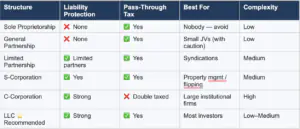
Sole Proprietorship: Skip This Entirely
A sole proprietorship is the default if you buy property in your own name. This applies when you do not form a legal entity. It’s not a business structure, it’s the absence of one.
There is zero separation between you and the business. If a tenant dispute escalates into a lawsuit, your personal assets are fully exposed. You’ll also pay self-employment tax on top of income tax: roughly 15.3% extra. And you’ll have no credibility with serious lenders or investors.
Bottom line: Don’t start here. Don’t stay here. If you’re currently operating as a sole proprietor, form an entity now.
General Partnership: Risky Without the Right Protections
A general partnership is formed automatically when two or more people invest together without a formal agreement. Every partner has full, unlimited liability, meaning one partner’s mistake exposes everyone.
This structure can make sense for a very small, short-term joint venture between people with deep trust. But without a written operating agreement and clear exit terms, general partnerships often end badly.
Bottom line: If you’re going in with a partner, at minimum use an LLC instead. It costs almost the same to set up and protects everyone involved.
Limited Partnership (LP): The Syndication Workhorse
A limited partnership has two tiers. A general partner (GP) manages the deal and takes on liability. Limited partners (LPs) contribute capital and receive passive returns. Their liability is capped at their investment.
LPs are used widely in multifamily syndications. They allow a sponsor to raise capital at scale while keeping management control. Limited partners enjoy pass-through taxation and liability protection; the general partner bears the operational and legal risk.
Bottom line: LPs are powerful for raising capital. But they need careful legal setup and experienced counsel. This is especially true if you raise from non-accredited investors.
S-Corporation: Good for Services, Not Rentals
An S-Corporation passes income directly to owners (avoiding corporate double taxation) and allows owners to take a salary plus distributions, reducing self-employment taxes.
The catch for real estate investors: the IRS restricts passive income to 25% of an S-Corp’s total revenue. Rental income is passive. If your rental income exceeds that threshold, you risk punitive taxes.
Bottom line: S-Corps work well for property management companies or active real estate businesses. This includes flipping operations, but not buy-and-hold investment portfolios.
C-Corporation: Only for Large Operations
A C-Corporation is a fully separate legal entity with the strongest liability protection available. It can issue stock, raise institutional capital, and go public. It’s the structure behind every major corporation in America.
But it comes with a brutal drawback: double taxation. The corporation pays taxes on profits, then you pay taxes again when you take distributions. Sell a property inside a C-Corp, and that gain gets taxed at the corporate level before it ever reaches you.
Bottom line: C-Corps make sense for very large real estate firms with institutional capital. For most investors, the tax drag is simply not worth it.
LLC: The Standard for How to Set Up a Real Estate Investment Company
The Limited Liability Company is the most widely used structure among real estate investors — and for good reason. It combines the liability protection of a corporation with the tax simplicity of a partnership.
- Your personal assets are protected from business lawsuits.
- Income passes through directly to you, taxed only once.
- You can split ownership and profits flexibly between multiple members.
- Compliance requirements are far simpler than a corporation.
- You can elect different tax treatments (sole proprietor, partnership, or even S-Corp) based on your situation.
The only real caveats are these: lenders may still require personal guarantees on loans. You must keep business and personal finances strictly separate. Otherwise, you could lose that liability shield.
Bottom line: For most investors starting or growing a real estate investment company, the LLC is the answer.
Real Estate Business Structure Comparison at a Glance
How to Start a Real Estate Investment Company: Step-by-Step
Once you’ve chosen your structure, here’s exactly how to set it up:
- Choose your state of formation. Most investors form their LLC in the state where they own property. Some use Delaware or Wyoming for added privacy and legal precedent, then register as a foreign LLC in their home state. Talk to your attorney about what makes sense for your situation.
- Pick a name and check availability. Your company name must be available in your state of formation and ideally available as a domain name. Keep it professional, relevant, and scalable.
- File your Articles of Organization. This is the official formation document filed with your state’s Secretary of State. Filing fees typically range from $50 to $500.
- Draft an Operating Agreement. This internal document spells out how the company is owned, how profits are distributed, how decisions are made, and what happens if a member wants to exit. Even a single-member LLC needs one.
- Get an EIN from the IRS. An Employer Identification Number is your company’s tax ID. It takes five minutes at IRS.gov and is free. You’ll need it to open a bank account and file taxes.
- Open a dedicated business bank account. All income and expenses must flow through a separate business account. Mixing personal and business funds is the fastest way to lose your liability protection.
- Register for state and local taxes. Depending on your state, you may need to register for sales tax, gross receipts tax, or business privilege tax. Your CPA will guide this.
- Get the right insurance. An LLC protects your personal assets legally, but insurance protects your business assets operationally. At minimum: property insurance, general liability, and umbrella coverage.
- Transfer or acquire properties under the company. Once the LLC is formed, either deed existing properties into it (check your lender’s due-on-sale clause first) or acquire new properties in the LLC’s name from the start.
Want to make sure you evaluate expenses correctly from the start?
Check out Rod’s guide to evaluating expenses before you run numbers on your first deal.
How to Set Up a Real Estate Investment Company for Scale: The Holding Structure
If you plan to own more than one or two properties, a single LLC won’t cut it for long. Here’s the professional-grade setup:
Property-Level LLCs
Each property, or each small cluster of similar properties, goes into its own LLC. This isolates risk. If a tenant sues over a specific property, the lawsuit is contained to that entity. Your other properties are walled off.
A Master Holding Company
A parent LLC or holding company sits above all the property LLCs. The holding company owns the membership interests in each property LLC. This gives you one clear entity to manage ownership, bring in investors, and handle entity-level decisions. It does this without directly owning any real estate.
An Operating Company (OpCo)
If you self-manage or run a property management operation, consider a separate operating company that handles management contracts, employee payroll, and day-to-day operations. This keeps operational liability away from both the holding company and the property LLCs.
This three-tier structure — OpCo / HoldCo / PropCo — is how serious multifamily firms are built. You don’t need it on day one. But you should be building toward it.
Syndicators often pair this with a limited partnership structure. If you want to go deeper on that, Rod’s free guide to multifamily syndications is the best place to start.
Naming Your Real Estate Investment Company or Firm
Your company name matters more than most new investors think. Here’s what to consider:
- Keep it broad enough to scale: Avoid names tied to a specific market, property type, or niche — unless that’s your permanent focus.
- Use words that signal professionalism: Capital, Properties, Holdings, Equity, Ventures, Group, Partners.
- Check availability in three places: your state’s Secretary of State database, the USPTO trademark database, and as a domain name (.com preferred).
- Avoid your personal name in the company name if you plan to raise capital. Sophisticated investors want to back a brand, not a person.
- Keep it memorable and easy to spell.
How Much Does It Cost to Start a Real Estate Investment Company?
Starting a real estate investment company is one of the cheapest forms of insurance you’ll ever buy. Here’s a realistic cost breakdown:
- State filing fee: $50–$500 depending on the state (Delaware: $90, Wyoming: $100, California: $70 + $800 minimum franchise tax).
- Registered agent: $50–$300/year if you use a service.
- Operating agreement: $0 with a template, $500–$2,000 if attorney-drafted (recommended for multi-member LLCs).
- Business bank account: Free at most online business banks.
- EIN: Free from IRS.gov.
- Attorney and CPA setup consultation: $500–$2,500 depending on complexity.
Total realistic cost to start: $500–$3,500. That’s a rounding error compared to what a lawsuit or tax mistake can cost you without the right structure.
Common Mistakes When Starting a Real Estate Investment Company
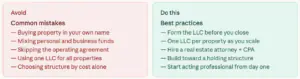
I’ve coached thousands of investors. These are the mistakes I see most often:
- Waiting too long. Every day you own property in your own name is a day you’re personally exposed. Form your entity before you close on anything.
- Mixing personal and business finances. This is the single fastest way to lose your liability protection. Use separate accounts. Period.
- Copying someone else’s structure. Your structure should reflect your tax situation, your state’s laws, your goals, and how you plan to raise capital. Get personalized advice.
- Skipping the operating agreement. Multi-member LLCs without operating agreements are lawsuits waiting to happen.
- Using one LLC for everything. One lawsuit against one property can take everything if it’s all in a single entity.
- Choosing structure based on cost alone. The cheapest option upfront often costs the most later.
- Not registering in the right state. Forming in Delaware sounds sophisticated, but if you own property in Florida, you’ll need to register as a foreign LLC there anyway.
Want to avoid more costly mistakes? Download Rod’s free ebook: The 29 Fatal Mistakes Apartment Buyers Make.
The Two Professionals You Cannot Skip
Creating a real estate investment company without professional guidance is like buying a property without due diligence. Here’s who you need:
A Real Estate Attorney
Your attorney drafts or reviews your operating agreement, advises on the right structure for your goals, handles property transfers into your entity, and ensures your company is formation-compliant in your state.
Rod’s podcast with a top SEC attorney is a must-listen if you plan to raise outside capital.
A CPA Who Specializes in Real Estate
A general accountant won’t cut it. You need a CPA who understands depreciation, cost segregation, 1031 exchanges, pass-through deductions, and entity-level tax elections. The right CPA pays for themselves — often many times over — in the first year.
Rod’s advice: Hire these professionals before you form your entity, not after. The setup conversation is the most valuable one.
What I Learned the Hard Way
When I started investing, I didn’t treat it like a business. I bought properties in my own name, kept sloppy records, and figured I’d sort the structure out later. Later came in 2008. The market crashed, and because I hadn’t built on the right foundation, the damage was far worse than it needed to be.
I’ve spent the years since helping investors avoid that lesson. The investors in my Warrior Program who build real, lasting wealth share one trait: they treat their real estate portfolio like the business it is from day one.
Don’t wait until you’re successful to start acting professional. Start now. Even if it’s your first deal.
The Bottom Line
Setting up a real estate investment company is not complicated. It takes a few hundred dollars, a few hours, and the right professional guidance. What you get back is worth far more than that investment. You get liability protection, tax efficiency, investor credibility, and room to scale.
For most investors, the path is clear. Form an LLC and open a dedicated business bank account. Get an operating agreement. As you grow, build toward a holding structure. Don’t operate as a sole proprietor. Don’t mix personal and business money. And don’t wait.
The best time to start a real estate investment company was before your first deal. The second best time is right now.
Ready to Build Your Multifamily Empire?
Join Rod at the next Multifamily Bootcamp — where investors become professionals and professionals become leaders.

🎟 Reserve Your Spot Now! Let’s take your real estate investing to the next level.
More resources from Rod:
- 👉 Join the next Multifamily Bootcamp
- 👉 Download Rod’s FREE Best-Selling Multifamily Book
- 👉 Check Out the Warrior Program
- 👉 Learn Online with Rod’s Multifamily Investing Course
Frequently Asked Questions: How to Start a Real Estate Investment Company
How do I start a real estate investment company?
Start by choosing the right legal entity; for most investors, that’s an LLC. Then file your Articles of Organization with your state’s Secretary of State. Draft an operating agreement. Get an EIN at IRS.gov. Open a dedicated business bank account. From there, acquire or transfer properties into the company’s name. The full step-by-step process is covered in this guide. But the most important thing is this: don’t wait until you’ve bought property. Set up the structure first, then buy. Every day you own real estate in your own name is a day your personal assets are exposed.
What is the best business structure for a real estate investment company?
For most investors, an LLC is the best starting structure. It gives you personal liability protection, pass-through taxation, flexible ownership options, and much simpler compliance than a corporation. If you syndicate deals and raise capital from passive investors, use a Limited Partnership (LP) with a holding LLC. It is a professional-grade setup. S-Corps and C-Corps have their uses. S-Corps work well for active businesses like property management or flipping. C-Corps work well for large institutional firms. But for buy-and-hold multifamily investing, an LLC is almost always the right choice.
How do I set up an LLC for real estate investing?
File Articles of Organization with your state’s Secretary of State (fees typically run $50–$500). Draft an operating agreement, even for a single-member LLC. Get a free EIN from IRS.gov. Open a dedicated business bank account and keep it completely separate from your personal finances. Then either buy new properties in the LLC’s name or deed current properties into it. Check your lender’s due-on-sale clause before transferring. The full setup usually costs $500 to $3,500.The cost depends on whether you use an attorney for the operating agreement. This is strongly recommended for any multi-member structure.
What is a real estate holding company and do I need one?
A holding company is a parent entity, usually an LLC, that owns membership interests in many property-level LLCs. The holding company sits above your properties. It gives you one clear entity to manage ownership and investors. Each property stays in its own LLC. This helps keep liability separate. You don’t need this on day one. But use this three-tier structure if you plan to own more than a few properties. Use it also if you want to raise capital through multifamily syndication. It includes an operating company, a holding company, and property LLCs. This is how serious multifamily firms are built.
Do I need an LLC to invest in multifamily real estate?
You don’t legally need one, but operating without one is a significant risk. When you own property in your own name, a tenant dispute, slip-and-fall lawsuit, or property damage claim can come directly after your personal savings, your home, and your wages. An LLC creates a legal wall between you and the business. It is also one of the cheapest types of protection you can buy. Setup usually costs under $1,000. That is far less than one lawsuit without protection. Before you close on any deal, talk to a real estate attorney and a CPA who specializes in real estate.
What is the difference between an LLC and an S-Corp for real estate?
An LLC is the standard structure for buy-and-hold real estate investing. Income passes through to you, you have liability protection, and compliance is simple. An S-Corp also passes income through to owners. It lets you take a salary plus distributions. This can reduce self-employment taxes. However, the IRS limits passive income, like rental income. It can be no more than 25% of total S-Corp revenue. If your rental income exceeds that threshold, you risk punitive taxes. For active real estate businesses, an S-Corp can be a good choice. This includes property management companies. It can also include fix-and-flip operations. For a multifamily investment portfolio built on rental income, stick with the LLC.
How much does it cost to start a real estate investment company?
Less than most people expect. State filing fees run $50-$500 depending on the state. A registered agent service costs $50–$300 per year. An EIN is free from IRS.gov. A business bank account is free at most online business banks. An attorney-drafted operating agreement runs $500-$2,000 and is highly recommended for any multi-member structure. An initial attorney and CPA consultation typically costs $500-$2,500. Total realistic cost: $500-$3,500. That’s a rounding error compared to what a single lawsuit or tax mistake can cost you without the right structure in place.
Do I need a lawyer to set up a real estate investment company?
You do not legally need one to file formation documents. Still, you should strongly consider hiring a real estate attorney for two key tasks. First, they can draft your operating agreement. Second, they can advise on the best structure for your goals and state. Multi-member LLCs without well-drafted operating agreements are lawsuits waiting to happen. If you plan to raise money from outside investors, you need an SEC-qualified attorney. This helps you stay compliant with securities law. Rod’s podcast with a top SEC attorney is a good place to start if you’re heading in that direction.
Disclaimer: This article was written with research support and reviewed by Rod’s team. Always consult a licensed attorney and CPA before making entity or tax decisions.
