
When I closed my first apartment building, I had a stack of advice telling me I should have bought a strip mall instead. The math looked cleaner on paper, the leases were longer, and the tenants were national brands with logos I knew. Then 2008 hit and the strip mall guys I knew got wiped out while my apartments kept renting because people still needed somewhere to sleep.
That moment is when I stopped listening to “commercial sounds more sophisticated” and started building a portfolio that could survive any cycle. If you are weighing multifamily vs commercial real estate right now and want a framework instead of a hunch, this guide is for you. The TechBullion editors invited me to share an early version of this thinking in this feature; what follows is the full breakdown with the framework, the math, the scenarios, and the comparison tables I use with every Warrior who walks me through their first decision.
Table of Contents
- Why Most Investors Pick the Wrong Asset
- The 5 Pillar Asset Decision Stack
- Why Multifamily Wins for Most New Operators
- How to Reverse Engineer Your Asset Choice
- Reactive Investor vs Framework Investor
- Multifamily vs Commercial: The Side By Side
- A Warrior Story: Frank Patalano Chose Multifamily
- When Commercial Actually Wins
- Common Mistakes in the Multifamily vs Commercial Decision
- Multifamily vs Commercial FAQ
- Ready to Take the Next Step?
Why Most Investors Pick the Wrong Asset
Direct answer: Multifamily vs commercial real estate is not a coin flip. Multifamily wins for most new operators because housing demand is structural, agency financing pushes leverage to 75 to 80 percent LTV, and a 20 unit asset spreads vacancy risk across 20 doors instead of 1 to 6 lease lines. Commercial wins for fully passive investors who can stomach concentrated tenant risk on long NNN leases.
That paragraph is the headline answer. The rest of this post is how to apply it to your situation, your capital, your timeline, and your tolerance for operational lift. I have coached Warriors who came in convinced commercial was the smart money play and left with their first apartment building under contract because the framework made the call obvious. I have also coached Warriors with a real edge in commercial NNN who stuck with it and built incredible portfolios. The point is not that one asset is universally better. The point is that you need a repeatable way to make the call.
Signs You Are Picking the Wrong Asset
Run this checklist before you sign a contract. If two or more describe you, you are about to make an asset choice based on emotion, not analysis:
- You are choosing the asset because it sounds more impressive at a dinner party
- You have not stress tested the building with the largest tenant gone
- Your underwriting assumes lease renewal rates that history does not support
- You cannot name the worst case scenario for that asset class in the last two cycles
- Your debt strategy depends on the bank loving the deal as much as you do
- You are mixing up “lower management” with “lower risk”
- Your exit plan is “hold forever” because you are afraid of the resale market
- You are choosing commercial because a broker showed you a single trophy listing
- Your debt service coverage ratio model only stress tests at one rate scenario
That checklist is the same diagnostic I run with new Warriors. Most people fail two or three lines the first time through. The five pillar framework below fixes that.
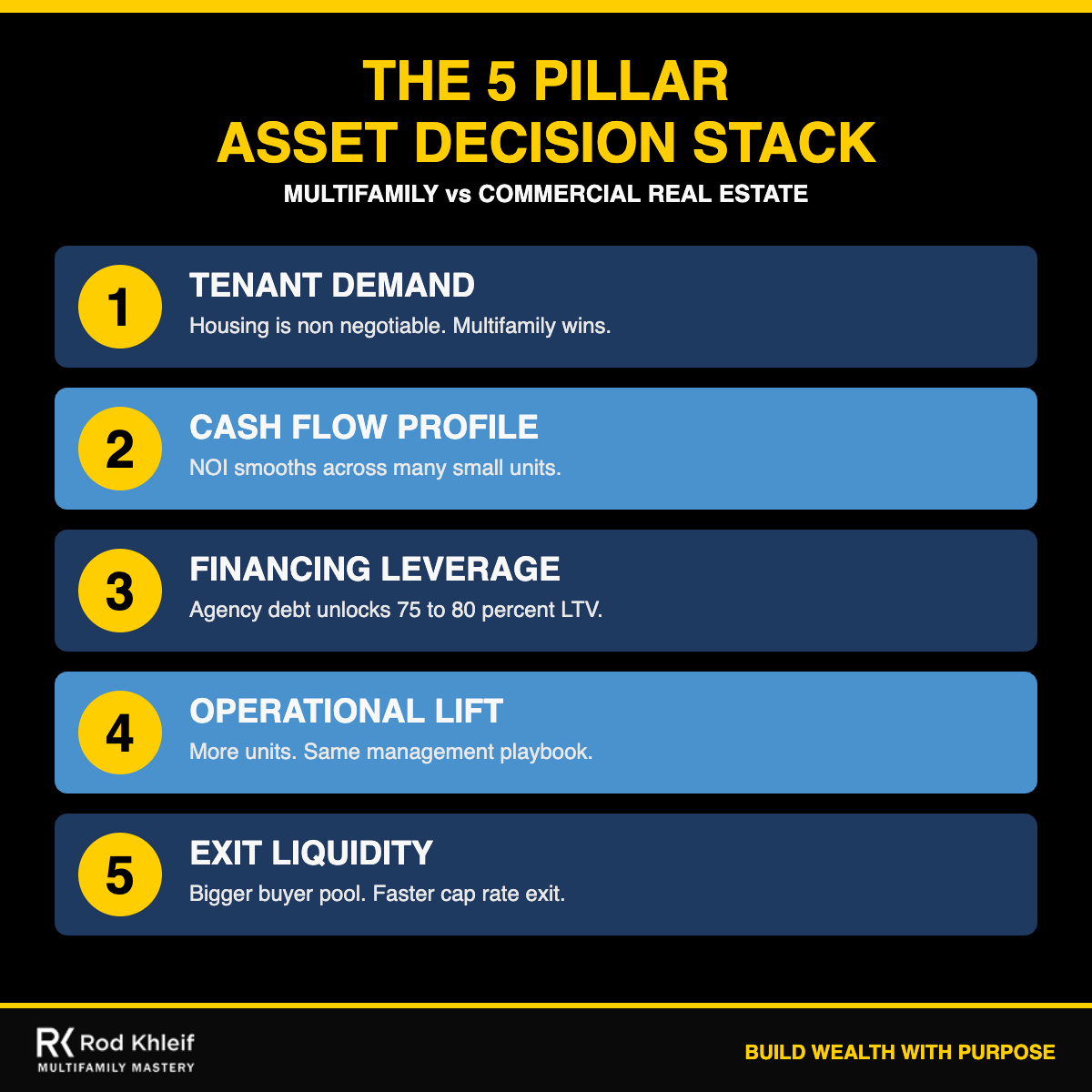
The 5 Pillar Asset Decision Stack
When a Warrior asks me how to choose between multifamily and commercial, I walk them through the same five pillars every time. These pillars are not opinions; they are the structural realities of each asset class that any sober underwriter will arrive at independently. The framework just makes those realities visible before the deal closes instead of after.
Pillar 1: Tenant Demand
Housing is the most non discretionary expense in a household budget. People will skip vacation, downgrade their car, drop streaming subscriptions, and rotate to private label groceries before they stop paying rent. That is the structural reason multifamily survived the 2008 financial crisis, survived the 2020 pandemic, and is still trading actively in 2026 while office and certain retail submarkets are repricing.
Commercial real estate is the opposite. Demand is tied to discretionary business decisions: lease renewals, hybrid work policies, consumer shopping habits, store footprint optimization. When economic uncertainty rises, a small business cuts office space first, and consumer foot traffic at retail drops fastest. The asset is functionally less recession resilient than housing because the underlying tenant decisions are elastic. You can run a business with less office, or shift sales online. You cannot raise a family in less house once the lease is signed.
The macro numbers back this up. NMHC research consistently shows the United States is short roughly four to seven million housing units depending on methodology, and the renter household formation rate has outpaced new supply for over a decade. That structural shortage does not exist in office or retail. In fact, office has the opposite problem in many metros: too much supply chasing too little demand. So when you ask “what is the underlying demand picture for the next 10 years,” multifamily has a tailwind and office has a headwind. That is not a small detail.
Pillar 2: Cash Flow Profile
A 20 unit apartment building with 95 percent occupancy still produces income on 19 units when one tenant moves out. A 4 tenant strip center with one anchor gone is at 75 percent collection overnight, and if the anchor was 60 percent of the income, you are at 40 percent collection. The two assets look similar on a gross rent line. They are very different on the variance around that gross rent line.
I call multifamily cash flow “smoothed by volume.” More small tenants paying smaller rents means individual moves out barely move the NOI needle. Multifamily NOI looks like a slightly wavy line. Commercial cash flow is “concentrated by lease.” A few big tenants paying big rents means one departure creates a cliff in income that lasts until the next deal is signed and the tenant improvement period burns through.
This is the single most underrated piece of the multifamily vs commercial debate. New investors look at the gross income on paper. Experienced operators look at the variance around that gross income. Multifamily has lower variance per dollar invested, which is exactly what banks reward with better debt terms. That is the bridge to Pillar 3.
Pillar 3: Financing Leverage
This is where the two asset classes diverge the hardest, and most new investors miss it. Multifamily of five units or more qualifies for agency debt: Fannie Mae and Freddie Mac products that consistently push 75 to 80 percent loan to value at fixed rate, non recourse, 10 year terms with very competitive pricing. In some programs you can do supplemental loans, interest only periods, and assumable debt that helps your future exit.
Commercial deals (office, retail, industrial, hospitality) live in the world of CMBS, life company, regional bank, and credit union debt. Typical leverage caps out at 60 to 65 percent. Terms are usually 5 years with a balloon at the end that creates refinance risk if cap rates move. Most loans are full recourse for sponsors under a certain net worth threshold, which puts your personal balance sheet on the line.
The leverage gap is not a small detail. A 20 point swing in LTV roughly doubles your equity multiple on the same property at the same cap rate, all else equal. Multifamily lets you control more asset with less equity, which is why the same 250K of capital builds a portfolio in apartments faster than the same 250K does in retail or office. That compounding effect over 5 to 10 years is the single biggest reason multifamily wealth builds faster than commercial wealth for active operators.
Pillar 4: Operational Lift
Multifamily management is repetitive. You set the playbook once: leasing, screening, lease renewals, maintenance tickets, turnover, evictions, capital expenditure planning. The same playbook runs 8 units or 800 units. Property management firms have built mature platforms around it. Software like AppFolio, Yardi, and Buildium is mature. Talent is mature: you can hire trained property managers, leasing agents, and maintenance technicians in almost any market in America.
Commercial is bespoke. Every lease is negotiated separately. Tenant improvement allowances (TI) are often six figure capital outlays per renewal. Lease administration requires specialists because each tenant has different load factors, common area maintenance allocations, escalation clauses, percentage rent clauses, exclusivity rights, co tenancy rights, and surrender provisions. The operational lift is not just higher than multifamily, it is qualitatively different. You are running a business that signs custom contracts with each customer.
If you are new and you want a business you can scale, multifamily is the lower friction path. The job description is knowable. The hiring profile is knowable. The reporting cadence is knowable. If you already have an operations team and you want to deploy capital with low ongoing labor (a stabilized NNN net leased strip center with national credit tenants on 10 year leases), commercial can fit your skill set. The question is which side of that operational profile matches the life you want to build.
Pillar 5: Exit Liquidity
The buyer pool for a stabilized 50 unit apartment building in a primary or secondary market is huge. Local operators, regional syndicators, national funds, private REITs, family offices, and 1031 buyers from coastal markets are all bidding. You can usually exit a clean, well operated multifamily asset in 60 to 120 days at the prevailing market cap rate, often with multiple bidders.
The buyer pool for a 50,000 square foot suburban office building in 2026 is much thinner. The buyer pool for a non anchored retail strip center is thin. The buyer pool for a hotel is thin in many submarkets. Exits can stretch 6 to 12 months or longer, and price discovery is brutal because the comp set is thin. You may end up selling 10 to 20 percent below your underwriting target because the next bidder simply does not exist.
Liquidity at exit is what determines whether you actually realize your projected returns or whether your “paper gains” stay on paper. Multifamily wins this pillar in almost every market environment. Even in a down cycle, apartments trade. The buyer pool gets more conservative on price, but the bids show up. That is rarely true for office and not always true for retail.
Why Multifamily Wins for Most New Operators
Across the five pillars, multifamily wins four outright and ties on operational lift if you are pursuing a fully passive NNN commercial play with a national credit tenant on a 15 year lease. For someone building a portfolio actively, multifamily is the structural answer.
The data backs this up. The Federal Reserve rental vacancy rate has hovered in the 6 to 7 percent range nationally even through cycles, while office vacancy in many metros climbed past 18 to 20 percent in 2024 to 2026. That is not opinion, that is the macro tape. When a structural difference of more than 10 percentage points in vacancy exists between two asset classes, the lower vacancy asset is going to compound wealth faster on the same capital, period.
There is another reason most of the operators I have coached in the Warrior Program build their wealth in apartments: the product is teachable. Underwriting an apartment building is a knowable skill. You learn rent comps, expense ratios, cap rates, debt sizing, and exit cap assumptions, and the model converges. Underwriting a single tenant office building with a CEO who is one bad earnings call away from giving back the lease is a guess. The model produces a number, but the number is anchored on one human decision you cannot control.
That is also why the recession resilience of multifamily is so durable. The risk is spread across many small tenant decisions that average out. Commercial concentrates risk in fewer larger tenant decisions that do not average. That is not a small distinction over a 10 year hold.

How to Reverse Engineer Your Asset Choice
The 5 Pillar Stack tells you which asset class wins for your profile. The next question is which specific deal in that asset class fits your goals. Here is the step by step process I walk every Warrior through. It works whether you have 50K to deploy as a limited partner or 5 million to lead as a general partner.
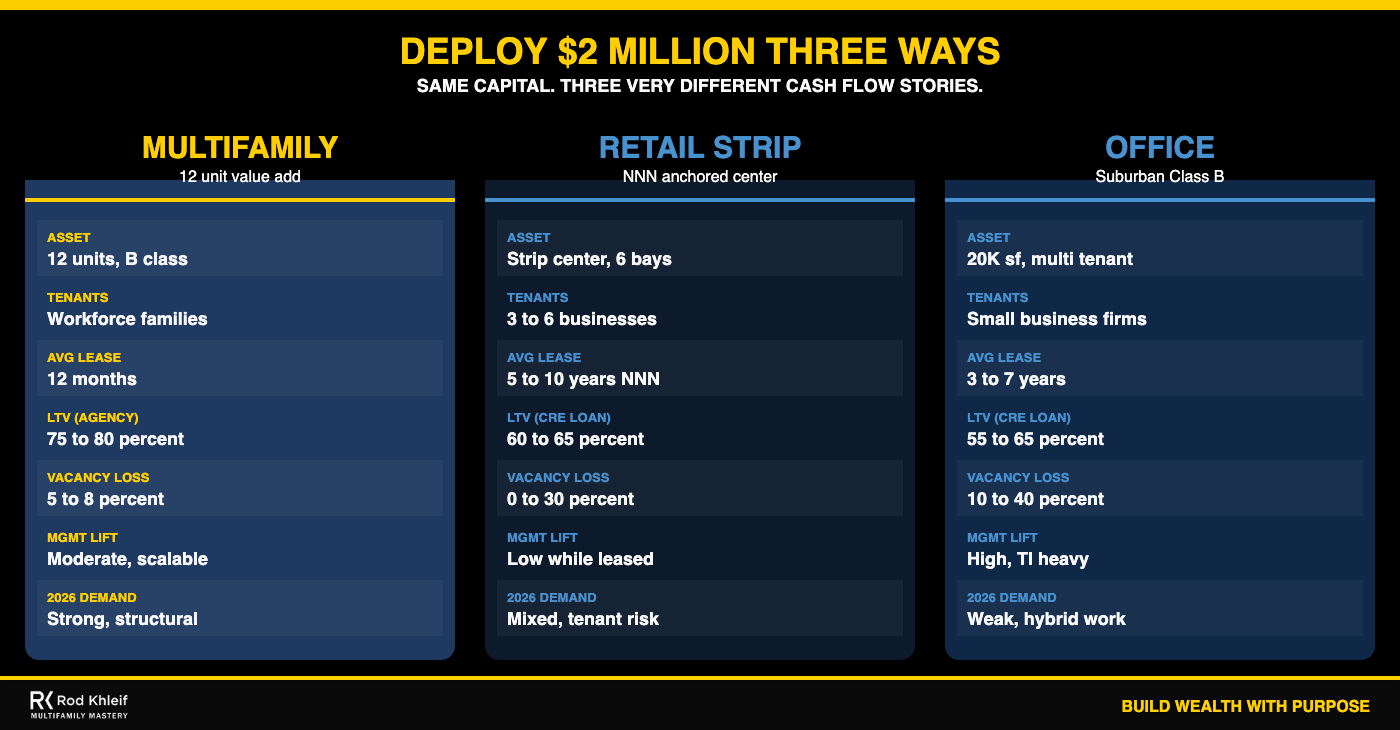
Three Worked Scenarios
Same 2 million dollars of buying power deployed three ways looks like this. The left column compounds. The middle column depends on tenant retention. The right column depends on the broader return to office trend in your specific submarket. One of those three is a bet you can make with confidence in 2026 even if you have never bought a deal before.
Step by step process
- Define your target monthly cash flow. Think in retirement income terms, not deal terms. Most Warriors target 10K to 30K monthly net of debt service, taxes, and reserves.
- Reverse engineer the equity needed. At a 7 percent cash on cash return on multifamily, 10K monthly requires roughly 1.7 million in deployed equity across the portfolio. Higher cash on cash, less equity. Lower cash on cash, more equity.
- Choose your asset class using the 5 Pillar Stack. Most Warriors land on multifamily because the leverage gets them to the equity target in 24 to 48 months instead of 10 years on the same capital base.
- Build the buy box. Unit count range, market, vintage, value add scope, expected exit cap rate. Write this down before you look at deals. Otherwise every listing looks attractive in isolation.
- Underwrite 20 deals to win 1. Yes really. The win rate on great deals is in the low single digits. If you are winning 1 in 5, you are paying too much. If you are winning 0 in 50, your buy box is too tight.
- Close, operate, refinance, repeat. This is where the agency debt leverage really shines because cash out refis return your equity to redeploy into the next deal. That is what compounds wealth.
That six step process is the same one I teach in the Multifamily Bootcamp. It is also the basis of every Warrior portfolio I have helped build over the last 10 years. The framework is not the secret. The willingness to actually follow the framework when emotions push you toward a deal that does not fit is the secret.
Reactive Investor vs Framework Investor
Multifamily vs Commercial: The Side By Side
A Warrior Story: Frank Patalano Chose Multifamily
When Frank Patalano joined the Warrior Program, he had a window of capital but was not sure which asset class to deploy it into. He was looking at retail strip centers because his network was telling him that is where the smart money was going. We walked him through the 5 Pillar Asset Decision Stack together and within 60 days he had his first multifamily under contract.
The interesting part of Frank’s story is not just the asset choice. It is the way he thinks about it now. He went from “commercial sounds smarter” to running the framework on every deal that crosses his desk. That is the exact mindset shift the framework is designed to create. You can hear him walk through it in his own words.
Watch the Full Interview
Frank Patalano walks through why he chose multifamily over retail and how the framework changed his investing.
Rod Khleif: “I made every mistake possible in my first 10 years in real estate. The framework matters because it keeps you out of the trades that look smart on paper and lose you money in reality.”
If you want more student stories like Frank’s, the full library is on the Lifetime Cash Flow Podcast. Listen to a few of those episodes back to back and you will notice a pattern: almost every Warrior who built real wealth did it by following a framework, not by chasing the deal that sounded smartest at the time. That is the entire game.
When Commercial Actually Wins
I want to be fair to commercial because there are profiles where it absolutely is the right call. If you are an experienced operator with a leasing team and a tenant rep relationship, a well located strip center anchored by a strong national tenant on a 15 year NNN lease can produce mailbox money with very little ongoing labor. If you have specialized knowledge of a vertical like medical office, self storage, or industrial flex, the operational lift drops because you understand exactly what each tenant needs and how to keep them. And for the limited partner who just wants quarterly distributions on a 5 to 7 year hold with a strong sponsor, commercial syndications can be a clean fit.
Those are real wins, but notice what they have in common. They all assume specialized expertise, deep tenant relationships, or fully passive participation. They are not the right starting point for a new investor building a portfolio from scratch. That is exactly why the 5 Pillar Stack tilts toward multifamily for first time and second time buyers, and why most of the operators in the Warrior Program lead with apartments and only layer commercial in later, after they have already built the cash flow base in residential.
Common Mistakes in the Multifamily vs Commercial Decision
After 5,000 plus students, I see the same handful of mistakes derail asset selection. Watch for these:
- Confusing cap rate with cash on cash return. A 7 cap commercial deal at 60 percent LTV produces different cash on cash than a 6 cap multifamily deal at 78 percent LTV. The leverage difference can flip which deal is “better” entirely once you run the equity returns.
- Underestimating downtime. Commercial leases that go vacant can sit for 9 to 18 months while you find the next tenant and complete tenant improvements. Underwriting that assumes 90 days of vacancy on a small business commercial space is wishful thinking and will not survive a real downturn.
- Treating “diversification” as automatic. Owning one commercial property with one anchor tenant is not diversified. Owning a 20 unit apartment building is diversified across 20 small tenants. Asset count matters less than tenant count when the question is risk concentration.
- Following the broker’s narrative. Brokers are paid on transactions. Their pro formas are optimized to make the deal close, not to keep you safe through cycle two. Build your own model from scratch before you trust theirs and make the broker defend their numbers.
- Ignoring the exit. The deal you cannot sell in 6 months is not a great deal regardless of the cap rate. Plan the exit the day you sign the LOI, not the day you list. Map the buyer pool, the comparable transactions, and the likely exit cap rate before you commit equity.
Fixing these is more about discipline than about education. The 5 Pillar Stack is designed to force the discipline because each pillar surfaces one of these mistakes before you commit capital to a deal that will not survive a downcycle.
Multifamily vs Commercial FAQ
Q: Is multifamily considered commercial real estate?
A: Apartment buildings of 5 units or more are classified as commercial real estate for financing and tax purposes. In the multifamily vs commercial conversation, “commercial” usually refers to office, retail, industrial, and hospitality. Multifamily is a separate asset class that sits under the broader commercial umbrella but trades on different fundamentals.
Q: Which is more profitable, multifamily or commercial?
A: For active operators, multifamily generally compounds wealth faster because of higher leverage at 75 to 80 percent LTV, more predictable cash flow across many small tenants, and stronger exit liquidity. Commercial NNN can be more profitable per labor hour for passive investors when long leases hold and the tenant credit is strong.
Q: Is multifamily a safer investment than commercial?
A: Multifamily is structurally safer because tenant demand for housing is non discretionary and risk is spread across many small tenants. Commercial concentrates risk in fewer larger tenants, so a single departure can wipe out a year of cash flow before the next deal gets signed and stabilized.
Q: How much money do I need to start investing in multifamily?
A: With agency financing at 75 to 80 percent LTV, a 1 million dollar 8 to 10 unit building requires 200K to 250K in equity plus reserves. Many Warriors start as limited partners in syndications for as little as 50K, then transition to lead general partner roles after learning the playbook.
Q: What is the difference between commercial real estate and multifamily syndication?
A: A commercial syndication pools investor capital to buy office, retail, industrial, or hospitality. A multifamily syndication pools capital to buy apartment buildings of 5 plus units. The legal structures are very similar; the underlying asset risk profiles, financing options, and exit liquidity are very different.
Q: Can you finance multifamily with conventional loans?
A: Properties of 1 to 4 units qualify for residential conventional loans like a primary residence or single family rental. Properties of 5 units or more require commercial or agency multifamily loans. Agency products from Fannie Mae and Freddie Mac are usually the best terms for 5 plus unit deals.
Q: What is a good cap rate for multifamily in 2026?
A: Market cap rates in 2026 range from 5.5 to 7.5 percent depending on market tier, asset class quality (A, B, or C), and vintage. Value add deals can pencil at higher entering cap rates if the operator can execute the business plan and exit 100 to 200 basis points tighter on stabilized NOI.
Q: How does commercial real estate differ from multifamily for taxes?
A: Both qualify for cost segregation, accelerated depreciation, and 1031 exchanges. The depreciation schedule for multifamily is 27.5 years; commercial is 39 years. That faster depreciation schedule on multifamily means more tax shielded cash flow per year for active investors.
Q: Is commercial real estate dead in 2026?
A: Office is repricing significantly and some submarkets will not recover for years. Retail is bifurcated: well located NNN with strong tenants is still trading at premium prices; speculative retail is struggling. Industrial remains strong. So “commercial” is too broad a label to call dead or alive without naming a subtype.
Q: How long does it take to build wealth in multifamily vs commercial?
A: Most Warriors hit financial freedom in 5 to 10 years through multifamily because of agency leverage and the cash out refinance cycle that returns equity to redeploy. Commercial timelines stretch longer because lower LTV means more equity per deal and slower portfolio velocity.
Ready to Take the Next Step?
If you are still weighing multifamily vs commercial, the fastest way to make the call is to learn the multifamily playbook end to end and then decide. Once you see how the math actually works on a real deal, the decision usually makes itself.
Join the Multifamily Bootcamp for the live training where I walk through this exact framework with worked examples and deal teardowns. Already past the basics and ready to scale? Apply for the Warrior Program for the full mentorship community.
Not ready for either yet? Start with my free book How to Create Lifetime Cashflow Through Multifamily Properties and use it as your daily reference while you build your buy box.
Disclaimer: This article was written with the help of AI and reviewed by Rod and his team.
Related reading: Letter of Intent Real Estate: Free Template 2026
