
Finding assisted living investors is the part of senior housing that keeps most new operators up at night. I’ve raised money for real estate for decades, and I can tell you the deal is rarely the problem. The problem is that most people go looking for capital in the wrong places, with the wrong story, in the wrong order. This guide fixes all three.
If you are still deciding whether senior housing is right for you as a buyer, start with my guide on how to invest in assisted living facilities. This post is for the operator or sponsor who has a deal (or is about to) and needs the equity to close it.
Table of Contents
- Why Assisted Living Investors Are Different
- The 5 Ring Investor Circle
- What Assisted Living Investors Want to See
- How to Raise Capital for an Assisted Living Facility
- Pitching Mistakes vs What Works
- Random Outreach vs the 5 Ring Investor Circle
- Warriors Who Learned to Raise Capital
- Assisted Living Investors FAQ
- Ready to Take the Next Step?
Why Assisted Living Investors Are Different From Apartment Investors
Assisted living investors are private individuals, family offices, and funds who put equity into licensed senior care communities. You find them by working outward from people who already trust you, then healthcare professionals, passive real estate investors, family offices, and strategic partners. They invest in the operator first and the building second.
When you raise money for an apartment building, your investor is buying a rent roll. Tenants sign leases, rent comes in, the mortgage gets paid. Investors understand that story because most of them have rented an apartment at some point in their lives.
Assisted living is a different animal. Your investor is buying into an operating business that happens to sit inside real estate. Revenue comes from residents who pay for housing plus care. That care requires a license, a staff that shows up every shift, a nurse on call, and an operator who knows how to keep families happy and regulators satisfied. If you want the full picture of how that changes the money side, read my breakdown of assisted living profit margins.
That difference changes who invests and why. A seasoned apartment investor might pass on your deal because the business risk feels unfamiliar. Meanwhile, a physician who has never owned a duplex might jump in because she sees families struggling to find good care every single week. You have to know which conversation you are walking into.
Here is the good news. Demand is not the hard part to explain. The U.S. Census Bureau projects that by 2030 every baby boomer will be 65 or older. Investors already feel that wave coming. What they need from you is proof that you can capture it without losing their money.
Signs You Are Not Ready to Raise Yet
Before you call a single investor, run through this checklist honestly. Every “no” is a question an investor will ask you, and a weak answer costs you the check.
- Do you have an operator? If you are not the licensed operator yourself, do you have a signed management agreement with one who has a track record you can show?
- Do you know your census? Can you explain current occupancy, the private pay versus Medicaid mix, and how fast you expect to fill empty beds?
- Do you know your staffing plan? Labor is the biggest expense line in assisted living. Investors want to see it modeled shift by shift.
- Do you have a lender lined up? Equity follows debt. If you have not talked to lenders, read my guide on senior housing financing first.
- Do you have an attorney? Raising money from passive investors is a securities offering. You need a securities attorney before you need a pitch deck.
- Do you have skin in the game? Investors want to know what you are putting in, whether that is cash, sweat, or a deferred fee.
If you checked every box, keep reading. If you didn’t, that is fine. You just found your to do list.
The 5 Ring Investor Circle: Where Assisted Living Investors Come From
I teach my students to think about capital as a set of rings around them. The closer the ring, the more trust already exists and the less you have to prove. The farther out you go, the bigger the checks get and the higher the bar. I call it the 5 Ring Investor Circle, and it is the framework we use inside the Warrior Program to plan every raise.

The mistake most new sponsors make is starting in Ring 4 or Ring 5. They chase a family office before they have closed a single deal with friends and family. Then they get a polite no and decide raising capital is impossible. Work the rings in order and every deal you close makes the next ring easier.
Ring 1: Your Inner Circle
These are friends, family, former coworkers, your dentist, the guy you play golf with on Saturday. They invest in you before they invest in the deal. Your first assisted living raise will very likely come mostly from this ring, even if the checks are small.
The key here is education, not selling. Most of these people have never heard the term preferred return. Host a simple dinner or a Zoom call where you explain senior housing, the demand story, and what you are working on. Do not ask for money in that first conversation. Ask them if they would like to be kept in the loop when you have a deal. That is how you build a soft commitment list.
Ring 2: Healthcare Professionals
This ring is the secret weapon of senior housing. Doctors, nurses, physical therapists, pharmacists, home health owners, and hospice directors see the shortage of quality care every day. Many of them have high incomes and no time to manage real estate themselves.
When you talk to a healthcare professional, you are not explaining why seniors need care. They already know. You are explaining how your community delivers better care and how that care produces a return. Speak their language: staffing ratios, care plans, and resident outcomes. Local medical associations, hospital foundation events, and physician investor groups are all good places to meet this ring.
Ring 3: Passive Real Estate Investors
These are accredited investors who already put money into multifamily or other syndications. They understand the structure. They know what a waterfall is and what the difference is between a general partner and a limited partner (if you need a refresher, see my post on GP vs LP).
What they don’t know is senior housing. Your job is to show them how it compares to the apartment deals they already own: different risk, different return drivers, and a demand curve that does not depend on job growth in one city. Real estate meetups, investor conferences, and podcasts are where this ring spends its time.
Ring 4: Family Offices
Family offices manage wealth for one family or a small group of families. They write bigger checks, often $1 million to $10 million or more, and they move slowly. They want a sponsor with a track record, audited or at least reviewed financials, and an operator with multiple communities under management.
You usually earn your way into this ring after two or three successful deals. When you get there, lead with data. Family offices will compare your deal against every other senior housing deal on their desk.
Ring 5: Strategic Capital Partners
This ring includes private equity funds, healthcare focused real estate funds, joint venture partners, and larger operators who co invest. These partners can fund an entire deal. In exchange they will negotiate hard on fees, control, and the split.
For most of my students, Ring 5 is a goal for year three or year five, not year one. But knowing it exists changes how you build your business today. Every report you send, every deal you close on time, and every investor you return capital to becomes part of the track record that opens this door.
What Assisted Living Investors Want to See Before They Write a Check
Every ring has different questions, but they all boil down to one: will I get my money back, and then some? Here is what serious assisted living investors look for, in roughly the order they look for it.
1. The Operator
In apartments, a weak property manager hurts returns. In assisted living, a weak operator can sink the entire deal. Investors want to know who runs the building day to day, how many communities they operate, what their occupancy looks like, and whether they have had any serious survey deficiencies. If you have not vetted your operator thoroughly, use my checklist on how to vet a senior housing operator before you show the deal to anyone.
2. The Market Story
Investors want proof that your market needs more beds and that you can fill them. Show population growth among adults 75 and older within your primary market area, nearby competition and their occupancy, and new construction in the pipeline. The national picture helps too. According to NIC MAP data reported by IREI, senior housing occupancy across the 31 primary markets reached 90.4 percent in the third quarter of 2026, the first time it cleared 90 percent since before the 2008 financial crisis. That is the kind of tailwind investors want to see, but always tie it back to your specific market.
3. The Business Plan
Is this a stabilized community you plan to run better? A turnaround with empty beds and a bad reputation? A conversion or new build? Each plan carries a different risk and should carry a different return target. Be honest about which one you are pitching.
4. The Downside Case
Here is where most new sponsors lose credibility. They show investors a beautiful upside case and nothing else. Experienced investors flip straight to the page that shows what happens if occupancy drops ten points or wages rise faster than rents. If that page does not exist, they assume you have not thought about it. Run your numbers through a full senior housing due diligence checklist so you can answer the tough questions before they are asked.
5. Alignment
Investors want to know how you get paid and when. Acquisition fees, asset management fees, and your share of the profits should all be laid out clearly. The more of your compensation that comes after investors get paid, the easier your raise will be.
When I sit down with a new investor, I am not trying to impress them. I am trying to be the most prepared person they have talked to all year. If you want a quick reference for the fundamentals behind every one of these conversations, my free book is a good place to start.
It walks through the mistakes I made early in my career, and many of them are exactly the mistakes new sponsors make when they raise capital. Click the cover below to get your free copy and keep it handy as you prepare your first investor conversations.
Get the free book and learn from my mistakes before you make them →
How to Raise Capital for an Assisted Living Facility in 7 Steps
Here is the exact process I would follow if I were raising my first senior housing deal today. I have also covered the general mechanics of how to raise money for real estate deals, so this section focuses on what is different for assisted living.
Step 1: Lock Down Your Operator and Your Team
Before you talk to investors, you need the people who make the deal credible: the operator, a senior housing lender or mortgage broker, a securities attorney, and a CPA who understands healthcare real estate. Your team is the first thing investors evaluate, so build it before you build your pitch.
Step 2: Choose Your Offering Structure With Your Attorney
Most private real estate raises in the U.S. use Regulation D. Under Rule 506(b) you cannot advertise the offering publicly, and you can accept up to 35 non accredited but sophisticated investors, as long as you have a preexisting relationship with them. Under Rule 506(c) you can advertise, but every investor must be accredited and you must take reasonable steps to verify it. The SEC explains what that verification looks like in its guide to assessing accredited investors under Regulation D. Your attorney makes the final call. I am not your lawyer, and this is not legal advice.
Step 3: Build Your Soft Commitment List
Go through Rings 1, 2, and 3 and list everyone who has said they want to hear about your next deal. Next to each name, write the amount you think they could comfortably invest. If the total on that list is not at least twice the equity you need, you are not ready to put a property under contract. Keep building relationships first.
Step 4: Package the Deal
Create a clear executive summary and a full investment memorandum. Include the business plan, the operator’s track record, the market data, the sources and uses of funds, the base case and downside case, and how investors get paid. Keep the language simple. If your neighbor cannot understand the first page, rewrite it.
Step 5: Host an Investor Webinar or Meeting
Present the deal live. Walk through the story, then open it up for questions. Record it so investors who could not attend can watch later. In my experience, a live presentation converts far better than an email with a PDF attached, because people invest in people.
Step 6: Collect Commitments and Close
Set a clear deadline. Use an investor portal to collect subscription documents, accreditation verification if you are using 506(c), and funds. Follow up personally with anyone who said yes but has not funded. Stay organized, because closing a raise late is one of the fastest ways to lose a deal and your credibility.
Step 7: Communicate Like Your Next Raise Depends on It
Because it does. Send monthly or quarterly updates with occupancy, revenue, expenses, staffing, and any problems you are solving. Investors forgive bad news. They don’t forgive silence. The investors who get great communication on deal one become the anchors of deal two.
Three Worked Scenarios: Reverse Engineering Your Raise
Let’s put real numbers on this. The figures below are illustrative only, but they show how the size of your deal decides which rings you need to work.
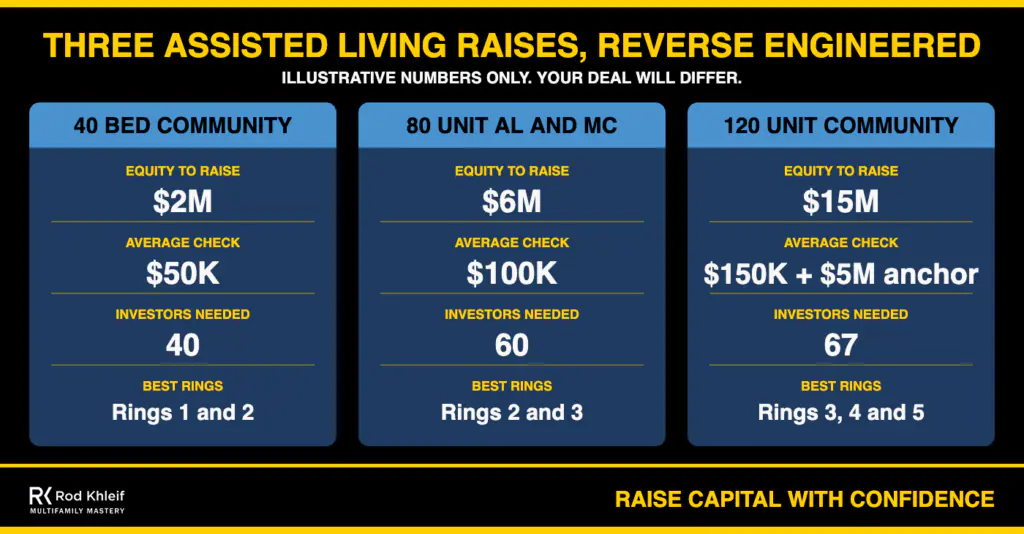
Scenario 1: A 40 bed community needing $2 million in equity. With an average check of $50,000, you need about 40 investors. That is very doable from Ring 1 and Ring 2 if you have spent a year educating your network. This is where most first time sponsors should start.
Scenario 2: An 80 unit assisted living and memory care community needing $6 million. At an average check of $100,000, you need about 60 investors. Your inner circle alone probably won’t get you there. You will lean on healthcare professionals and passive real estate investors who already understand syndications.
Scenario 3: A 120 unit community needing $15 million. If a family office anchors the deal with $5 million, you still need $10 million from roughly 67 investors at $150,000 each. That raise requires a real track record, a strong operator, and relationships across Rings 3, 4, and 5.
Notice the pattern. You don’t jump to Scenario 3. You earn it by closing Scenario 1, delivering on your promises, and growing your circle with every deal.
Pitching Mistakes vs What Works
I have watched hundreds of new sponsors pitch their first deal. The ones who struggle tend to make the same handful of mistakes. Here they are, side by side with what works.
None of these fixes require more money or a bigger network. They require preparation and a little humility. Investors can tell the difference between someone who wants their money and someone who wants to protect it.
Random Outreach vs the 5 Ring Investor Circle
The second comparison is about strategy. Most people raise capital the way they would throw darts in the dark. The 5 Ring Investor Circle turns the lights on.
The order matters because trust compounds. Every investor you take care of in Ring 1 becomes a reference for Ring 2. Every deal you close becomes proof for Ring 3. That is how small sponsors become the people family offices call first.
Warriors Who Learned to Raise Capital
Raising capital is a learnable skill. I have seen it over and over with the students in my Warrior Program, many of whom had never asked anyone for a dollar before they joined.
Take Frank Patalano. Frank became a school teacher right out of college. He saved money, bought a house or two a year, and eventually took the leap to invest full time. Today he is involved in syndications across multiple markets. His story is a perfect example of the 5 Ring Investor Circle at work: he started with the people who knew and trusted him, built a track record, and grew from there. In our conversation he talks about why people choose to invest with you and why you should never go in alone.
Watch the Full Interview
Frank walks through how a grade school teacher built the trust and the team to raise money for real estate.
If you want to hear how the senior housing side of this works from someone in the trenches, listen to my conversation on senior living real estate investing with Ryan Byrne, and my episode on capital raising in multifamily real estate. You will find hundreds more on the Lifetime Cash Flow Through Real Estate Investing podcast.
Rod Khleif: “Investors don’t write checks to buildings. They write checks to people they trust. Your job is to become the most trustworthy, most prepared person in the room, and then the money finds you.”
Assisted Living Investors FAQ
Q: What are assisted living investors?
A: Assisted living investors are individuals, family offices, and funds who provide equity for licensed senior care communities. They usually invest passively as limited partners while an operator and sponsor run the business. Some also invest through joint ventures or larger healthcare real estate funds.
Q: Where can I find investors for an assisted living facility?
A: Start with people who already trust you, then healthcare professionals, passive real estate investors, family offices, and strategic capital partners. I call this the 5 Ring Investor Circle. Working the rings in order is far more effective than cold pitching large funds before you have a track record.
Q: How much money do I need to raise for an assisted living facility?
A: It depends on the purchase price, the loan, and your business plan. Many small and mid size deals need anywhere from $1 million to $15 million or more in equity. Reverse engineer your raise by dividing the equity you need by a realistic average check size to see how many investors you need.
Q: Do I need to be accredited to invest in assisted living?
A: Under Rule 506(c) every investor must be accredited and verified. Under Rule 506(b) a sponsor can accept a limited number of non accredited but sophisticated investors who have a preexisting relationship with the sponsor. A securities attorney should decide which structure fits your offering.
Q: What returns do assisted living investors expect?
A: Return targets vary with risk. A stabilized community usually targets lower returns than a turnaround or a new development. Investors care less about the headline number than about how believable it is, so show your assumptions and a downside case.
Q: Is assisted living a good investment for passive investors?
A: It can be, because demand is driven by an aging population and occupancy has been improving. It also carries operating risk, especially around staffing and licensing. The operator you partner with matters more than almost any other factor.
Q: Can I raise money for assisted living without experience?
A: Yes, but you need to borrow credibility. Partner with an experienced operator, build a strong team, and start with a smaller deal your inner circle can fund. Many sponsors also join a mentorship program to shorten the learning curve.
Q: What do assisted living investors look for in an operator?
A: They look at how many communities the operator runs, their occupancy history, staffing turnover, state survey results, and how they handle family satisfaction. A proven operator with clean surveys is often the single biggest reason an investor says yes.
Q: How do I talk to doctors about investing in senior housing?
A: Speak their language. Doctors already understand the need for quality senior care, so focus on care quality, staffing ratios, and how good care drives occupancy and returns. Respect their time and never pressure them on a first conversation.
Q: Should I use 506(b) or 506(c) to raise capital for assisted living?
A: Use 506(b) if most of your investors come from relationships you already have and you want the option to include some sophisticated non accredited investors. Use 506(c) if you want to advertise publicly and are comfortable verifying every investor’s accreditation. Make the final decision with your securities attorney.
Ready to Take the Next Step?
Finding assisted living investors is not about luck or having rich friends. It is about working the right rings in the right order, with a deal and a team worth backing. If you are ready to raise capital and scale with a community of investors who do this every day, that is exactly what we do together.
Apply for the Warrior Program and raise capital with confidence →
Not ready for the Warrior Program yet? Start by learning the senior housing business itself at the Senior Housing Bootcamp, and grab my free book so you avoid the mistakes that cost me millions.
Disclaimer: This article was written with the help of AI and reviewed by Rod and his team.
