
Almost every senior housing course being sold right now teaches the same thing: buy a house in a nice neighborhood, convert it into a 6 to 16 bed residential care home, fill the beds, and repeat. I understand the appeal. It feels small, it feels safe, and you can picture yourself doing it. I do not teach that. I teach how to buy the 60 bed, 80 bed, and 120 bed assisted living facility down the road, and this post is where I explain why, with real numbers, so you can make the call for yourself.
Quick answer: A residential care home is a converted single family house licensed for a handful of residents, usually run by the owner, financed like a house or a small business, and valued like one. An assisted living facility is a purpose built community licensed for dozens of residents, run by a professional administrator, financed with institutional debt, and valued on net operating income like an apartment building. If your goal is a side business that you work in, the care home can be a fine choice. If your goal is to build wealth that scales and sells, the facility wins on every line that matters: revenue per owner hour, staffing efficiency, access to debt, and the buyer waiting at your exit.
Here is what we will cover: what separates the two models, why nearly everyone teaches the small one, what the money looks like at 6 beds versus 60, why care homes stop scaling, what it actually takes to buy a facility, and a decision framework you can use this week. If you already know you want the facility path, the Senior Housing Bootcamp is where I teach it start to finish.
What Is the Difference Between a Residential Care Home and an Assisted Living Facility?
Both serve seniors who need help with daily living. Both are licensed at the state level. From there, they diverge on almost everything.
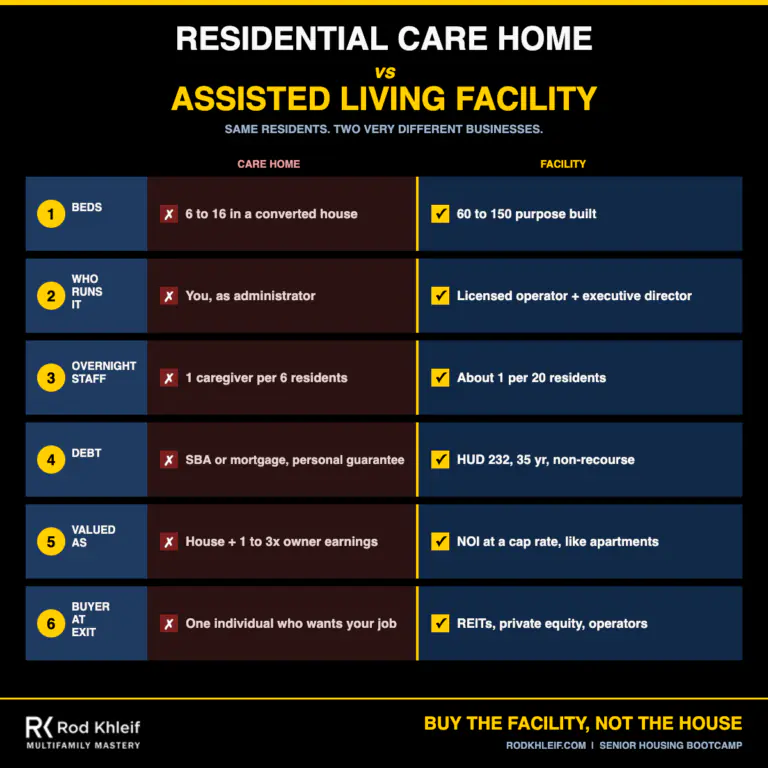
A residential care home (also called residential assisted living, a board and care home, an adult family home, or an RCFE in California) is a house. It is licensed for a small number of residents, typically 6 to 16 depending on the state, and the care is delivered by a few caregivers on shifts inside what is still, legally and physically, a single family residence. The owner is usually the administrator, the bookkeeper, the hiring manager, and the person who gets the 2 a.m. phone call.
An assisted living facility is a licensed community built or converted for the purpose, with private or semi-private apartments, a commercial kitchen, a dining room, common areas, a nurse on staff, and a licensed administrator who runs it. The AHCA/NCAL counts roughly 41,000 assisted living communities in the United States with nearly 1.4 million licensed beds. The average licensed size is 33 beds, and the institutional end of the market, where my students buy, runs 60 to 150 beds.
The simplest way to see the difference is to look at who the residents are and who does the work. In the CDC’s 2020 National Post-acute and Long-term Care Study, 51 percent of residents in 4 to 25 bed communities had Alzheimer’s or another dementia, versus 39 percent in communities over 50 beds. Seventy-nine percent of small home residents needed help bathing versus 60 percent in larger communities. Small homes carry heavier acuity per bed with fewer hands, and that one fact drives most of the economics you are about to see.
Where the two models actually differ
- Licensing: a care home holds one license for one house. A facility holds one license for 60 to 150 beds. Both are inspected, but one inspection covers ten times the revenue.
- Staffing: a care home needs at least one awake caregiver overnight for 6 to 10 residents. A facility staffs overnight at ratios closer to 1 to 15 or 1 to 20, with a nurse on call.
- Management: a care home is owner operated. A facility is run by a licensed administrator and, in most deals I do, a third party operator with a track record.
- Financing: a care home is financed with a residential mortgage, an SBA loan, or hard money. A facility qualifies for bank, agency, and HUD debt that is non-recourse and amortizes over decades.
- Valuation: a care home is valued as a house plus a small business. A facility is valued on net operating income at a cap rate, the same way an apartment building is.
- Exit: a care home sells to another individual operator. A facility sells to REITs, private equity, and regional operators who are actively buying.
Why Does Almost Every Senior Housing Course Teach the Small Care Home Model?
I will give you the honest answer, because I respect the people who built the care home niche and I do not need to name them to make the point.
First, the barrier to entry is low, and low barriers sell seats. A house costs a few hundred thousand dollars in most markets. A student can picture the purchase, the renovation, and the first resident. That is a great story in a webinar. A $12 million facility with a HUD loan and a syndicated equity raise is a harder story to tell to someone who has never bought anything.
Second, the care home model makes the owner the operator, and most courses sell the dream of “owning your own business.” That is a real benefit if you want a job. It is a liability if you want an investment, because an owner operated business has no value without the owner in it.
Third, and this is the part nobody says out loud, most of the people teaching care home conversion have never bought a facility. They teach what they did. I teach what I do, and what I do is buy large communities with partners, professional operators, and institutional debt. If that sounds like a bigger mountain, it is. It is also the mountain where the money is.
I want to be fair here. I have met care home owners who run beautiful homes, give exceptional care, and clear a respectable income. If that is the life you want, go do it well. This post is for the investor who looked at the care home math, felt something was off, and wanted to see the other option laid out plainly.
What Does the Money Look Like: 6 Beds vs 60 Beds?
Let me walk you through both models with numbers that are current as of late 2026. I am using the CareScout 2025 Cost of Care Survey national median of $6,200 a month for assisted living, up 5 percent year over year, and the Q3 2026 NIC MAP assisted living occupancy of 89.1 percent. Care homes usually charge a premium for the home setting and the higher staff ratio, so I give the care home $7,000 a month and a strong 92 percent occupancy.
The 6 bed care home
Six beds at $7,000 a month at 92 percent occupancy is $463,680 a year in revenue. Payroll in a well run small home lands around 43 percent of revenue, or about $199,000, because you cannot run a home with fewer than roughly four and a half full time equivalents no matter how few residents you have. Add food, utilities, insurance, supplies, licensing, marketing, and the mortgage on a house that now carries commercial insurance, and a realistic net before the owner pays themselves is $40,000 to $70,000. The California numbers I pulled from an industry training firm show a sample home at $42,000 of NOI, about 9 percent of revenue, before owner compensation. One bed sitting empty for six months at $7,000 a month wipes out that entire year.
What is it worth? A house, plus whatever a buyer will pay for a business that needs them to run it. In practice that is one to three times the owner’s discretionary earnings. Call it $150,000 to $250,000 of business value on top of the real estate, and only if the buyer can get licensed and wants your job.
The 60 bed assisted living facility
Sixty beds at a blended $5,800 a month (a mix of studios, one bedrooms, and care level add-ons that lands below the national median because I buy in secondary markets) at 89 percent occupancy is 53 occupied units, or $3.69 million a year in revenue. A stabilized assisted living community run by a competent operator throws off a 26 to 32 percent operating margin. At 28 percent, that is about $1.03 million in net operating income after a 5 percent management fee to the operator.
What is it worth? The CBRE H1 2026 investor survey puts Class A assisted living in core markets at a 6.5 percent cap rate, with every segment compressing since October. A Class B community in a secondary market trades closer to 7.5 to 8 percent. At 7.5 percent, $1.03 million of NOI is a $13.8 million asset, about $230,000 a bed. I did not run it. A licensed administrator and a regional operator did. My job was to find it, underwrite it, structure the debt and the equity, and watch the numbers every month. You can see how I underwrite in how to underwrite senior housing deals and assisted living profit margins.
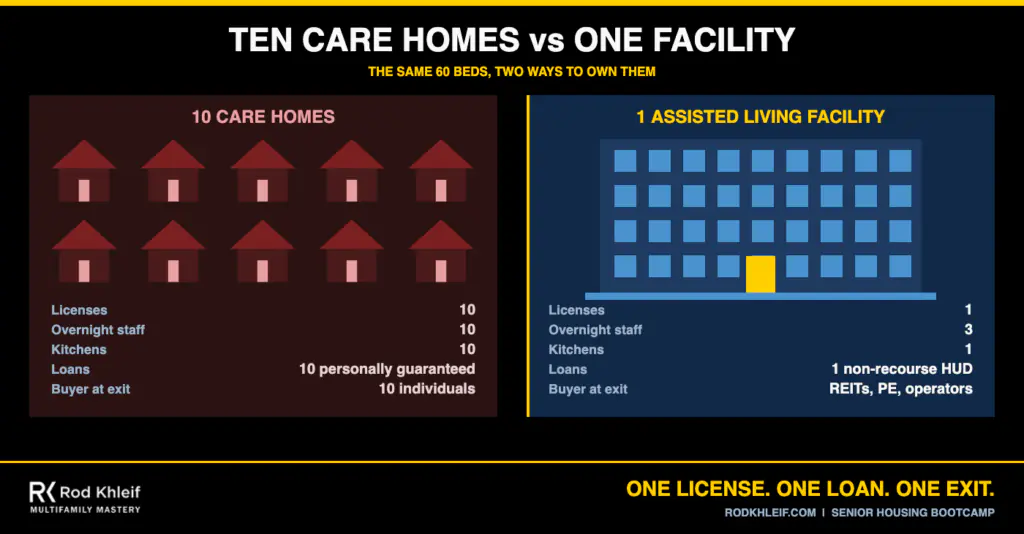
Read that table one more time and look at the last two rows. Ten care homes get you to 60 beds with ten licenses, ten kitchens, ten overnight caregivers, and ten mortgages, and the combined business still sells to individuals one house at a time. One facility gets you to 60 beds with one license, one kitchen, three overnight staff, one non-recourse loan, and an institutional buyer at exit. That is the whole argument in two rows.
Why Don’t Small Care Homes Scale?
The pitch is always the same: buy one, learn the business, then buy five more. Here is what actually happens at home number three.
1. Every home is its own license, inspection, and liability
Licensing is per location. Ten homes means ten applications, ten surveys, ten fire marshal visits, ten sets of resident files, and ten chances for a single deficiency to put a stop placement on a building that only has six residents to begin with. A facility carries the same regulatory weight once, spread over 60 to 150 beds.
2. The overnight shift kills the margin
Most states require at least one awake, trained caregiver overnight in every licensed home regardless of census. One caregiver for six residents is a 1 to 6 ratio at the most expensive hour of the day. A 60 bed facility runs overnight at roughly 1 to 20. On ten homes, that is seven extra overnight employees, about $350,000 a year in wages and taxes, to care for the same 60 people. The small model is structurally more expensive per resident, and no amount of good management fixes that.
3. The owner is the operator, and the operator does not scale
In a care home, the owner is the administrator of record, and in most states the administrator must be reachable and on site regularly. You can hire a manager for each home, but now you are paying a manager’s salary against $460,000 of revenue, and your 9 percent NOI goes to zero. A facility pays one executive director against $3.7 million of revenue, and the operator’s regional team covers the rest.
4. Institutional lenders do not want the house
This is the one almost nobody talks about. HUD 232/223(f), the best debt in this business, is built for licensed facilities serving 20 or more residents: up to 85 percent loan to value, 35 year fully amortizing, non-recourse, at a 1.45 debt coverage. Fannie Mae’s seniors housing program starts at a $5 million loan with a 75 percent loan to value and is also non-recourse. None of that is available on a converted house. The care home owner carries a personally guaranteed SBA loan or a residential mortgage that technically should not be used for a commercial business. The facility owner has a 35 year government insured loan that the next buyer can assume.
5. There is no institutional buyer for a care home portfolio
When you go to sell, who buys ten care homes? Another individual, one at a time, who needs to get licensed in each one. When you sell a 60 bed facility, the buyer list includes regional operators, private equity funds, and healthcare REITs that are actively acquiring. In the CBRE survey, 72 percent of investors said senior housing cap rates fell between October 2025 and April 2026, and 82 percent expect 3 to 7 percent rent growth over the next twelve months. That demand is for facilities. It is not for houses.
What Does It Take to Buy a Large Assisted Living Facility?
Here is where most people assume they are disqualified. They are not. You do not need $5 million in the bank, a nursing license, or twenty years in healthcare. You need four things, and three of them are other people.
Capital: raise it, do not save it
A $13.8 million facility at 70 percent leverage needs about $4.5 million of equity including closing costs and reserves. Nobody writes that check alone. You raise it the same way I have raised capital for apartment buildings for twenty years, through a syndication where investors fund the deal and you earn an acquisition fee, an asset management fee, and a share of the profits for finding and running it. Senior housing investors are hungry for deals with a credible operator attached. Your job is to be the person who brings the deal and the operator together.
An operator with a track record
This is the piece the care home courses skip because the owner is the operator. In a facility deal, you partner with a licensed operator who already runs communities in that state. They hold the license, employ the staff, and manage the building for a fee of around 5 percent of revenue plus incentives. Lenders underwrite the operator as much as the building. I wrote a full guide on how to vet a senior housing operator, and it is the most important read on this site if you are serious about the facility path.
Debt that fits the asset
Most acquisitions close on a bank or bridge loan at 65 to 75 percent of cost, then refinance into HUD or agency debt once the community is stabilized and seasoned. Underwrite the exit refinance on day one. If the deal only works with the bridge loan, it does not work. I covered every option in senior housing financing.
A due diligence process you actually run
Census verification, payroll audits, survey history, resident contracts, and the operator transition plan. The senior housing due diligence checklist and my 15 tips for buying an assisted living facility are the two posts I would hand you before your first tour.
The seven steps, in order
- Pick a segment and a market. Assisted living or memory care, in a secondary market with 80 plus population growth and limited new supply. Only 16,159 units were under construction nationally in Q3 2026, the lowest since 2012, so most markets qualify on supply.
- Line up the operator before the deal. Interview three regional operators in that state. Get their management agreement terms in writing.
- Build the buyer list. Brokers in senior housing are specialists. Call every one in your target state, tell them what you buy, and ask for off market and distressed communities.
- Underwrite on trailing income, not the pro forma. Trailing twelve month census, rates, and payroll. If the seller’s numbers only work with a rent increase, pass.
- Structure the debt and the equity together. Term sheet from the bridge or bank lender, HUD refinance underwriting, and a syndication structure with a preferred return your investors understand.
- Run the full diligence checklist with your operator in the room. They catch what you cannot.
- Close, transition, and watch the numbers weekly. Census, collections, payroll per resident day, and survey readiness. The first ninety days decide the deal.
That is the exact curriculum of the Senior Housing Bootcamp, because it is the exact process I use.
Which Should You Buy?
I am not going to pretend there is one answer for everybody. Use this framework honestly.
If you landed in the left column on most rows, buy the care home and run it with pride. If you landed in the right column, the care home will frustrate you within eighteen months, because it will take all of your time to produce an income you could have earned as the asset manager on a single facility deal. I have watched that exact thing happen to students who came to me after starting down the small road. They were not wrong to want senior housing. They were sold the wrong size.
The question that settles it
Ask yourself: do I want to work in a senior housing business, or do I want to own senior housing real estate? Those are both honorable. They are not the same thing, and the courses that blur them are doing you a disservice. I teach the second one.
How the Senior Housing Bootcamp Teaches the Facility Path
The Senior Housing Bootcamp is built around buying licensed communities, not converting houses. Over the event we cover market selection using NIC MAP and census data, the four segments and which to buy first, how to find and vet operators, underwriting on trailing income with the deal analyzer I use myself, HUD and agency debt, syndicating the equity, due diligence, and the first ninety days after closing. You leave with a process, a template set, and a room full of people doing the same thing.
If you have read this far and the facility path is the one you want, that is where I will see you. If you are not ready for a live event, start with how to invest in senior housing and whether senior housing is a good investment in 2026, then come back.
Residential Care Home vs Assisted Living Facility FAQ
Q: What is the difference between a residential care home and an assisted living facility?
A: A residential care home is a licensed single family house serving roughly 6 to 16 residents, usually owner operated and financed like a house or small business. An assisted living facility is a purpose built licensed community serving dozens of residents, run by a licensed administrator, financed with institutional debt, and valued on net operating income like an apartment building.
Q: Is residential assisted living a good investment?
A: It can be a good owner operated business, with a realistic net of $40,000 to $70,000 a year on a 6 bed home before the owner pays themselves. As a passive real estate investment it is weak, because the value depends on the owner working in it and there is no institutional buyer or non-recourse debt for a converted house.
Q: How much does a residential care home make per year?
A: A 6 bed home at $7,000 a month and 92 percent occupancy grosses about $464,000. After payroll of around 43 percent and the other operating costs, net operating income before owner compensation is typically 9 to 15 percent, or roughly $42,000 to $70,000. One bed vacant for six months can erase most of that.
Q: How much does a 60 bed assisted living facility make?
A: At a blended $5,800 a month and 89 percent occupancy, a 60 bed community grosses about $3.7 million a year. A stabilized operator margin of 26 to 32 percent produces roughly $1 million of net operating income, which at a 7.5 percent cap rate supports a value near $13.8 million.
Q: Can you buy an assisted living facility with no healthcare experience?
A: Yes, if you partner with a licensed third party operator who holds the license and runs the community. Lenders and investors underwrite the operator’s track record. Your role is finding the deal, structuring the debt and equity, and asset managing the investment.
Q: How do you finance an assisted living facility purchase?
A: Most acquisitions close on a bank or bridge loan at 65 to 75 percent of cost, then refinance into HUD 232/223(f) or Fannie Mae seniors housing debt once stabilized. HUD lends up to 85 percent loan to value on a 35 year non-recourse fully amortizing loan to licensed facilities serving 20 or more residents.
Q: Why do most senior housing courses teach the care home model?
A: Because the entry cost is a house, the story is easy to sell, and most of the instructors built care homes themselves. The model works as a small business, but it does not scale, qualify for institutional debt, or attract institutional buyers at exit.
Q: How many beds does an assisted living facility need to qualify for HUD financing?
A: The HUD 232/223(f) program is built for licensed facilities serving 20 or more residents, and independent living units cannot exceed 25 percent of the total. Most lenders look for loans of about $2 million and up.
Q: What is a typical cap rate for assisted living in 2026?
A: The CBRE H1 2026 investor survey put Class A assisted living in core markets at 6.5 percent, with all senior housing segments compressing 11 to 28 basis points since October 2025. Class B communities in secondary markets generally trade between 7.5 and 8.5 percent.
Q: Should I start with a care home and then buy a facility?
A: Usually not. The skills do not transfer well: a care home teaches you to be a caregiver and administrator, while a facility deal requires deal finding, underwriting, capital raising, and operator oversight. Most students who start small spend two years in a job they did not want before learning the facility process from scratch.
Ready to Take the Next Step?
The senior housing wave is real. Occupancy has climbed nineteen straight quarters, construction is at a fourteen year low, and the 80 plus population is only getting started. The question is not whether to get into senior housing. It is what size you get into, and whether you build a business that needs you or an asset that pays you.
Come learn the facility path at the Senior Housing Bootcamp. Bring your questions, your market, and your doubts. I will show you exactly how I buy these.
And if you have not already, grab a free copy of my book and join the community where my students post the deals they are working on.

Get the free book | Join the free community | Senior Housing Bootcamp
This article is for educational purposes only and is not investment, legal, licensing, or tax advice. Figures are illustrative examples based on published industry data as of October 2026; actual results vary by market, operator, and asset. Consult licensed professionals before making any investment or licensing decision.
