
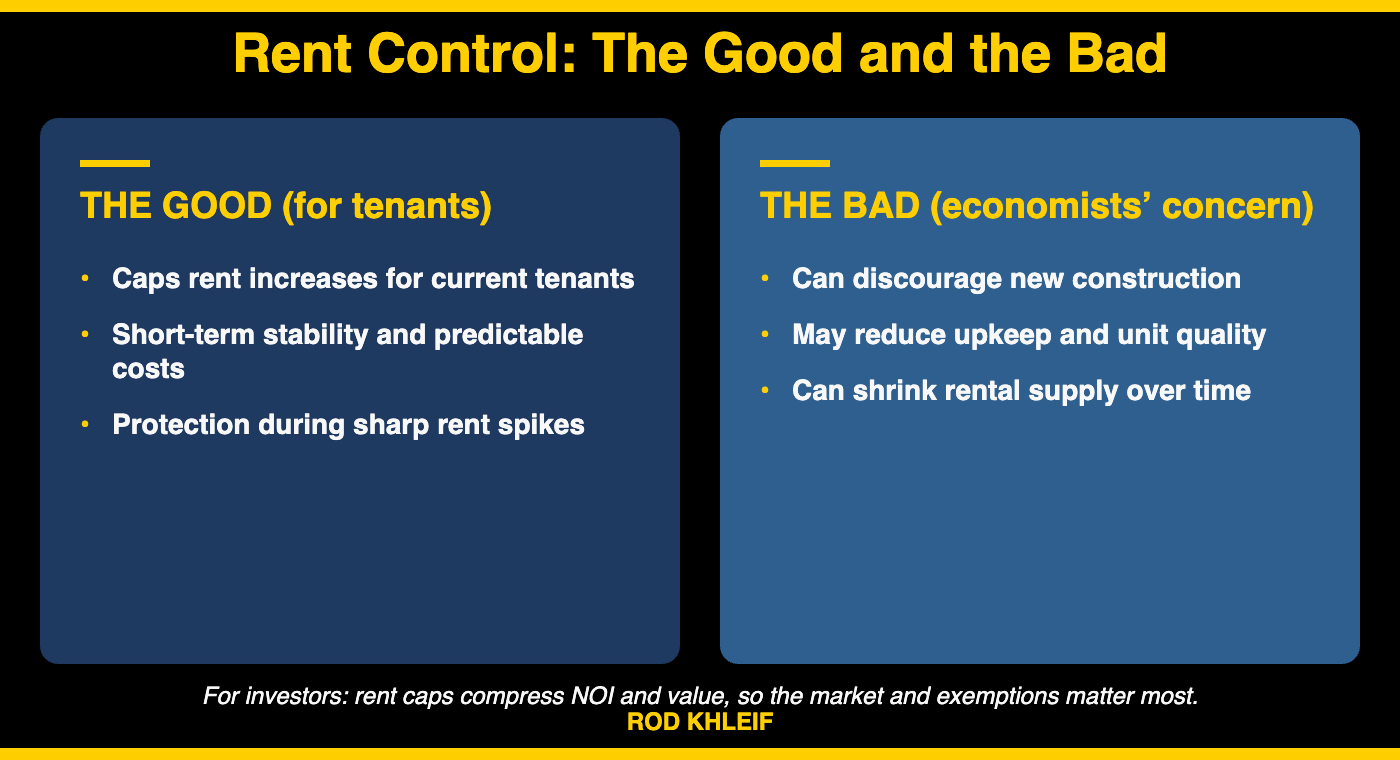
Rent control caps how much a landlord can raise rent, usually on existing tenants. It can shield renters from sharp increases in the short term, but most economists warn it also discourages new supply and maintenance over time. There is no national rent control law in the United States. It is set state by state, so for investors the market you buy in matters more than the headlines.
The concept of rent control often sparks debate, particularly among investors concerned about rental property profitability and long-term sustainability. National rent control introduces uncertainty and risk for landlords, impacting the housing supply and overall rent price trends.
With rent control back on the agenda in statehouses across the country, it is critical to assess the benefits, drawbacks, and economic impact of such policies. The proposal specifically targets corporate landlords with 50 or more units, requiring them to cap rents at 5% annual increases or forfeit certain tax benefits.
Although the full details of the plan are still unclear, it is expected that any national rent stabilization policy would resemble existing state and local rent control laws. This raises important questions: does rent control work? What are the effects on housing supply? Is rent control good or bad for long-term affordability? Let’s break it down.
What is in this guide
- Where national rent control stands in 2026
- The advantages of rent control
- The downsides: why rent control can be bad
- The pros and cons debate
- Does rent control work?
- How smart investors operate in rent-controlled markets
- Final thoughts
- Frequently asked questions
- Want to learn more?
Where national rent control stands in 2026
Here is the honest status. There is no national rent control law in the United States, and there is not one on the books in 2026. The most visible federal effort was a 2024 proposal to push large corporate landlords, owners with 50 or more units, to cap annual rent increases at 5 percent or give up favorable depreciation treatment. That proposal was never enacted into law.
What is real is the activity at the state and local level, where rent control actually lives. California passed statewide caps on many older properties with its 2019 Tenant Protection Act, and other states and cities have their own rules while some states ban it outright. Heading into 2026 the National Apartment Association has been tracking well over one hundred active rent control bills nationwide as affordability stays front and center. For an investor, that means the rules you live under depend far more on the market you buy in than on any national headline. Independent industry trackers are the place to follow it.
The Advantages of Rent Control: How It Benefits Owners and Tenants
Owner Perspective: Leveraging Rent Caps and Market Trends
A 2018 study by economists Diamond, McQuade, and Qian (DMQ) analyzed the effects of a 1995 rent control policy in San Francisco. The research found that tenants were 8% less likely to move after rent stabilization was enacted.
However, this also led to a 15% reduction in available rental units as landlords converted properties into condominiums. With lower turnover rates and fewer available apartments, rental prices for non-rent-controlled units surged.
In a rent control scenario, landlords may still see advantages, including:
- Higher occupancy rates as tenants stay longer
- Lower eviction rates due to tenants avoiding market-rate housing
- Reduced turnover costs with fewer vacancies
- Higher rent increases on new tenant leases, allowing for some revenue growth
Even under national rent control, investors can capitalize on market shifts by adjusting pricing strategies and benefiting from higher lease rates on new tenants.
Example of Value Creation Despite Rent Caps
Consider a multifamily rental property where:
- Operating expenses typically account for 45% of rental income
- The property generates $1M in rental income, with $450K in annual costs
- A 5% increase in expenses raises costs by $22.5K annually
- If 80% of tenants receive a 5% rent increase and new leases increase by 10%, overall rental income rises by 7% ($70K annually)
- At a 5% CAP rate, this results in a $950K increase in property value, despite rent caps
While rent control limits rental price increases, landlords may still benefit from higher rents on new leases and strong occupancy rates.
Tenant Perspective: The Benefits of Rent Control
For tenants, rent stabilization policies serve as a financial safety net, limiting sharp housing cost increases and preserving affordability.
Key benefits include:
- Predictable rent prices with a 5% annual cap
- Easier long-term budgeting and reduced risk of displacement
- Protection from gentrification-driven rent hikes, ensuring more stable housing costs
For tenants who secure a rent-controlled unit, the policy provides financial security, particularly in high-cost urban markets.
The Downsides: Why Is Rent Control Bad?
Owner Perspective: The Challenges of Rent Control Economics
While rent control economics may benefit tenants, it presents significant challenges for rental property owners.
- Capped rental income growth limits the ability to adjust rents for rising operational costs
- Inflationary pressures and rising expenses (e.g., property taxes, insurance, and maintenance) continue to climb
- Renovation restrictions prevent property owners from repositioning units, affecting value-add investment strategies
In a rent-controlled housing market, investors must shift their focus from short-term rental price appreciation to long-term property appreciation.
Tenant Perspective: The Unintended Effects of Rent Control
While rent stabilization policies provide benefits to existing tenants, they can also lead to negative housing supply issues.
- Fewer available rental properties – As shown in San Francisco (DMQ Study, 2018), rental supply declined as landlords converted units into condos or withdrew from the market
- Higher starting rent prices – Since landlords cannot freely adjust rents, they often charge higher rates for new tenants to compensate for lost revenue
- Declining property maintenance – The same study found that property upkeep suffered, as landlords had little incentive to reinvest in rent-controlled buildings
This raises a crucial question: what are some of the unintended effects of rent control, and how do they impact overall housing quality?
The National Rent Control Pros and Cons Debate
Economists broadly agree that government-imposed price regulations can create unintended consequences. If national rent stabilization policies take effect, it could:
- Reduce new rental property investment due to lower profit potential
- Limit housing supply, causing landlords to exit the market
- Increase market-rate rents, as restricted supply makes available units more expensive
Most multifamily real estate investors model for 3% organic annual rent growth. However, value-add investment strategies often project higher rent increases post-renovation.
Under rent caps, landlords can only raise rents to market rates on vacant units. The biggest risk is low tenant turnover, which can delay renovations and reduce potential returns.
At a national level, policymakers must strike a balance between protecting tenants and incentivizing continued investment in the housing market.
Does Rent Control Work?
The effectiveness of rental policies depends on various factors.
- For tenants, rent stabilization ensures predictability and affordability
- For landlords, it restricts revenue potential and discourages investment in new housing development
As debates over national policies continue, investors must stay informed and be ready to adapt investment strategies to comply with potential regulatory changes.
How smart investors operate in rent-controlled markets
You cannot vote rent control up or down from your desk, but you can decide how exposed to it you are. I call this the Rent-Control Resilience Playbook, and it is how experienced operators protect returns whatever the policy does.
- Know the local rules before you buy. Caps, exemptions, and vacancy rules vary by city. Read them into your underwriting before you make an offer, never after.
- Favor markets and product that are exempt. Newer construction is often exempt from caps for years, and landlord-friendly states carry far less policy risk.
- Underwrite to the cap, not the dream. Model rent growth at or below the legal limit so a capped year is your base case, not a surprise.
- Force value through operations. Where rent growth is limited, protect net operating income by cutting expenses, adding ancillary income, and improving units at turnover within the rules.
- Keep tenants and buildings healthy. Long, stable tenancies and well maintained buildings are your best hedge when raising rents is off the table.
Rod Khleif: “Policy is not something you control, so stop arguing about it and start underwriting around it. The investors who win in tough markets are the ones who bought right and operate well, not the ones who guessed the politics.”
Final Thoughts: Is National Rent Control Good or Bad?
The effects of national rent stabilization are complex. There are clear advantages for tenants, but unintended consequences such as shrinking housing supply, increased rental prices for new tenants, and declining property conditions remain concerns.
Economists frequently cite evidence that price controls often lead to housing shortages and quality deterioration.
For real estate investors, understanding rent control economics is critical when making strategic investment decisions. The key question remains: is it good for affordability, or does it discourage new investment and reduce supply?
Frequently asked questions
Is there national rent control in the United States?
No. There is no federal rent control law. A 2024 proposal would have pressured large corporate landlords to cap increases at 5 percent, but it was never enacted. Rent control is set at the state and local level.
Is rent control good or bad?
It depends on who you ask and the time frame. It can protect existing tenants from sharp increases in the short term, but most economists find that broad rent control reduces new supply and maintenance over the long term. Both can be true at once.
How does rent control affect real estate investors?
Caps limit how fast you can grow rents, which compresses net operating income and therefore value. It does not make deals impossible, but it makes your choice of market, the exemptions that apply, and disciplined underwriting far more important.
Which states have rent control?
Rules vary widely and change often. California and Oregon have statewide measures, several cities have their own, and many states preempt or ban it entirely. Always confirm the current local rules for your specific market before you buy.
Can you still make money with rent-controlled properties?
Yes, but the strategy shifts from pushing rents to protecting income through operations, expense control, ancillary revenue, and buying in the right markets rather than relying on rapid rent growth.
Want to Learn More?
New to apartments? Start with the complete beginner guide to multifamily investing, then grab the free Lifetime CashFlow ebook and join my Multifamily Bootcamp.
Explore the latest insights on multifamily investing, rental property economics, and government housing policies on Rod’s podcast.
This article is for educational purposes only and is not legal, financial, or investment advice. Rent control laws vary by state and city and change often. Always confirm the current local rules with a qualified professional before you invest.
