
I have watched too many multifamily investors lose great deals because their lender wanted three years of tax returns showing depreciation losses while a clean cash flowing property sat on the contract waiting. A multifamily DSCR loan was built for that exact moment. It qualifies the deal on the property’s ability to service its own mortgage instead of on your taxable income, and the right investor uses it to close in three weeks while everyone else is still waiting on agency underwriting.
This guide walks through how multifamily DSCR loans actually work, when they beat agency debt, when they are the wrong tool, what they cost in 2026, and how to underwrite a deal so your DSCR clears with cushion. If you are a passive investor in syndications, the section near the end on questions to ask a GP will save you from bad capital calls.
Table of Contents
- Why Most Multifamily Investors Pick the Wrong Loan
- The Five Filter DSCR Stack
- How a Multifamily DSCR Loan Actually Works
- Multifamily DSCR Loan Requirements in 2026
- DSCR Loan Rates and What Moves Them
- How to Underwrite a Multifamily DSCR Deal in Five Steps
- DSCR Loan vs Agency Debt
- PITIA Based vs NOI Based DSCR
- When DSCR Is the Right Tool
- When DSCR Is the Wrong Tool
- A Warrior Who Scaled With DSCR Debt
- Common Mistakes to Avoid
- DSCR Loans for Passive LPs in Syndications
- Multifamily DSCR Loan FAQ
- Ready to Take the Next Step?
Why Most Multifamily Investors Pick the Wrong Loan
A multifamily DSCR loan qualifies the property on its own cash flow rather than the borrower’s tax returns or W2 income. Lenders calculate Debt Service Coverage Ratio as net operating income divided by annual debt service, or rent divided by PITIA on smaller deals, and approve any property that clears their threshold without ever opening your personal tax file.
Conventional and agency lenders measure you, not the deal. They want W2 stubs, two years of returns, a debt to income ratio under 43 percent, and a story for every passive loss on Schedule E. That works fine for someone buying their first house. For a real estate investor running a portfolio with bonus depreciation, cost segregation, and accelerated write offs, it is a brick wall. You can be sitting on $400,000 of taxable losses and $80,000 a month of real cash flow and a full doc underwriter will still tell you no.
The fix is not louder arguing with the underwriter. The fix is a different loan product. DSCR financing exists because lenders eventually figured out that the property itself is the better credit. The property does not have a tax return. The property has a rent roll, a T12, an insurance binder, and a tax bill. Plug those into a coverage ratio and you have a decision. Three weeks later you are at the closing table.
Signs Your Deal Belongs in a DSCR Loan
Use this short list to self diagnose before you call a lender:
- Your last two tax returns show passive losses or modest taxable income that does not reflect your real cash flow.
- You hold properties through an LLC or a revocable trust for liability protection.
- The deal is under $1.2 million and unlikely to clear agency small balance minimums.
- You need to close in 30 days or less to beat another offer.
- You are past the conventional 10 mortgage cap.
- You are self employed, foreign national, or otherwise outside the W2 box.
- You want to scale into 5 to 10 properties without re documenting your life every six months.
If two or more of those describe you, agency or conventional debt will fight you on this deal. Read on.
The Five Filter DSCR Stack
I use a simple framework to decide whether a multifamily DSCR loan is the right financing tool or whether the deal belongs on a different shelf. I call it the Five Filter DSCR Stack. Run the deal through each filter in order, and by the time you reach Filter 05 you know exactly what financing path makes sense.
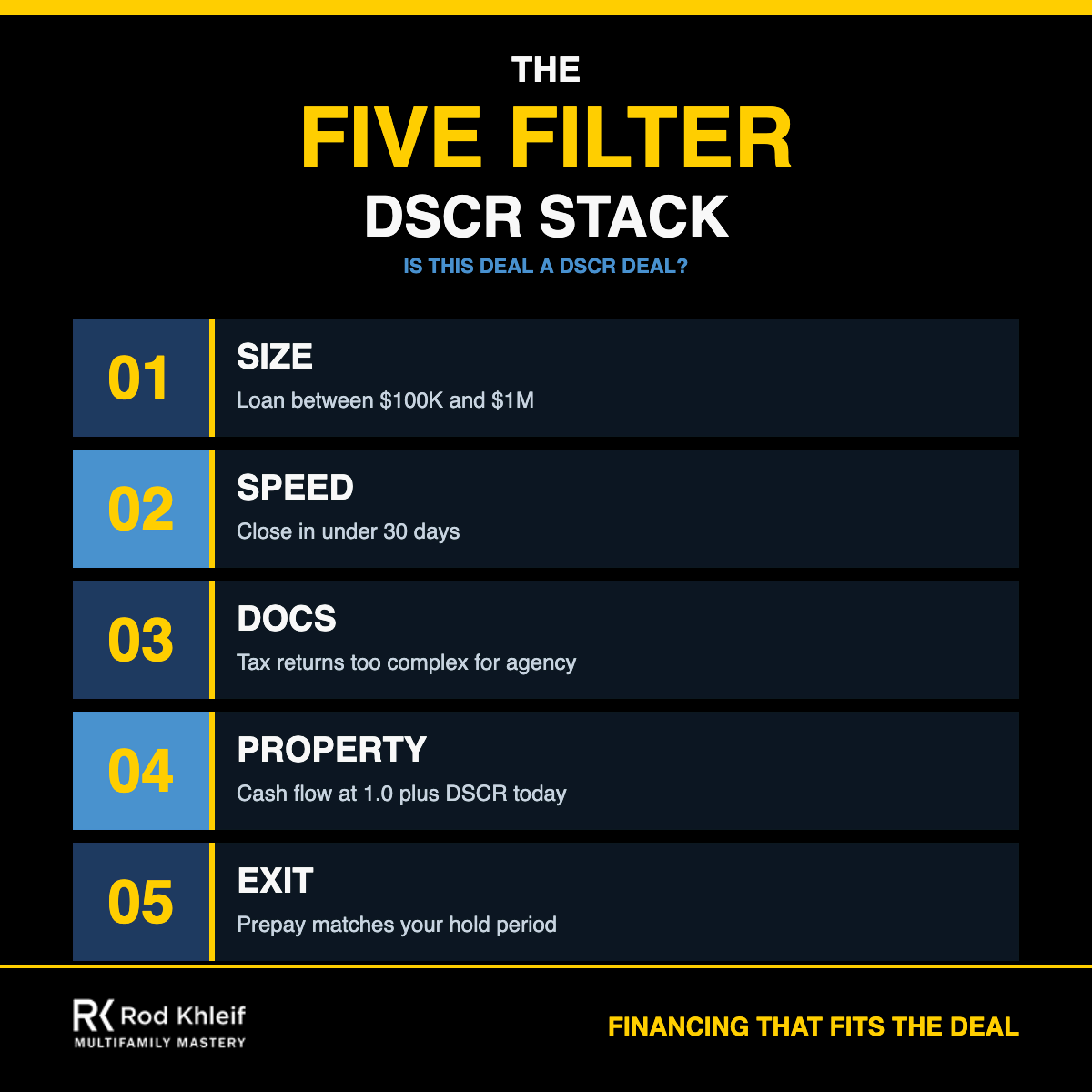
Filter 01. Size
DSCR loans are happiest between roughly $100,000 and $1.5 million. Below $100,000 you struggle to find a lender willing to underwrite the file because fixed costs eat their margin. Above $1.5 million the same property usually qualifies for Fannie Mae or Freddie Mac small balance debt at 50 to 150 basis points lower. The sweet spot for DSCR is small multifamily, two to ten units, where the deal is too big for a conventional rental loan and too small for agency programs.
Filter 02. Speed
If you need to close in 21 to 30 days, DSCR is one of the only paths that actually delivers. Agency timelines run 60 to 90 days even on a clean file. The reason is documentation. DSCR underwriters do not chase your tax returns, business returns, K1s, or your CPA. They chase the property’s appraisal, the rent roll, the insurance binder, and the LLC operating agreement. That is a much shorter checklist.
Filter 03. Docs
This is the filter that saves most experienced investors. If you write off depreciation aggressively, run cost segregation studies, or own a stack of pass through entities, your personal returns make conventional underwriters nervous even when your real cash flow is strong. DSCR removes that fight entirely. You hand over an LLC operating agreement, a rent roll, a T12, and a credit pull. No personal returns, no DTI calculation, no game of explaining bonus depreciation to a 22 year old underwriter.
Filter 04. Property
The property has to actually cover its own mortgage at acquisition. That means an in place DSCR of at least 1.0 to qualify and 1.25 or higher to win the best pricing. If you are buying a value add building that runs negative cash flow until you push rents, you need bridge or hard money first and then a DSCR refinance after stabilization. The deal that lands you at a 0.85 DSCR today is not a DSCR loan deal today. It might be a beautiful BRRRR deal tomorrow.
Filter 05. Exit
DSCR loans usually come with prepayment penalty structures, often three, four, or five year step downs. Take a 30 year DSCR loan with a five year prepay and then try to 1031 out at year two and you will eat a meaningful penalty. Match the prepay structure to your real hold plan. If you are a long term holder, take the lower rate that comes with a longer prepay. If you might sell or refi inside three years, pay the rate premium for a shorter prepay window.
How a Multifamily DSCR Loan Actually Works
Underwriting on a DSCR loan revolves around a single number, the Debt Service Coverage Ratio. There are two ways the math gets done depending on the size of the deal, and missing the distinction is one of the most expensive rookie mistakes in the entire space.
For one to four unit residential rentals and small multifamily under five units, most DSCR programs use a simplified formula. The lender takes the market rent for the property and divides it by the monthly PITIA payment. PITIA stands for principal, interest, taxes, insurance, and HOA if applicable. That number is your DSCR. A duplex renting for $4,000 a month with a $3,200 PITIA produces a 1.25 DSCR. Done.
For five plus unit properties most lenders shift to commercial style underwriting. They calculate net operating income, which is rent minus vacancy minus operating expenses minus reserves, then divide that NOI by the annual debt service. A 20 unit apartment with $400,000 of NOI and $320,000 of annual debt service produces the same 1.25 DSCR but the math is far more conservative because NOI includes property management, repairs, vacancy assumptions, and replacement reserves. That difference matters when you are comparing apples to apples.
According to recent data from the National Multifamily Housing Council, debt availability tightened meaningfully in 2024 and remained selective into 2026, with non agency lenders capturing share specifically in the small multifamily space agency products do not serve. That is the lane DSCR loans own.
One nuance worth flagging: the same property can produce wildly different DSCRs depending on whether the lender uses the small balance PITIA method or the commercial NOI method. A property with $50,000 of NOI on a $40,000 annual debt service shows a 1.25 DSCR on the commercial method, but if a small balance lender ignores operating expenses and just runs gross rent over PITIA, that same property might score 1.55. Same building. Two completely different numbers. Always ask up front which method the lender uses before you spend a week underwriting against the wrong formula.
Multifamily DSCR Loan Requirements in 2026
Program terms shift constantly so treat what follows as a framework, not a quote. As of early 2026, here is what most reputable DSCR lenders are asking for on multifamily product:
- Credit score: 620 minimum for entry level programs, 680 to 740 plus for best pricing. Score above 740 and you typically save 25 to 75 basis points.
- Down payment: 20 to 25 percent on most multifamily programs, with 15 percent available on a small number of aggressive products at a rate premium.
- Minimum DSCR ratio: 1.0 to clear the box, 1.25 or higher to unlock the lowest rates and the highest leverage.
- Cash reserves: 3 to 12 months of mortgage payments held in liquid accounts. Larger loan sizes pull longer reserve requirements.
- Property condition: Rent ready at closing. Major deferred maintenance kicks you toward bridge debt.
- Loan to value: 75 to 80 percent purchase, 70 to 75 percent rate and term refinance, 65 to 70 percent cash out refinance.
Property eligibility on multifamily DSCR programs spans one to four unit rentals, five to ten unit small multifamily, short term rentals in many markets, and mixed use buildings where the residential square footage is majority. Programs vary, so confirm property type approval before you sign the contract.
Borrower flexibility is one of the genuine perks. DSCR programs typically allow foreign national borrowers, LLCs, revocable living trusts, partnerships, and S corps. Some require a personal guarantee from the principals, others offer fully non recourse structures at slightly higher rates. Experience requirements are usually entry level on single family and small multifamily but tighten quickly on five plus unit deals, where many lenders want to see at least one or two prior investment properties in your name.
DSCR Loan Rates and What Moves Them
DSCR rates in May 2026 run roughly 6.0 to 8.5 percent for typical multifamily borrowers, with the cleanest files pricing closer to the bottom of that range and weaker credit or higher leverage scenarios closer to the top. The pricing structure is usually a Treasury index plus a spread, with most programs running 250 to 400 basis points over the 5 year or 10 year Treasury depending on loan term.
Several inputs move your rate within that range. Credit score moves it most. A 760 plus borrower can be 75 basis points cheaper than a 660 borrower on the same property. DSCR ratio matters next. A 1.40 in place DSCR usually beats a 1.05 by 25 to 50 basis points because the lender’s risk drops. Down payment matters less than people think above 25 percent but matters enormously at 20 percent versus 25 percent thresholds.
Two pricing levers that investors underuse: buydown points and prepayment penalty term. Paying 1 to 2 points up front to buy your rate down can shave 25 to 50 basis points off the note rate, which on a $750,000 loan saves serious money over a five year hold. Lengthening your prepayment penalty term from three years to five years also reduces the rate, sometimes by another 25 basis points. Both of those moves only make sense if your real hold plan supports them.
The single number that actually matters is the monthly payment in your hand, not the headline rate on the term sheet. A 6.75 percent rate with no points often beats a 6.25 percent rate with two points, depending on hold period. Run the breakeven math before you sign.
How to Underwrite a Multifamily DSCR Deal in Five Steps
Here is the exact process I teach Warrior students to run on every deal before they call a DSCR lender. This is the deal side of the equation, not the lender shopping side.
- Pull the rent roll and trailing 12 month profit and loss. Both documents have to tie. If the rent roll says 18 occupied units and the T12 says 15, you have a problem. Reconcile before you spend another hour on the file.
- Choose the calculation method. Confirm with the lender whether the program runs PITIA based DSCR or commercial NOI based DSCR. The wrong assumption here can blow up your loan sizing by 20 to 30 percent.
- Stress test for vacancy and expenses. Run the DSCR at acquisition. Then rerun it with vacancy at 8 percent instead of 4 percent. Rerun it again with operating expenses 10 percent higher than current. If any of those scenarios drop you under 1.10, the deal is thin.
- Quote three lenders in parallel. Get term sheets from at least three DSCR shops on the same day. Compare rate, points, prepay structure, max LTV, and total cost over your intended hold. Lender competition is the single biggest savings lever available to you.
- Lock prepay to your exit. Decide your exit before you sign anything. If you plan to refi or sell in two years, take a two year or three year prepay step down even at a rate premium. If you are holding ten years, lock the five year prepay for the lower rate.
The files that close fastest share a pattern. Clean rent roll, clean T12, current leases scanned, LLC operating agreement ready, insurance binder available, and one decision maker on the borrower side. Files that delay always share the opposite pattern.
Three Worked Scenarios Across Deal Sizes
The math changes meaningfully as you move up the size curve. Here are three real world style scenarios at different multifamily deal sizes showing how the calculation method and the best financing path both shift.
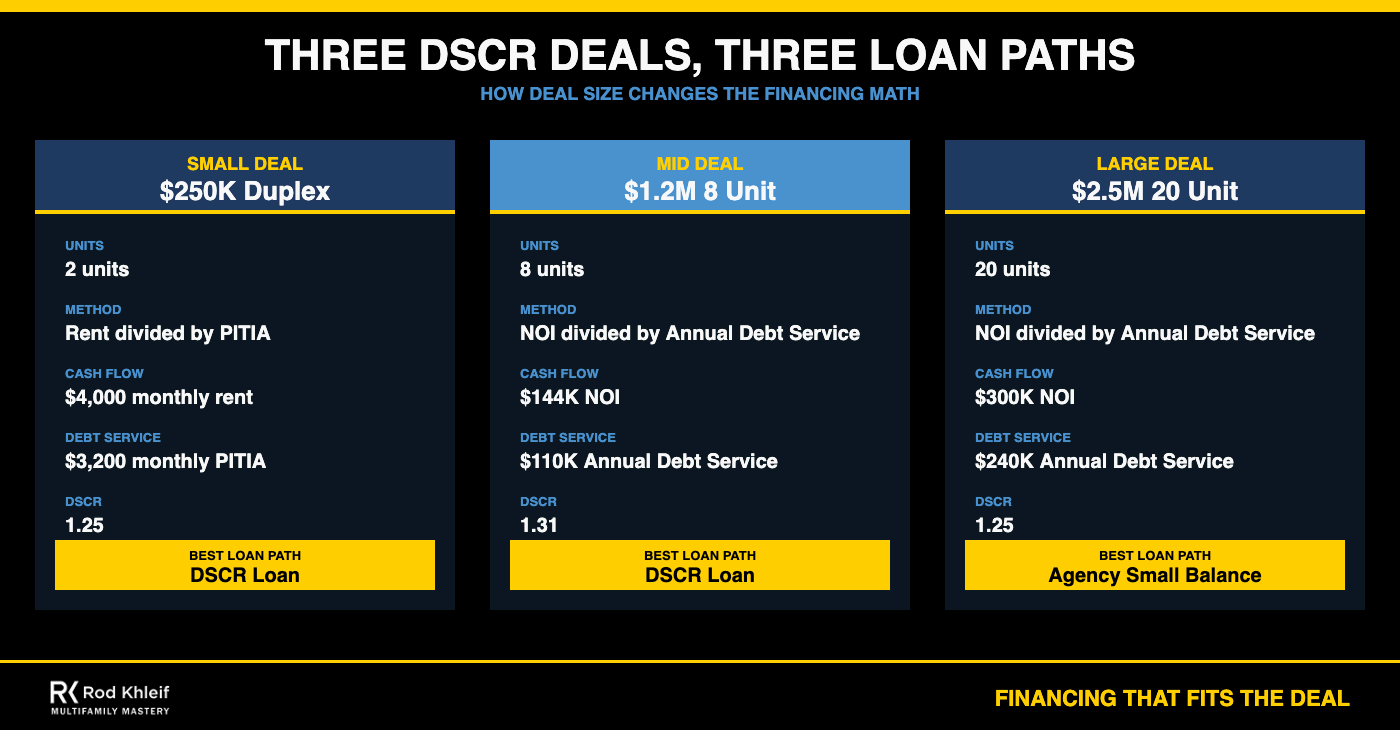
Notice the pattern. At $250K you are using PITIA based math and DSCR is the clear winner because no agency program touches a deal that small. At $1.2 million on an 8 unit you are still inside DSCR territory and the commercial NOI calculation kicks in. At $2.5 million on a 20 unit the same DSCR clears, but Fannie Mae or Freddie Mac small balance debt is now in play and the agency rate is usually 50 to 100 basis points lower. The right financing depends on the deal, not on your preference.
DSCR Loan vs Agency Debt
This is the comparison that decides most experienced investors’ financing choice. Side by side:
| DSCR LOAN vs AGENCY DEBTSIDE BY SIDE COMPARISON | ||
|---|---|---|
| Factor | Agency Debt | DSCR Loan |
| Documentation | Full borrower financials | Property cash flow only |
| Minimum Loan Size | $1M plus small balance | $100K to $250K floor |
| Property Size | 5 plus units, no upper cap | 1 to 10 units typical |
| Minimum DSCR | 1.25 to 1.30 | 1.0 to 1.25 |
| Closing Speed | 60 to 90 days | 21 to 30 days |
| Rate Premium | Lower base rate | 50 to 150 bps higher |
| Recourse | Non recourse | Often non recourse |
| Best Use Case | Stabilized $1M plus, rate sensitive, long hold | Small multifamily, fast close, complex returns |
The honest takeaway is that DSCR wins for deals under $1 million, time sensitive closings, and investors with complicated personal financials. Agency wins on rate and loan size for stabilized larger properties. The investor who masters both, and knows when to deploy each, dramatically outperforms the investor who is loyal to one product. For a deeper look at the full multifamily financing landscape, my multifamily financing complete guide walks through every major option.
PITIA Based vs NOI Based DSCR
If you only remember one nuance from this entire guide, remember this one. The same property can produce wildly different DSCRs depending on which calculation method your lender uses.
| PITIA BASED vs NOI BASED DSCRWHICH MATH YOUR LENDER USES MATTERS | ||
|---|---|---|
| Dimension | PITIA Method | NOI Method |
| Typical Use | 1 to 4 unit residential, small DSCR | 5 plus unit commercial multifamily |
| Formula | Gross rent divided by PITIA | NOI divided by annual debt service |
| Expenses Included | Taxes, insurance, HOA only | Full operating expenses plus reserves |
| Vacancy Assumption | Usually ignored | 5 to 8 percent built in |
| Difficulty to Clear | Easier, less conservative | Tougher, more conservative |
| Investor Risk | Hidden expense risk on cash flow | Closer to real cash flow reality |
Always know which method your lender is using before you spend underwriting hours on the file. My multifamily underwriting guide goes deeper on the NOI calculation specifically.
When DSCR Is the Right Tool
Five scenarios where a multifamily DSCR loan is clearly the right tool for the job:
- Small multifamily in the 5 to 10 unit range. Too big for conventional residential lenders, too small for agency programs. DSCR owns this lane.
- Investors with significant depreciation and write offs. Your real cash flow looks great. Your tax return looks like you barely break even. DSCR ignores the second one.
- Self employed investors without W2 documentation. Business owners, contractors, and entrepreneurs with non standard income streams skip the agency obstacle course entirely.
- Time sensitive deals where 60 to 90 day agency timelines will not work. Foreclosure auctions, off market opportunities with short fuses, and 1031 exchange deadlines all push toward DSCR speed.
- Scaling past the conventional 10 property cap. Fannie Mae stops counting once you cross 10 financed properties. DSCR lenders do not.
A sixth bonus scenario worth naming: LLC and entity ownership for liability protection without agency complications. DSCR programs are built for LLCs from the ground up.
When DSCR Is the Wrong Tool
The wrong loan kills more deals than the wrong property. Five scenarios where DSCR is not the answer:
- Large stabilized properties where the agency rate advantage outweighs DSCR convenience. On a $4 million stabilized apartment building, a 100 basis point rate savings from Fannie Mae or Freddie Mac dwarfs the documentation hassle.
- Heavy value add deals where the property does not cash flow at acquisition. A 0.85 DSCR will not qualify for DSCR financing. That deal needs bridge debt first, DSCR second.
- Long term holders who care more about rate than flexibility. If you are buying for a 20 year hold and the cash flow is tight, the rate matters more than anything else.
- Ground up construction. DSCR programs underwrite existing income. New construction needs a construction loan, then DSCR or agency refinance after certificate of occupancy.
- Mixed use buildings where commercial square footage is majority. Most DSCR programs cap commercial square footage at 30 to 49 percent. Beyond that you are in commercial mortgage backed securities territory.
If your deal is heavy value add, my BRRRR method for multifamily investors walks through how to bridge to DSCR refinance properly.
A Warrior Who Scaled With DSCR Debt
Anthony Metzger walked into the Warrior program as a grade school teacher with a small portfolio and a big ambition. Two of his early scaling moves were small multifamily acquisitions financed through DSCR debt. The reason was simple. He was self employed on the side, his tax returns were complicated, and he needed to close fast on opportunities that would not wait for a 90 day agency timeline. DSCR was the only path that worked.
Watch the Full Interview
Anthony walks through how he went from teaching grade school to raising real capital and scaling a multifamily portfolio with the right financing at each step.
The pattern I see again and again with our Warriors is that the financing decision is downstream of the scaling decision. If you have decided to scale past 10 doors, you need DSCR or commercial financing in your toolkit. Period. The investors who get stuck at five or six properties are usually the ones who treat their lender like a marriage instead of a tool.
Rod Khleif: “The right loan for the deal is the loan that lets you close the deal. Stop trying to force every property into the same financing box. Build a relationship with two DSCR shops, two agency shops, and one bridge shop, and let the deal pick the product.”
Common Mistakes to Avoid
Seven mistakes that I see repeatedly on DSCR files. Avoid all of them:
- Underestimating the prepayment penalty. A 5 percent prepay in year one on a $600,000 loan is $30,000. That eats most of a 1031 exchange profit if you sell too early.
- Confusing PITIA based DSCR with NOI based DSCR. Walking into a 5 plus unit deal assuming PITIA math will get you a rude surprise at underwriting when NOI math drops your DSCR by 30 percent.
- Not stress testing for vacancy and expense creep. A 1.0 DSCR at acquisition means zero cushion. One vacancy and you are paying out of pocket. Build for 1.15 or higher in your stress case.
- Forgetting that property tax reassessment can crater DSCR post acquisition. Buy a property at $1 million that was last assessed at $500,000 and you might wake up to a property tax bill that doubled. Run your DSCR at the reassessed tax bill, not the current one.
- Ignoring the rate premium when agency was actually available. If your deal could have qualified for Fannie or Freddie, taking DSCR convenience costs real money over a long hold.
- Stacking short prepay DSCR debt across a correlated portfolio. Five DSCR loans with three year step downs all coming due in the same 12 month window during a rate spike is a refinance nightmare.
- Skipping the due diligence trip because the lender does not require it. DSCR does not protect you from a bad property. Walk every unit. Pull every lease. My multifamily due diligence guide is the checklist I make every Warrior run before closing.
DSCR Loans for Passive LPs in Syndications
Even if you are not signing the loan yourself, you need to understand DSCR financing because plenty of syndicators use it on smaller deals. If you are an LP in a 20 to 50 unit deal under $5 million, there is a real chance the GP is financing it through DSCR rather than agency.
That changes your risk profile in three ways. First, DSCR loans usually carry shorter terms and higher rates than agency, so the refinance risk and rate exposure are higher. Second, DSCR prepay structures can lock the deal into specific exit timing whether or not the market is cooperative. Third, the loan to value is often slightly tighter on DSCR than agency, which means less leverage and lower equity multiple potential.
Questions every passive LP should ask the GP before signing the subscription docs:
- What is the in place DSCR at acquisition?
- What does the DSCR look like at year three pro forma versus stress case?
- What happens to the loan if rents come in 5 to 10 percent under projection?
- What is the prepay structure, and how does it line up with the planned hold?
- Is the loan recourse or non recourse, and who is signing the guarantee?
If you want a deeper passive investor framework, my multifamily financing complete guide covers the LP perspective in detail.
Multifamily DSCR Loan FAQ
Q: What is the minimum DSCR to qualify for a multifamily DSCR loan?
A: Most programs in 2026 require a minimum DSCR of 1.0 to qualify, with 1.25 or higher unlocking the best pricing and maximum leverage. A handful of aggressive programs go down to 0.75 DSCR with significant rate adjustments, but those should be treated as bridge style products, not long term holds. The lower your DSCR at acquisition, the thinner your cushion against vacancy or expense increases.
Q: Can I get a multifamily DSCR loan on a property I plan to renovate?
A: DSCR loans underwrite the property as it is today, so if the property does not cash flow at 1.0 DSCR currently, you cannot qualify. Most investors use a bridge or hard money loan for the acquisition and renovation phase, then refinance into a permanent DSCR loan once the property stabilizes at the higher post renovation rent roll. This bridge to DSCR path is the standard playbook for value add multifamily deals.
Q: Do multifamily DSCR loans require a personal guarantee?
A: It depends on the program and lender. Many DSCR loans require a personal guarantee from the principal owners of the borrowing LLC, but a growing number of programs offer non recourse structures at slightly higher rates. The trade off is real. Non recourse means the property is the only collateral. Recourse means your other assets are exposed if the loan defaults.
Q: Can I use a DSCR loan inside an LLC?
A: Yes, and most DSCR programs prefer LLC borrowers. Single member LLCs and multi member LLCs both work, as do certain trust structures. Most programs require a personal guarantee from the LLC members, a clean operating agreement, and verification that the LLC was formed in a state recognized by the lender. The LLC structure is one of the genuine advantages over conventional financing.
Q: What is the difference between a multifamily DSCR loan and a small balance agency loan?
A: The biggest differences are loan size, documentation, and speed. Agency small balance programs from Fannie Mae and Freddie Mac typically start at $1 million and require full borrower documentation, but offer lower rates and longer prepay flexibility. DSCR programs go down to $100,000 to $250,000, require only property level documentation, and close faster, but at a 50 to 150 basis point rate premium. The deal size and timeline usually decide which is the right tool.
Q: Are multifamily DSCR loans available for short term rentals?
A: Yes, but with more conservative underwriting than long term rentals. Most programs use trailing 12 month short term rental income with a haircut, or in some cases switch to market long term rent comps to calculate DSCR. Programs vary widely on whether they accept Airbnb and VRBO income, so confirm with the lender up front. Markets with short term rental restrictions can disqualify the property entirely.
Q: Can I refinance an agency loan into a DSCR loan?
A: Yes, and there are specific scenarios where it makes sense. The most common is when an agency loan is coming up on a balloon or rate reset and the borrower wants to lock long term, but the tax returns no longer support agency underwriting. Another is when an investor is preparing to sell within a year or two and wants the flexibility of a shorter DSCR prepay window. Run the math on rate, points, and prepay before refinancing.
Q: What credit score do I really need for the best DSCR rates?
A: 740 plus typically unlocks the lowest rate tier on most programs, with notable improvements at the 700 and 720 break points. A 660 to 680 borrower can still qualify but usually pays 50 to 100 basis points more than a 740 plus borrower on the same property. If you are within 30 days of a closing, do not open new credit accounts and do not let utilization spike. A small score swing can move you between rate tiers.
Q: Are multifamily DSCR loan rates higher than conventional?
A: Yes, usually by 50 to 150 basis points. The premium pays for the lack of personal income documentation, the faster closing speed, and the willingness to lend in the small multifamily space agency programs avoid. For deals that would never qualify for conventional financing in the first place, the rate premium is irrelevant because no alternative exists. For deals that could qualify either way, you have to run the math on hold period and total cost.
Q: Do multifamily DSCR loans have prepayment penalties?
A: Almost always, yes. Most DSCR loans come with three, four, or five year prepayment penalty step downs, typically structured as 5 percent in year one declining to 1 percent in the final prepay year, then open prepay after. Some programs offer prepay buyouts where you can buy out the prepay at origination for a higher rate. Match your prepay term to your real hold plan.
Ready to Take the Next Step?
DSCR financing is not a workaround. It is a purpose built tool that beats agency debt in specific scenarios and loses in others. The investors who win in 2026 are the ones who know exactly which loan fits which deal and never try to force a deal into the wrong financing box.
If you are still working through your first multifamily deal and want a live walkthrough of how to choose financing, evaluate properties, and underwrite with confidence, the free Multifamily Bootcamp is where I teach this end to end alongside a community of investors taking action every week. Reserve your seat at the next free Multifamily Bootcamp.
Want to keep the framework on hand for every deal you underwrite? Start with the free 60 Days to Cash Flow ebook. Download the free ebook here. When you are ready to scale beyond your first few properties, the Warrior Program is the deeper coaching environment for serious operators.
Disclaimer: This article was written with the help of AI and reviewed by Rod and his team. Loan terms, rates, and program requirements change constantly. Treat this article as an educational framework, not financial advice. Always work with a licensed mortgage professional and your CPA before signing a loan commitment.
