
Table of Contents
- What Purpose Driven Real Estate Investing Actually Means
- The Three Returns Framework
- How to Identify Your Personal Purpose as an Investor
- Integrating Giving Into Your Deal Structure
- The Tiny Hands Foundation Story
- Purpose Driven Investors in the Warrior Community
- How Purpose Driven Investing Outperforms Long Term
- Three Returns vs Financial Only Investor
- Three Returns Stack vs Traditional Goal Setting
- Purpose Driven Real Estate Investing FAQ
- Ready to Take the Next Step
What Purpose Driven Real Estate Investing Actually Means
Purpose driven real estate investing is the practice of building a multifamily business that intentionally generates three returns at once. A financial return through cash flow and equity, a freedom return through time and schedule control, and an impact return through what your wealth does for people who are not you. Investors who design for all three outperform on retention, partner quality, and downturn survival.That is the answer in one paragraph. The rest of this guide is the system that makes it real.
Signs Your Purpose Is Borrowed (Not Yours)
Run through this self check before you read another word. If three or more apply to you, your purpose is probably borrowed from someone else and your real estate plan is getting built on the wrong foundation.- Your stated goal is a unit count, but you cannot say what the units are for in plain language.
- The first thing you imagine doing with cash flow is buying something for yourself rather than freeing up time or funding a cause.
- Your why is borrowed from a podcast or book and you have never written it in your own handwriting.
- You feel guilty when you take time off, even though “time freedom” is the reason you got into this.
- You have not picked a single mission, family commitment, or cause that the business is supposed to serve.
- If you sold every property tomorrow, you could not name three things you would do with the next ten years.
The Three Returns Framework
This is the framework I rebuilt my business around after 2008. It is also the lens we use inside my mentorship community to grade an investor’s plan. Want a live walkthrough of the framework with worked numbers? Join the free Multifamily Bootcamp.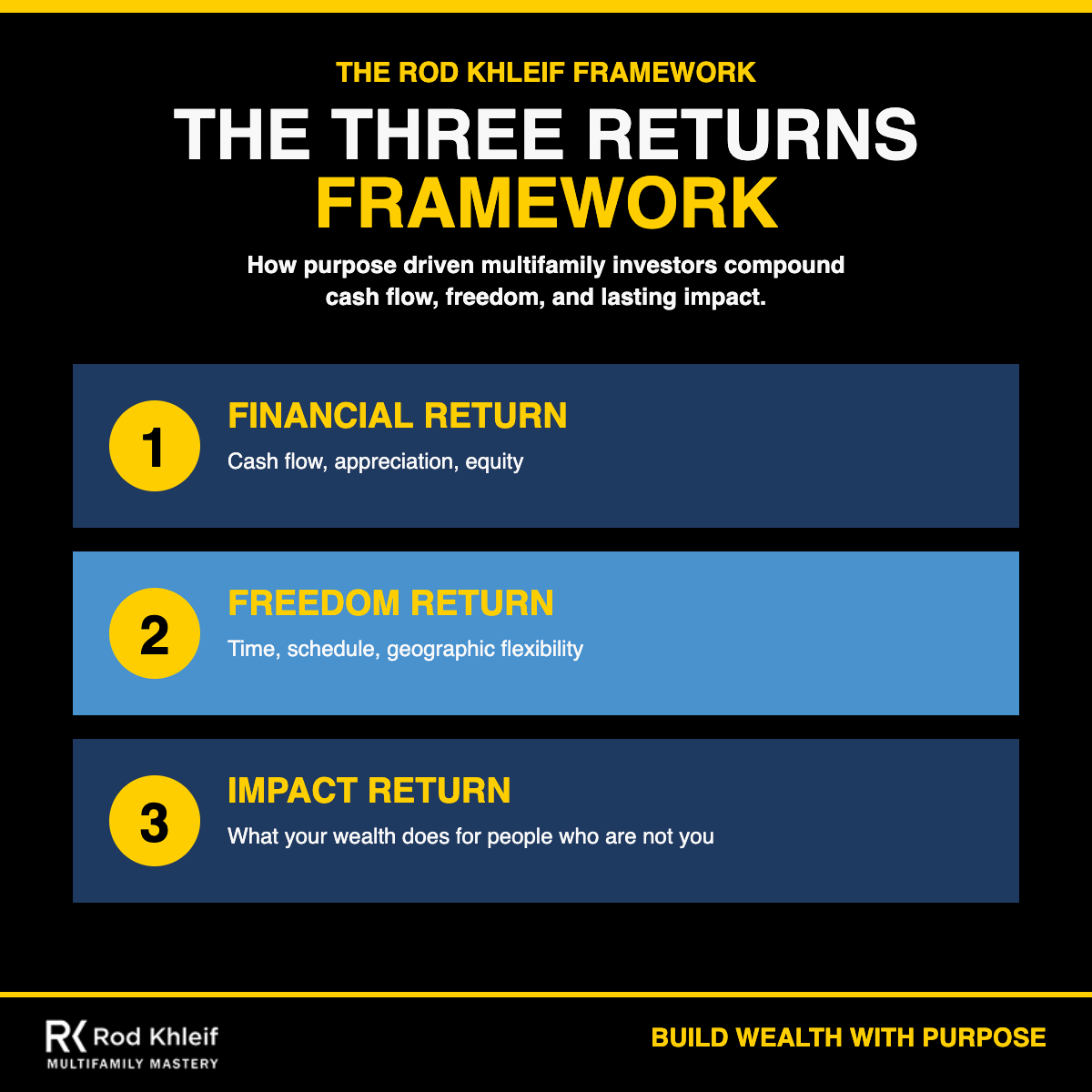
Want to see the Three Returns applied to a live deal? Join the free Multifamily Bootcamp →
Return 1: Financial Return
The financial return is the obvious one. Monthly cash flow from rents after debt service, equity buildup as the loan amortizes, forced appreciation from a value add business plan, and disposition gains at sale or refinance. Most investors stop here. They set a monthly cash flow target, back into a unit count, and treat the work as an extraction game. Financial return is necessary, but it is not enough. Investors who optimize only for financial return tend to over leverage in good markets, take on partners they should not, chase yield into deals they do not understand, and burn out around the time they finally hit their number. The financial return is the price of admission, not the prize.Return 2: Freedom Return
The freedom return is the one most operators do not put on the page. It is the return on your calendar. How many days a week do you actually own. Where can you live. Whose call do you have to answer. Can you take a Tuesday off without breaking the business. Freedom is engineered, not stumbled into. It is engineered by hiring earlier than feels comfortable, by writing systems and SOPs even when there are only ten units, and by choosing asset classes and operating partners that match your tolerance for involvement. The investor who closes ten deals a year and works seventy hours has won the financial return and lost the freedom return. That is not a multifamily wealth business. That is a job with rentals attached.Return 3: Impact Return
The impact return is what your wealth does for people who are not you. Impact has to be specific. “Giving back” as a phrase does almost nothing. “Funding twenty thousand meals a year through Tiny Hands Foundation” does. The specificity of the impact decision is the part that compounds emotionally and that survives the next downturn. Impact is also the only return that compounds forever. Cash flow stops when you stop owning units. Freedom contracts as health and energy contract. Impact, structured well, outlives you. That is the math behind why the strongest multifamily operators I know give early, not late.How to Identify Your Personal Purpose as an Investor
You cannot back into a Three Returns plan without first answering three questions in your own handwriting. Print these. Sit with them. Do not skip them. Research from the Princeton longhand-versus-laptop study by Mueller and Oppenheimer shows that handwriting forces deeper processing than typing, and what you are doing here needs the deepest processing you have.- If money was already solved, what would I spend the next ten years doing. Be specific. Do not write “travel.” Write where, with whom, how often, and why.
- Whose pain do I feel as if it were mine. Children, veterans, single parents, addicts, people in your hometown, immigrants, your own family. Whose story makes you stop scrolling. That is a clue to your impact return.
- What do I want my children, or the next person who carries my name, to inherit besides money. Habits, businesses, a foundation, a body of teaching, a community. The answer reshapes how you take chips off the table.
Integrating Giving Into Your Deal Structure
Most investors treat giving as something they will do “after they make it.” That is backwards. Investors who pre commit a percentage of cash flow to a cause from day one tend to make more, not less, because the constraint forces underwriting discipline and attracts investors who care about the same thing. Here is how to put it in the structure.- Pick a percentage you cannot fake. One percent of distributions is real. Five percent makes investors raise their eyebrows in a good way. Ten percent puts your business in the same conversation as the strongest values driven operators in the country.
- Write it into the partnership agreement. A one line clause that says a fixed percentage of GP distributions goes to a named recipient turns intention into structure. Investors will see that line in the PPM and you will not be able to talk yourself out of it on a tough month.
- Pick one recipient and stay loyal. Spreading impact across ten causes dilutes both the storytelling and the relationship. Pick one foundation, one school, one shelter, one mission. Build a long arc with them.
- Talk about it when investors ask why. Do not lead with it, but do not bury it either. Limited partners who like the financial return AND the impact return are the longest tenured investors you will ever have.

Download the free Lifetime Cash Flow ebook →
How to Reverse Engineer Your Three Returns Plan
This is the step by step we walk through in the mentorship. It works for a brand new investor and for a fund manager with eight hundred units. The point is to stop starting with the unit count and start with the life you actually want.- Write your impact return target first. Pick the cause, pick the annual dollar pledge, pick the milestone you want to fund. Example: “Fund one hundred thousand meals a year through Tiny Hands Foundation by year five.”
- Write your freedom return target second. How many hours a week do you want this business to take when it is mature. How many days off. Where do you want to live. Example: “Twenty five hours a week, four weeks off a year, anywhere with internet.”
- Convert both into an annual cash flow number. Add personal lifestyle cost, retirement contribution, impact pledge, and the cost of the team that buys you freedom. Example: three hundred sixty thousand dollars per year.
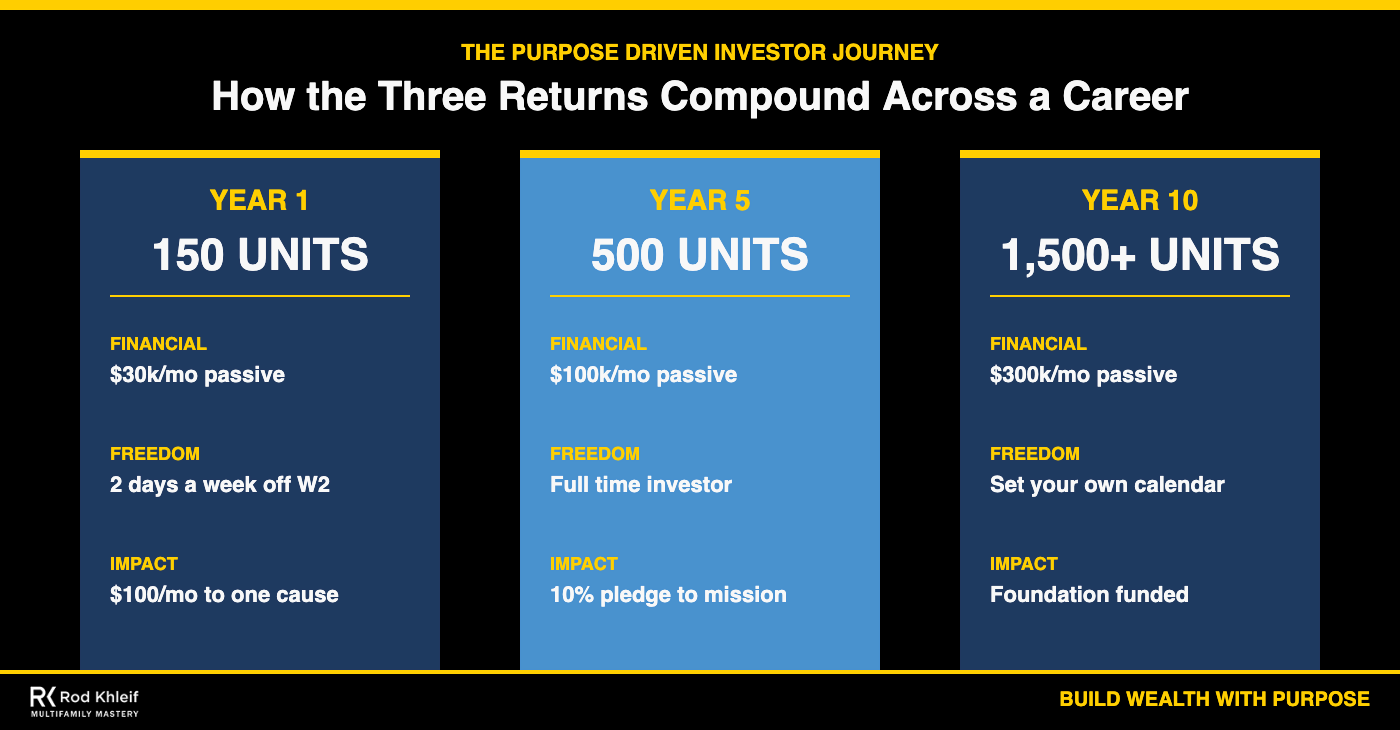
- Back into a unit count. At a conservative two hundred dollars per door per month net, three hundred sixty thousand a year requires one hundred fifty doors of stabilized cash flow. Adjust the per door number based on your asset class and market.
- Map the deal pipeline. First deal at twenty to fifty units in year one. Second deal stacks toward the target. Joint ventures and syndications fill the gap.
- Codify the giving in writing. Add the impact pledge to your partnership agreement, your operating cadence, and your investor presentations.
The Tiny Hands Foundation Story
I started Tiny Hands Foundation more than two decades ago, long before the multifamily business became what it is today. The foundation feeds children, fills backpacks for the school year, runs holiday outreach for kids whose families have nothing. We have served more than ninety thousand children since the early days. The work is intentionally local in flavor and direct in delivery, because that is how I grew up needing help. I share this not as a humblebrag. I share it because Tiny Hands is the proof point that the Three Returns Framework is not a slide I made up. It is the operating system I have run on for thirty plus years, including the lean years and the years right after the 2008 collapse when nothing else made sense to me. Impact return is what kept me building when financial return was negative.Purpose Driven Investors in the Warrior Community
The Warrior Program is the long form mentorship. The thing that keeps surprising me is how many of them organize their portfolios around a mission instead of a number. Anthony Metzger went from teaching grade school to raising millions and closing a 218 unit deal as his first deal with no money of his own. Anthony has talked openly about how building a portfolio meant his family no longer had to choose between his kids’ school and his wife’s career. That is the freedom return on the page. Frank Patalano, another Warrior, runs a mission first investing approach grounded in the New England communities he grew up in. His version of impact return is hyper local: the apartments he buys are buildings he wants his neighbors to live in. He talks about the framework on his podcast episode with me. Zach, who came in as a bootcamp attendee, used the goal stack to engineer his way out of a W2 he hated and into a multifamily portfolio he funds his family’s giving from. His interview covers how the giving piece kept his head straight while the unit count was still small.Watch the Full Interview
Anthony Metzger walks through the leap from grade school teacher to closing a 218 unit deal with a Three Returns mindset.
Rod Khleif: “The fastest investors I coach are not the ones with the most money or the best market. They are the ones who picked a mission early and let it drag them through the hard years.”
How Purpose Driven Investing Outperforms Long Term
Skeptics treat purpose as soft. The numbers say otherwise. Three structural reasons purpose driven investors tend to outperform across full cycles. Better partner selection. An investor who screens partners on values, not just rate of return, ends up with a partner pool that does not blow up in a downturn. Capital that aligns to mission tends to be patient capital, and patient capital is the only kind that survives a 2008 or a 2022 rate shock. Lower decision fatigue. When you know what the business is for, you say no faster. You walk away from deals that do not fit, you turn down JV partners that look great on a spreadsheet but feel wrong in a conversation, and you focus your scarce energy. Purpose is a filter, and filters compound. Recruiting and retention. Per the Federal Reserve Survey of Consumer Finances, the wealth gap between top earners and the rest is widening, which means the investors who attract the strongest team members are the ones offering more than a paycheck. Purpose driven operations attract long tenured property managers, asset managers, and acquisitions analysts. Lower turnover, better execution.Three Returns vs Financial Only Investor
Side by side, here is how the two approaches diverge over a ten year arc. Both can hit a unit count. Only one of them tends to produce an investor who is still in the business and still healthy at year ten.Three Returns Stack vs Traditional Goal Setting
Most goal setting curricula were not built for real estate. SMART goals, OKRs, and the standard self help template all optimize for one axis. The Three Returns Stack is built specifically for investors who need to balance cash flow, calendar, and cause across a long career. If you want a deeper dive into the goal setting layer that feeds the Three Returns Stack, the goal setting accelerator post walks through the daily writing ritual that drives all of this. The resilience post covers the Five Pillar Resilience Stack you will lean on when the market punches back. And the fear post covers the F.E.A.R. process for getting through the first deal.Purpose Driven Real Estate Investing FAQ
Q: What is purpose driven real estate investing? A: Purpose driven real estate investing is the practice of building a real estate business that is intentionally designed to produce three returns at once: financial, freedom, and impact. The framework forces you to define why you are investing before you set a unit count, then back into the deal pipeline that funds the life and the mission you actually want. Q: Can you give back to the community through multifamily investing? A: Yes, and multifamily is one of the cleanest vehicles to do it. Apartments serve real residents, the cash flow is recurring, and operators can pre commit a percentage of distributions to a named cause inside the partnership agreement. That structure turns intention into accountability. Q: How do I build a real estate business aligned with my values? A: Start by writing your Three Returns target in your own handwriting: impact, freedom, and financial in that order. Translate the impact and freedom targets into an annual cash flow number, then back into a unit count and a deal pipeline. Codify the impact pledge inside your operating agreement so it becomes a structural commitment, not a mood. Q: What percentage of cash flow should I donate as an investor? A: There is no single right number, but one to ten percent of GP distributions is the working range I see produce real outcomes. One percent is the minimum that feels real. Five percent is when investors start to notice. Ten percent puts your operation in the same conversation as the strongest values driven multifamily firms in the country. Q: How does Rod Khleif integrate philanthropy with multifamily investing? A: Through Tiny Hands Foundation, the charity I started more than two decades ago that has served more than ninety thousand children. The foundation is intentionally tied to the multifamily business: a portion of personal distributions flows to it every year, the team participates, and it is named publicly so I cannot quietly back out of it on a tough quarter. Q: What is the Tiny Hands Foundation? A: Tiny Hands Foundation is the nonprofit I founded that feeds children, fills backpacks for the school year, and runs holiday outreach for kids in need. It has served more than ninety thousand children to date and is the proof point that the Three Returns Framework is not a slide. It is the operating system I have run on for more than thirty years. Q: Does purpose driven investing hurt returns? A: The research and my direct experience say no. Purpose driven operators tend to have lower team turnover, more patient capital, better partner selection, and stronger downturn behavior. All four of those compound in your favor over a full real estate cycle, which is why Three Returns operators tend to outperform Financial Only operators across ten plus year horizons. Q: How do I find investing partners who share my values? A: State your values in writing on your investor deck, in your PPM, and on every podcast you go on. The wrong investors will self select out and the right investors will self select in. You will raise less in the first year and significantly more from year three onward. Q: What legacy can multifamily investing create for my family? A: A multifamily portfolio built around the Three Returns Framework can leave three things to your family: an income producing asset base, a foundation that funds a cause for generations, and a body of operating practice your children can step into or sell. The financial inheritance is the smallest of the three. Q: How do I balance profit and purpose in real estate syndication? A: Stop treating them as a tradeoff. Underwrite both at the same time. Pre commit the impact percentage inside the partnership structure, build the freedom return into how you staff and systematize the operation, and let financial return be the discipline that funds both. That is the entire job of a Three Returns operator.Ready to Take the Next Step
If the Three Returns Framework lit something up for you, do not let the moment pass. The fastest way to build a purpose driven multifamily business is to surround yourself with operators who already do it.Join the next free Rod Khleif Multifamily Bootcamp →
Not ready for a live event yet? Start with my free book that lays out the full goal setting, underwriting, and giving structure side by side.Download How to Create Lifetime Cash Flow Through Multifamily Properties →
Disclaimer: This article was written with the help of AI and reviewed by Rod and his team.Warriors who built businesses with intention include Aaron Novotney with his 53 unit Ohio deal and Alejandro Chardon with his Arizona land development project.
At scale, see how Ronal and Mary Jane Lou closed 204 units in Texas and Victor Collazo closed 92 units in Kansas.
