
I learned this lesson the expensive way. Early in my career I handed a building to a management company because their fee was the lowest number on the page, and within a year my occupancy had slipped, my reports were a mess, and my net operating income was bleeding out a little more every month. The property was fine. The operator was not. Your multifamily property management company is the single biggest day to day driver of whether an apartment deal performs the way your spreadsheet promised, and most owners pick one based on price instead of proof.
You can buy a great building in a great market and still lose money if the people running it are not great. So before you sign anything, you need a way to separate the professionals from the pretenders. This guide gives you the exact scorecard I use, the questions that expose a weak operator, and the red flags that should make you walk away.
What This Guide Covers
- Why Your Property Manager Makes or Breaks the Deal
- The Property Manager Scorecard: 5 Things to Check
- Property Management Is Not Asset Management
- How Property Management Fees Really Work
- How to Vet a Multifamily Property Management Company
- When and How to Switch Operators
- Cheapest Bid vs Best Operator
- Self Managing vs Hiring a Pro
- What a Great Operator Looks Like
- Multifamily Property Management FAQ
- Ready to Take the Next Step?
Why Your Property Manager Makes or Breaks the Deal
Your property manager controls the two levers that set an apartment building value: income and expenses. A great operator pushes rents to market, keeps units full, and controls costs, which grows your net operating income and your equity. A weak one quietly does the opposite, and you feel it in every distribution.
Here is what most new owners miss. In multifamily, value is tied directly to net operating income, which is your income minus your operating expenses. That means the company running your building is not just collecting rent. They are moving the exact number your property value is built on. A point of occupancy here, a turnover cost there, a slow leasing season, and suddenly the returns you underwrote are gone.
Think about what that means in real numbers. On a building with strong income, a few points of extra occupancy and tighter expense control can add tens of thousands of dollars to annual net operating income, and because value is a multiple of that number, the building itself becomes worth far more. The same math runs in reverse when the operator is weak. That swing, year after year, dwarfs any difference in management fee you were trying to save. The operator is not a cost to minimize. They are a lever on your entire return.
This is why I treat hiring a property manager as one of the most important decisions in the entire deal, right next to the purchase itself. You are handing your asset, your reputation with investors, and your cash flow to a third party. Get it right and they make you money while you sleep. Get it wrong and they will cost you far more than their fee ever saved you.
Signs You Have the Wrong Operator
Run your current or prospective company through this quick gut check. Three or more yes answers is a warning:
- You cannot get a clear answer on your occupancy and delinquency without chasing them.
- Monthly reports are late, confusing, or change format every time.
- They manage mostly single family homes and your building is their biggest one.
- Turnovers take weeks and you never see the scope or the invoices.
- Their fee was the only thing they led with when you first talked.
None of these are about being mean to a vendor. They are about protecting an asset that thousands of your dollars depend on every month.
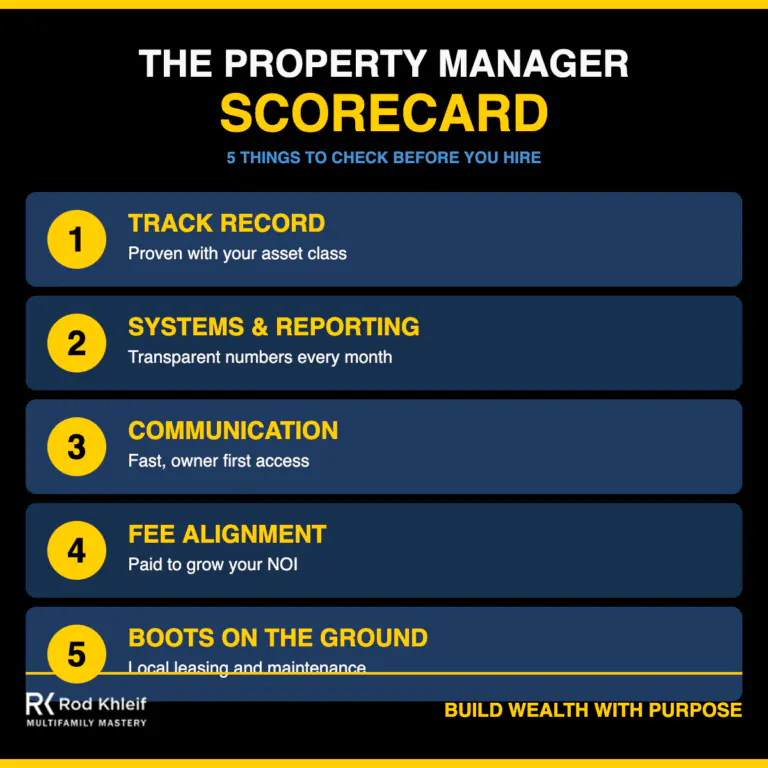
The Property Manager Scorecard: 5 Things to Check
After decades of owning and operating apartments, I boiled the hiring decision down to five things that actually predict performance. I call it the Property Manager Scorecard, and it is the filter I run every candidate through. Score each one before you ever talk about price. You can go deeper on operations inside my Warrior mentorship program.
Want my full operations playbook and a vetted network of operators? Explore the Warrior Program →
1. Track Record With Your Asset Class
A company that manages single family rentals or small duplexes is not ready for your 80 unit building, no matter how nice they are. Ask how many units they currently manage, how many properties look like yours in size and class, and how long they have held those accounts. You want an operator who has already solved the problems you have not even hit yet. Experience with your specific asset class is the strongest predictor of performance.
Be specific when you ask. A company can technically manage a thousand units and still have almost none that look like your deal. Ask how many of their units are in buildings of your size, in your class, and in your submarket, because a manager who is great with luxury high rises may be lost on a workforce housing value add, and the reverse is just as true. Match the operator to the actual job.
2. Systems and Reporting
Great operators run on real systems. They use professional property management software, they give you a live owner portal, and they send a clean monthly report you can actually read. You should be able to see income, expenses, occupancy, delinquency, and a variance against budget without asking. If their reporting is a messy spreadsheet emailed late, imagine how they handle a real problem on the property.
3. Communication and Access
When something goes wrong at your building, and it will, how fast do they respond and who picks up the phone? Ask who your point of contact is, how often you will get updates, and what their response time standard is for owners. The best operators are proactive. They tell you about the problem before you have to find it. Slow or vague communication during the sales process never gets better after you sign.
A simple test works well here. During your interviews, send an email with a couple of real questions and time the response. If a company that wants your business takes days to reply with a vague answer, that is exactly how they will treat you once they have your building. The way they communicate before you hire them is the clearest preview you will ever get of life as their client.
4. Fee Structure and Alignment
Most companies charge a management fee as a percentage of collected income, often in the range of three to ten percent depending on size and market, plus leasing fees and sometimes other charges. The number matters, but alignment matters more. You want a fee model that rewards them for growing your net operating income, not just for collecting checks. Ask for the full fee schedule in writing and watch for hidden markups on maintenance, turnovers, and vendor work.
5. Boots on the Ground
Software does not fix a leaking roof or lease a vacant unit. Ask about their local presence, their maintenance team, and their leasing process. Do they have people near your property, or are they managing it from three states away? Strong local operations are what keep your units full and your residents happy, and resident satisfaction is what protects your income over the long run.
Maintenance is where this gets real. Ask how they handle after hours emergencies, how quickly routine work orders get closed, and whether they have in house technicians or rely entirely on outside vendors. Slow or sloppy maintenance is the fastest way to lose good residents, and every resident you lose costs you a turnover, a vacancy, and a new leasing push. A strong local maintenance operation quietly saves you far more than it ever shows up as a line item.
Property Management Is Not Asset Management
This trips up a lot of first time owners, so let me make it clear. Property management is the day to day operation of the building: leasing, rent collection, maintenance, resident relations. Asset management is the higher level strategy: setting the business plan, managing the budget, deciding when to refinance or sell, and holding the property manager accountable to the numbers.
Even with a great management company, you or your team still own the asset management role. The property manager runs the play. You call the game. If you want to understand that side more deeply, read my overview of multifamily asset management, and for the operational hiring details see my breakdown of how to hire a third party property management company. The two roles work together, but they are not the same job.
Rental housing is also a real industry with real standards. Groups like the National Multifamily Housing Council and the National Apartment Association publish operating benchmarks and best practices, and the strongest companies hold credentials and follow those standards. Asking whether a company participates in the professional side of the industry tells you how seriously they take the craft.
How Property Management Fees Really Work
Fees confuse a lot of owners because companies bundle them in different ways. Understanding the full structure is how you avoid surprises and compare two companies fairly. The headline percentage is never the whole story, so make every candidate hand you the complete schedule in writing before you compare anything.
Here are the charges you will typically run into:
- Management fee. The core charge, usually a percentage of collected income, often somewhere in the three to ten percent range depending on size and class. Larger properties tend to pay a lower percentage because the dollar amount is still meaningful to the operator.
- Leasing fee. A charge for filling a vacant unit, sometimes a flat amount and sometimes a portion of the first month rent. Ask how it works and how it is split if they use outside leasing agents.
- Renewal fee. Some companies charge a smaller fee when an existing resident renews. This one is worth negotiating, because keeping a good resident should be part of the core job.
- Setup or onboarding fee. A one time charge to take over the property, inspect units, and load everything into their systems.
- Maintenance and vendor markups. This is where weak operators quietly make money. Ask directly whether they mark up maintenance, repairs, or vendor invoices, and by how much. A markup is not automatically bad, but it must be disclosed.
The goal is not to find the lowest number. The goal is to find a fair, transparent structure that pays a good operator to do great work. A company charging a point more but growing your occupancy and protecting your expenses will beat a cheaper one every time. When you understand the fee model fully, you can also tie part of the relationship to performance, which keeps everyone pulling in the same direction toward a stronger net operating income.
How to Vet a Multifamily Property Management Company
Here is the exact process I walk through before I hand over a building. Do not skip steps, and do not let a smooth sales pitch replace real proof.
- Define your needs first. Write down your unit count, asset class, location, and what success looks like in numbers. You cannot judge a fit until you know what you are hiring for.
- Build a short list of specialists. Find companies that already manage properties like yours in your market. Ask other owners and your broker who they trust. Reputation in the local owner community is gold.
- Run the Scorecard. Score each candidate on track record, systems, communication, fees, and boots on the ground before you ever compare prices.
- Ask for proof and references. Request a sample owner report, current occupancy across their portfolio, and three owner references with buildings like yours. Then actually call the references.
- Read the contract carefully. Check the fee schedule, the term, the termination clause, and how maintenance and vendor markups work. Make sure you can exit if performance slips.
To make the judgment fast, here is the side by side I keep in my head: the red flags that should scare you off, the questions that cut through the pitch, and the green flags that signal a real operator.
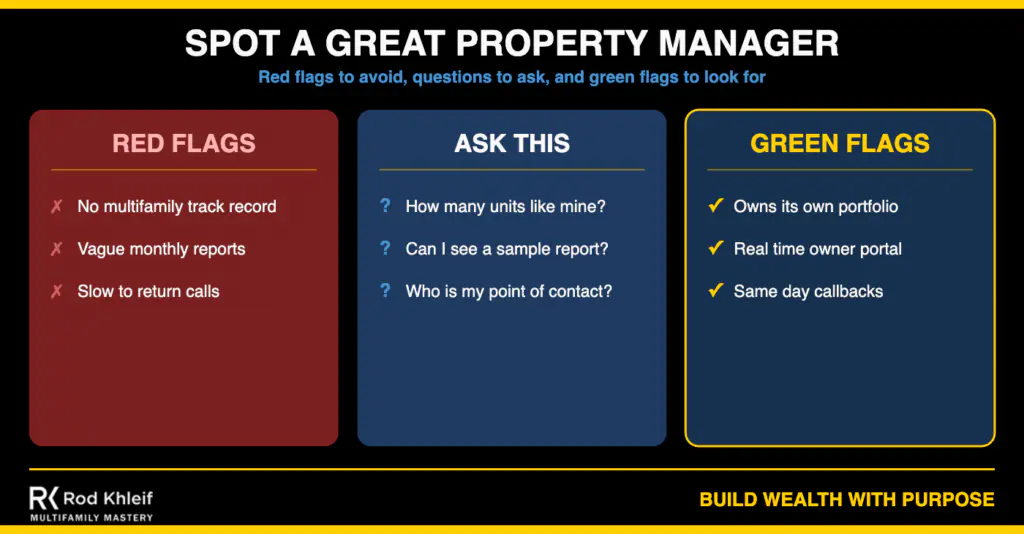
Notice that none of those questions are about price. Price is the last conversation, not the first. A company that nails the green flags and answers the hard questions well is worth more than a cheaper company that cannot, every single time.
Before you start interviewing companies, get your own underwriting and operating expectations straight. My free book walks through how the numbers actually work so you can hold any operator accountable to a real budget. Click the cover below to download it and keep it as your reference.

Download the free book and learn the numbers behind great operations →
When and How to Switch Operators
Sometimes the operator you have is the problem, and the most profitable move you can make is replacing them. I have turned struggling properties around simply by changing who runs them. The trick is knowing when the issue is fixable and when it is time to move on.
Give your current company a clear chance first. Put your concerns in writing, set specific targets for occupancy, delinquency, and reporting, and give them a defined window to fix it. A good operator will welcome the clarity and respond. If the numbers do not move and the communication does not improve, that is your answer.
When you do decide to switch, protect the transition. Read your termination clause so you know your notice period and any fees. Line up the new operator before you cut the old one so there is no gap in leasing or maintenance. Make sure resident records, deposits, and financials transfer cleanly, and tell your residents about the change in a calm, professional way so they feel taken care of. A clean handoff protects your occupancy during the most fragile moment in the relationship.
The lesson I want you to take from this is simple. You are never stuck. The property manager works for you, and your job as the owner is to hold the standard. If they will not meet it, someone better will, and the upside of making that change is often far larger than the hassle of making it.
Cheapest Bid vs Best Operator
The most expensive mistake in this business is hiring the cheapest manager. A one or two percent difference in fee is nothing compared to what a weak operator costs you in lost occupancy and sloppy expense control. Here is how the cheap bid stacks up against a quality operator.
Self Managing vs Hiring a Pro
A lot of new owners ask whether they should just manage the building themselves to save the fee. Sometimes that works for a small local property. For most multifamily owners who want to scale, a professional operator is the better choice. Here is the honest comparison.
What a Great Operator Looks Like
If you want to see the standard you should be hiring to, study the best. Robert Martinez built an award winning property management operation around exactly the things on this scorecard: relentless leasing, tight expense control, real systems, and a resident experience that keeps occupancy high. When I had him on the podcast, what stood out was not a secret trick. It was discipline applied to the basics, every single day.
Watch the Full Interview
Robert Martinez breaks down how award winning property management actually drives occupancy, expense control, and net operating income.
You do not have to become Robert to win. You have to learn to recognize his standard and refuse to settle for less when you hire. For more operator interviews and lessons, the Lifetime Cash Flow Through Real Estate Investing podcast is full of them, and my breakdown of the nine things you need to know about property management companies goes even deeper on the diligence.
Rod Khleif: “I have made more money fixing bad management than I ever made buying cheap. The building rarely fails you. The operator does. Hire the team that grows your net operating income, not the one with the lowest fee.”
Multifamily Property Management FAQ
Q: What does a multifamily property management company actually do?
A: They run the building day to day. That includes marketing and leasing units, screening residents, collecting rent, handling maintenance and turnovers, paying property bills, and reporting the numbers to you. They turn your asset into income while you focus on strategy.
Q: How much does multifamily property management cost?
A: Fees commonly run in the range of three to ten percent of collected income depending on the size and class of the property, plus leasing fees and sometimes other charges. Bigger properties usually pay a lower percentage. Always get the full fee schedule in writing.
Q: What should I look for when choosing a property management company?
A: Score them on five things: track record with your asset class, systems and reporting, communication and access, fee structure and alignment, and boots on the ground. Check all five before you ever talk about price.
Q: What is the difference between property management and asset management?
A: Property management is the day to day operation of the building. Asset management is the higher level strategy, including the budget, refinance and sale decisions, and holding the property manager accountable. You keep the asset management role even with a great operator.
Q: How many units do I need before I should hire a property manager?
A: There is no hard rule, but most owners who want to scale hand off management as soon as the property is large enough to support a professional fee, often at the small apartment level and almost always once you cross into mid size buildings.
Q: Should I use a third party manager or build my own team?
A: Most owners start with a quality third party operator because it is faster and less risky. Building an in house team can make sense once you own enough units in one market to support the overhead. Start with proven third party management and grow into the decision.
Q: What are the biggest red flags in a property management company?
A: Vague or late reporting, no experience with your asset class, slow communication, hidden markups on maintenance, and leading with the lowest fee. Any one of these is a caution. Several together is a no.
Q: How do I hold my property manager accountable?
A: Set a budget, get a clear monthly report, and review actual performance against that budget every month. Track occupancy, delinquency, and expenses. Clear expectations and consistent review are how you keep an operator performing.
Q: Can a good property manager really increase my property value?
A: Yes. Because value is tied to net operating income, an operator who raises occupancy and controls expenses directly increases what your building is worth. That is the whole reason quality management is worth more than its fee.
Q: What questions should I ask before signing a management contract?
A: Ask how many units like mine you manage, can I see a sample owner report, who is my point of contact, what is your response time, and how do maintenance and vendor markups work. Then read the term and termination clause carefully.
Ready to Take the Next Step?
Choosing the right operator is an owner level skill, and it is one of many you need to scale a portfolio with confidence. If you are serious about buying and operating apartments the right way, my Warrior mentorship program gives you the systems, the network of proven operators, and the coaching to do it without the expensive mistakes I made.
Not there yet? Start with the fundamentals. Download my free book, How to Create Lifetime Cash Flow Through Multifamily Properties, and learn the numbers that let you hold any property manager accountable to a real plan.
Disclaimer: This article was written with the help of AI and reviewed by Rod and his team.
