
Insurance is the line item most multifamily investors ignore until the day they need it, and by then it is too late to fix. It is also one of the fastest rising costs in the business. In this guide I break down multifamily insurance the way it actually behaves in the real world: the good it does when you get it right, the bad news on 2026 pricing, and the ugly claims traps that leave owners underpaid after a loss. Get this right and one disaster becomes a bad month instead of the end of your deal.
What is in this guide
- What multifamily insurance actually covers
- The Good: what strong coverage protects
- The Bad: the 2026 insurance crunch
- The Ugly: the claims traps that leave owners underpaid
- How a multifamily claim actually plays out
- How to protect yourself: the Claim-Ready Checklist
- Frequently asked questions
- Ready to take the next step?
What multifamily insurance actually covers
Multifamily insurance is a stack of coverages, not one policy. The core pieces are property or hazard insurance on the building, general liability for injuries and lawsuits, and business interruption or loss of rents that keeps income flowing while units are unrentable. Flood and a handful of others sit outside the standard policy and have to be added on purpose.
Most owners assume they are covered because they have a policy. What actually matters is which coverages are in it, how the limits are set, and where the gaps hide. Here is the stack that protects a typical apartment building.
| Coverage | What it covers | Why it matters |
|---|---|---|
| Property / hazard | The building and fixtures against fire, wind, storm, and similar perils | Protects your single biggest asset |
| General liability | Injuries and lawsuits tied to the property | One tenant slip-and-fall can cost six figures |
| Business interruption / loss of rents | Lost rental income while units are unrentable after a covered loss | Keeps the mortgage paid when the rent stops |
| Flood | Flood damage, which standard property policies exclude | Required by lenders in flood zones, and not optional there |
| Ordinance or law | The extra cost to rebuild to current code | Older buildings almost always need this |
| Umbrella / excess liability | Liability above your primary limits | A large judgment can exceed a base policy fast |
The Good: what strong coverage protects
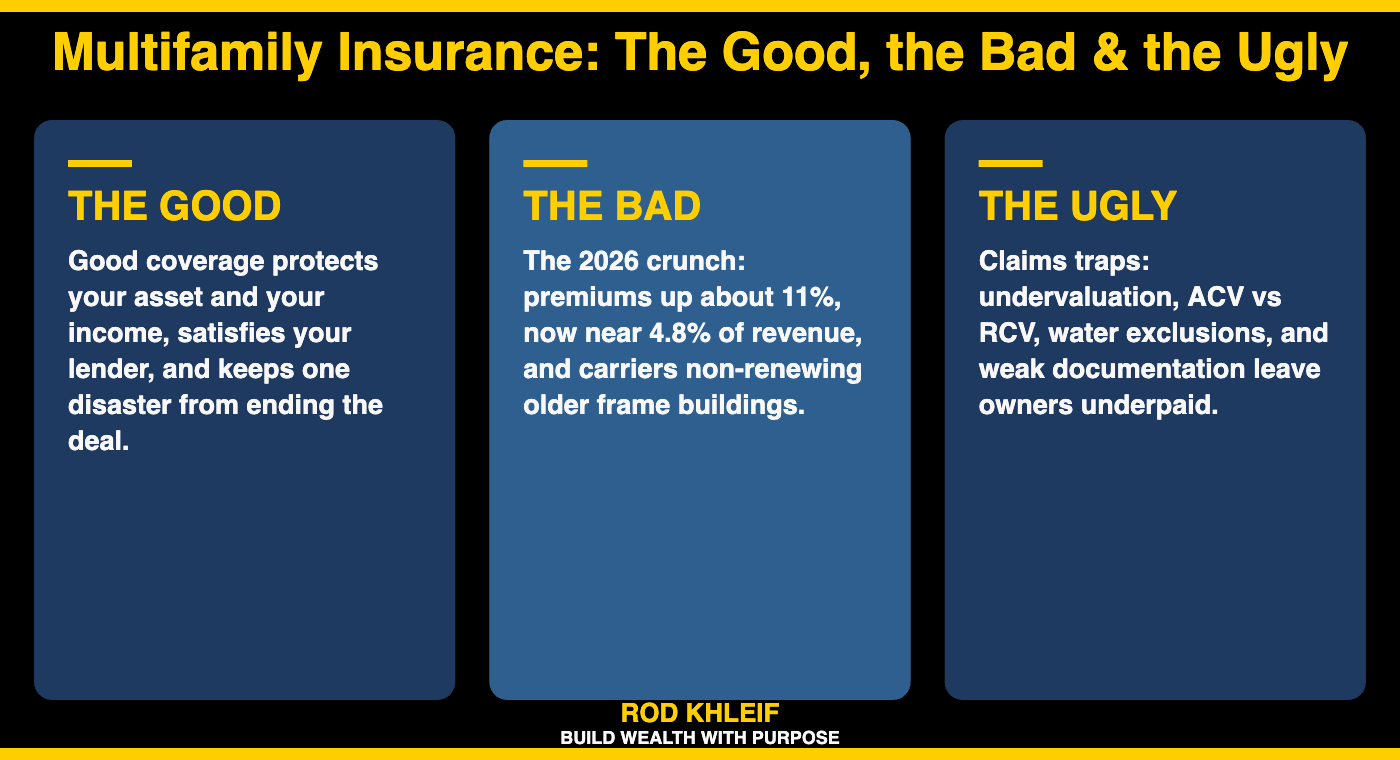
When your coverage is built right, insurance quietly does three big jobs. It protects your asset, so a fire or a storm does not wipe out the equity you worked to build. It protects your income, because loss of rents coverage keeps cash flowing to the mortgage while damaged units are offline. And it protects the deal itself, since your lender requires proof of coverage and will force-place expensive insurance if yours lapses.
That is the whole point. A well insured building turns a catastrophe into an inconvenience. The owner with the right limits, the right endorsements, and a documented plan sleeps at night. The owner who bought the cheapest policy to make a deal pencil finds out what was missing at the worst possible moment. Insurance is not where you cut corners to win a deal. It is part of what makes the deal survivable, and it belongs in your numbers from the first time you underwrite a multifamily deal.
The Bad: the 2026 insurance crunch
Here is the bad news. Insurance has gone from a boring, predictable expense to one of the biggest swing factors in multifamily. Industry data shows multifamily premiums climbed roughly 11 percent in 2026, on top of years of steep increases, with owners budgeting a few hundred dollars more per unit than they did just a couple of years ago and some tough markets running well over $1,000 per unit.
The bigger story is what insurance now costs as a share of your income. Across the industry, property, hazard, and liability insurance grew from under 2 percent of multifamily revenue in 2000 to nearly 5 percent by 2024. That is money coming straight out of your net operating income, which means it directly lowers what your building is worth. On top of the price, coverage itself is shrinking. Habitational property is one of the hardest classes to place right now: water claims dominate, reinsurance costs keep rising, and many carriers have non-renewed older frame buildings or pushed them to the surplus lines market. If you own or are buying older apartments, assume insurance will be harder and pricier than the seller’s current policy suggests.
The Ugly: the claims traps that leave owners underpaid
The ugly part is not the premium. It is what happens at claim time, when owners discover the coverage they paid for does not pay what they expected. These are the traps I see over and over.
Undervaluation and the coinsurance penalty
If you insure the building for less than it costs to rebuild, most policies apply a coinsurance penalty that cuts your payout on every claim, not just total losses. Insure a building for $2 million when it costs $3 million to rebuild and the carrier can pay a fraction of even a small claim.
ACV versus replacement cost
Actual cash value pays you the depreciated value of what was damaged. Replacement cost pays to actually rebuild. An ACV roof claim on a twenty year old roof can leave you tens of thousands short. Know which one your policy uses before you need it.
Water and exclusions
Water is the number one source of habitational claims, and it is also where the fine print bites. Flood is excluded from standard policies. Gradual leaks, sewer backup, and mold are often limited or excluded too. The peril most likely to hit you is frequently the one your policy covers the least.
The business interruption gap
Loss of rents coverage sounds simple until you read the waiting period and the limits. If it takes a year to rebuild but your coverage caps at a few months, you carry the mortgage on an empty building for the rest. This is the hidden challenge that sinks otherwise fine deals.
How a multifamily claim actually plays out
Picture a kitchen fire in one unit of a 24 unit building. The fire is out in an hour, but smoke and the water used to fight it damage eight units, and part of the building has to be vacated during repairs. Here is where the coverage you chose months ago decides your outcome.
Property coverage pays to repair the physical damage, but only up to your limit and only on your valuation basis, so replacement cost versus ACV matters right away. Loss of rents replaces the income from the units you cannot rent while crews work, but only within your waiting period and cap. Liability comes into play if a tenant was hurt. And through all of it, the adjuster is working from the carrier’s side of the table. The owner who documented the building, kept the policy current, and understands the coverage gets paid fairly and fast. The owner who did not spends months fighting for a check that still comes up short.
How to protect yourself: the Claim-Ready Checklist
You cannot control the insurance market, but you can control how ready you are when a loss hits. I call this the Claim-Ready Checklist, five moves that separate owners who get paid from owners who get burned.
- Insure to true replacement cost. Get a real replacement cost estimate and keep it current so you never trigger a coinsurance penalty.
- Buy replacement cost, not ACV, on the building and especially the roof wherever you can.
- Close the water and flood gaps. Add flood anywhere you have exposure and read the water, sewer backup, and mold limits before you sign.
- Size loss of rents to your real rebuild timeline, not the cheapest cap the broker quotes.
- Document everything now. Photos, inventories, maintenance records, and updated valuations, kept off site, are what get a claim paid quickly.
Then shop it properly. Use an independent broker who actively places habitational risk, get multiple quotes at every renewal, and never let coverage lapse. Simple prevention, water sensors, updated roofs and plumbing, and a documented maintenance program, lowers both your claims and your premium over time.
Rod Khleif: “Nobody buys real estate for the insurance. But I have watched a single uncovered loss erase years of profit on a great building. Treat your policy like part of the deal, because on the wrong day it is the only thing standing between you and a wipeout.”
Frequently asked questions
How much does multifamily insurance cost in 2026?
It varies widely by market, building age, and construction, but many owners are budgeting a few hundred dollars more per unit than a couple of years ago, and tough markets can run well over $1,000 per unit. Premiums rose roughly 11 percent in 2026 on top of prior increases. Get a real quote for your specific building rather than trusting the seller’s current premium.
What does multifamily insurance actually cover?
The core stack is property or hazard coverage on the building, general liability, and business interruption or loss of rents. Flood, ordinance or law, and umbrella liability are usually added on. Which coverages and limits you carry matter far more than simply having a policy.
Why is multifamily insurance so hard to get right now?
Habitational property is one of the hardest classes in the market. Water claims are frequent, reinsurance costs keep climbing, and many carriers have non-renewed older frame buildings or moved them to surplus lines. Older buildings especially should expect higher cost and tighter terms than the current owner’s policy shows.
What is the biggest insurance mistake multifamily investors make?
Underinsuring the building to make a deal pencil. It triggers coinsurance penalties, leaves you short on claims, and turns a recoverable loss into a financial one. Insure to true replacement cost and size loss of rents to a realistic rebuild timeline.
Is loss of rents coverage worth it?
Yes. It replaces the income from units you cannot rent after a covered loss, which keeps your mortgage paid while you rebuild. Just make sure the waiting period and the cap match how long a real rebuild would actually take.
Ready to take the next step?
Insurance is one line on a much bigger scorecard. If you want the full system for buying and running multifamily the right way, grab the free Lifetime CashFlow ebook and join my Multifamily Bootcamp, where I teach how the pros protect and grow their portfolios. New to apartments? Start with the complete beginner guide to multifamily investing.
This article is for educational purposes only and is not insurance, legal, tax, or investment advice. Coverage terms vary by policy and by state. Always review your specific policy with a licensed insurance professional.
