
I have owned and managed more than 2,000 properties over 40 plus years, and the fastest way I have seen a good apartment investor lose money is buying senior housing like it is an apartment building with a nurse call button. The five types of senior housing are like five completely different businesses that happen to share a demographic tailwind. The gap between the easiest one and the hardest one is enormous.
This guide breaks the whole spectrum into a ladder you can actually use. You will see what each type is, what it takes to run, where the money comes from, and which rung fits where you are right now.
What This Guide Covers
- Why Senior Housing Investing Humbles Apartment Buyers
- The Senior Housing Ladder: 5 Rungs by Operational Intensity
- What the Demand Data Actually Says
- How to Pick Your Rung in 5 Steps
- Apartment Instincts vs Senior Housing Reality
- Cap Rate Buying vs the Ladder Method
- Senior Housing Investing FAQ
- Ready to Take the Next Step?
Why Senior Housing Investing Humbles Apartment Buyers
Senior housing investing covers five property types that sit on a spectrum from real estate to healthcare business: active adult, independent living, assisted living, memory care, and skilled nursing. Each rung adds staffing, licensing, and reputation risk. Your returns rise as you climb, and so does the operating skill required to earn them.
In apartments, the building is the business. You buy a rent roll, you fix the units, you push rents, you cut waste, and the value follows the net operating income. A mediocre operator in a rising market still survives.
Senior housing does not work that way. You are buying an operating company that lives inside a building. Revenue is layered across base rent, care levels, and ancillary services. Expenses are labor heavy and labor is the single hardest input to control. Your reputation online moves occupancy within weeks. And in the upper rungs, a state surveyor can walk in unannounced and change your economics with one citation.
That is why the same 6 percent cap rate means two completely different things depending on which rung you are standing on. On the bottom rung it is close to an apartment yield with a demographic kicker. On the top rung it is compensation for running a licensed healthcare operation with 24 hour clinical staffing.
Signs You Are Underwriting the Wrong Rung
Run this checklist against your current deal. If you cannot answer three or more of these, you are looking at a rung above your operating capability:
- Can you name the property’s move in conversion rate from tour to lease, and the market benchmark for it?
- Do you know the caregiver turnover percentage and what agency labor costs per hour in that submarket?
- Can you break revenue into base rent, care level fees, and second person fees, or is it one blended number in your model?
- Do you know the average length of stay by care type at this property, and how it compares to the market?
- Have you read the last three state survey reports and priced the open deficiencies?
- Do you know who the executive director is, how long they have been there, and whether they stay after closing?
- Can you name the top three referral sources feeding this building, and are those relationships with the property or with a person who is leaving?
If you are coming from apartments and most of those questions felt foreign, that is not a reason to walk away. It is a reason to start on the right rung. Our complete beginner’s guide to multifamily investing covers the fundamentals that carry over, and everything in this article builds on top of them.
The Senior Housing Ladder: 5 Rungs by Operational Intensity
The Senior Housing Ladder is the framework I use to sort every senior housing deal that crosses my desk, and it ranks the five property types by one variable that predicts almost everything else: how much operating intensity the asset demands. Learn to underwrite the ladder properly in the Multifamily Bootcamp, where we work real deals in the room.
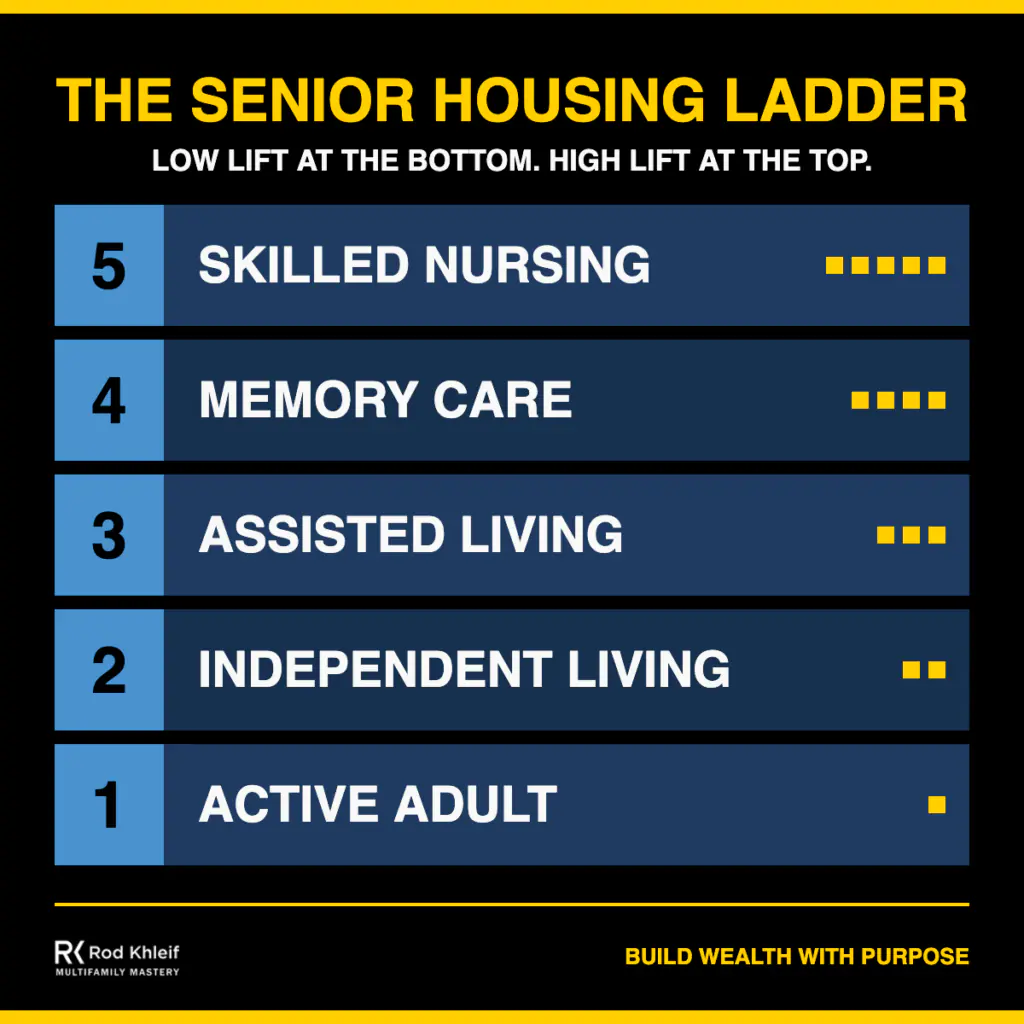
Climb one rung and you add staffing hours per resident, licensing exposure, and revenue that is tied to care delivery instead of square footage. That is the trade. Higher rungs pay more per unit and carry more ways to lose. Here is each one.
Rung 1: Active Adult (55 Plus Communities)
Active adult is age restricted rental or for sale housing, typically 55 plus, with no care services at all. Think lifestyle amenities, a clubhouse, a social calendar, maybe a pickleball court. Residents are usually in their 60s and early 70s, fully independent, and choosing the property over a regular apartment for the community and the low maintenance living.
- Operating lift: Lowest on the ladder. Staffing looks like a conventional apartment team plus an activities director.
- Revenue model: Rent only. Occasionally a small amenity or club fee. No care revenue.
- Typical length of stay: The longest of any rung, often 5 to 10 years, which means low turnover cost.
- Regulatory load: Fair housing age restriction compliance. No healthcare licensing.
- Who it fits: Multifamily investors who want demographic exposure without changing their operating model.
This is the only rung where your existing apartment playbook mostly transfers. If you can operate a Class B value add apartment community, you can operate active adult. The demographic tailwind gives you demand support, the sticky residents give you low turnover, and you are not underwriting a care business.
Rung 2: Independent Living
Independent living looks like a hotel that people live in. Residents get an apartment plus a package that usually includes daily meals, housekeeping, transportation, and programming. There is no clinical care staff. Residents who need help hire outside home health services on their own.
- Operating lift: Moderate. You now run a dining operation, a housekeeping department, and a transportation function. Food cost and dining labor become real line items.
- Revenue model: Rent plus a services package, plus a second person fee for couples. Ancillary income from guest meals, salon, and parking.
- Typical length of stay: Roughly 3 to 5 years.
- Regulatory load: Light. Food service permits and standard building compliance in most states.
- Who it fits: The natural first step off the apartment ladder. Familiar underwriting with one new department to learn.
Independent living is where most multifamily investors should test the water. You learn the senior sales cycle, which is nothing like apartment leasing, without taking on clinical liability. Our breakdown of assisted living vs independent living goes deeper on where this line sits and why it matters to your model.
Rung 3: Assisted Living
Assisted living serves residents who need regular help with activities of daily living: bathing, dressing, medication management, transferring, toileting. The building may look like independent living. Underneath, it is a licensed care operation with caregivers on the floor around the clock.
- Operating lift: High. Caregiver scheduling, medication administration, care plan documentation, and state survey readiness all become daily work.
- Revenue model: Base rent plus tiered care level fees priced by acuity. Care revenue can be 25 to 40 percent of total revenue, which is why acuity mix drives your margin.
- Typical length of stay: Roughly 18 to 30 months. Higher turnover means your move in engine has to run constantly.
- Regulatory load: State licensed. Periodic surveys, staffing ratio requirements, and documented care plans.
- Who it fits: Investors with an experienced third party operator, or limited partners backing a proven sponsor.
This is the rung where most apartment investors get hurt, because the building looks familiar and the business is not. If assisted living is where you are headed, read our full guide on how to invest in assisted living facilities before you sign anything.
Rung 4: Memory Care
Memory care is a secured environment purpose built for residents with Alzheimer’s and other dementias. Higher staffing ratios, specialized training, secured egress, and programming designed around cognitive decline.
- Operating lift: Very high. Staffing ratios are the tightest of any residential rung, and caregiver burnout is a constant management problem.
- Revenue model: The highest revenue per resident of the residential rungs, often all inclusive rather than tiered.
- Typical length of stay: The shortest, often 12 to 24 months, which puts brutal pressure on census.
- Regulatory load: State licensed with dementia specific training and physical plant requirements layered on top of assisted living rules.
- Who it fits: Specialist operators only. Passive positions behind a sponsor with a documented memory care track record.
Memory care pays the highest rate per unit in the residential band and it is the least forgiving. A short length of stay combined with high staffing means your sales operation and your care quality both have to be excellent at the same time. One bad review cycle and census bleeds.
Rung 5: Skilled Nursing
Skilled nursing is healthcare with a real estate wrapper. Licensed nurses on site 24 hours, rehabilitation services, and a payer mix that usually includes Medicare, Medicaid, and managed care alongside private pay.
- Operating lift: The highest on the ladder. Clinical leadership, compliance infrastructure, billing and reimbursement expertise, and quality star ratings that directly drive referrals.
- Revenue model: Per resident per day rates that vary sharply by payer. Payer mix, not occupancy alone, determines profitability.
- Typical length of stay: Bimodal. Short stay rehab measured in weeks, long term custodial care measured in years.
- Regulatory load: The heaviest. Federal and state oversight, quality measure reporting, and reimbursement rules that change by legislative cycle.
- Who it fits: Institutional capital and career healthcare operators. Almost never a first move for an apartment investor.
The Sixth Structure: CCRCs and Life Plan Communities
A continuing care retirement community, now often called a life plan community, is not a sixth rung. It is a campus that stacks several rungs together, usually independent living through skilled nursing, so residents can age in place without moving out. Some use entrance fee models where residents pay a large upfront deposit that is partially refundable.
CCRCs are complex because you are running three or four businesses at once and, in entrance fee models, carrying a long dated refund liability on the balance sheet. Freddie Mac’s multifamily seller and servicer guide treats seniors housing property types, including CCRCs, as distinct underwriting categories with their own eligibility rules, which tells you how differently lenders see them. You can review those definitions in Chapter 21 of the Freddie Mac Multifamily Guide.
What the Demand Data Actually Says
The demographic case for senior housing investing is the easiest part of the thesis, and that is exactly why it gets oversold. Everybody knows the population is aging. Almost nobody prices what it costs to serve them well.
Two things are true at once. Demand is real and durable, because the 80 plus population is the fastest growing age cohort in the country and need based housing does not turn off during a recession. And supply has been constrained, because construction costs and financing conditions since 2022 pushed a lot of planned development off the board. CBRE’s ongoing senior housing and care investor survey work tracks exactly this dynamic, showing development costs climbing sharply while investor confidence recovers. You can follow their published survey data at CBRE’s senior housing research hub.
Here is what that combination does not tell you: which rung captures the value. Demographic demand shows up first at the bottom of the ladder, where 65 to 75 year olds are making a lifestyle choice, and last at the top, where entry is driven by a health event rather than a preference. If your thesis is “boomers are aging so I will buy a nursing home,” you have skipped about 15 years of the demographic curve.
The right way to read the data is this. Demographics tell you the sector will grow. Operating skill tells you whether you personally will capture any of it. Those are two separate questions, and only the second one is under your control.
How to Pick Your Rung in 5 Steps
This is the exact sequence I run when someone asks me where to start in senior housing investing.
- Audit your operating capability honestly. Write down what you actually operate today, not what you have read about. If you have never run a dining program, a kitchen is a new department, not a line item. If you have never managed clinical staff, assisted living is not a stretch goal, it is a different profession. Your honest answer sets your ceiling for deal one.
- Pick the rung one step above your capability, not three. Apartment operators go to active adult or independent living. Independent living operators go to assisted living. Nobody jumps from apartments to skilled nursing and survives it. One rung at a time is how you compound skill instead of losing capital.
- Underwrite the operator before the building. On rungs three through five, the operator is the asset. Pull their portfolio performance, their staff turnover, their survey history, and their online review trend across other properties. If the operator does not hold up, no purchase price fixes the deal.
- Model revenue in layers, never as one blended rent. Split base rent, care level fees, second person fees, and ancillary income into separate lines. Then stress each one independently. A model that blends care revenue into rent hides the exact variable that will move your net operating income most.
- Stress test census and labor together. Run the deal at occupancy 500 basis points below the seller’s number with agency labor covering 10 percent of caregiver hours. If the deal still services debt, you have a real deal. If it only works at proforma census with zero agency usage, you have a hope. Our senior housing underwriting guide walks the full model line by line.
Three Worked Scenarios
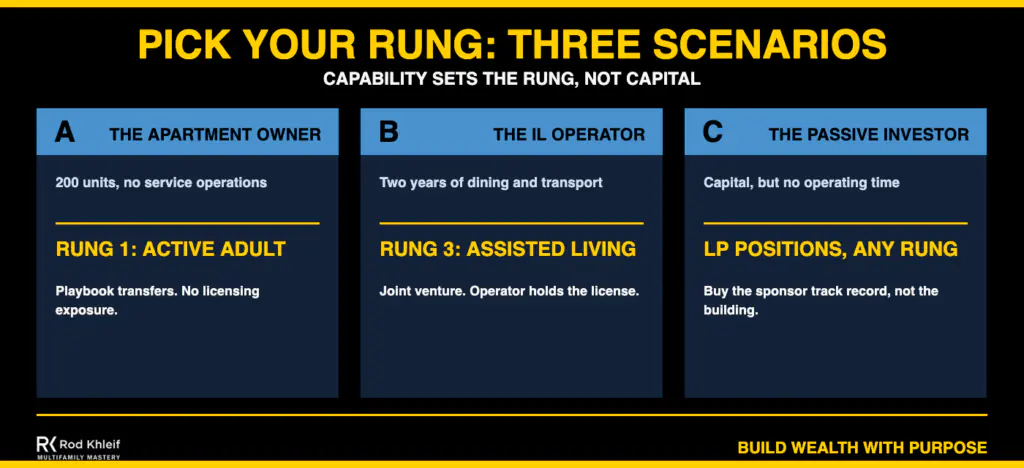
Same investor, three different starting points. Watch how the right rung changes with capability rather than with capital.
Scenario A: The apartment owner with 200 units and no service operations. Correct rung is active adult. The playbook transfers almost entirely, the demographic tailwind supports rent growth, and there is no licensing exposure. This investor should not touch assisted living directly for at least one full cycle.
Scenario B: The investor with a stabilized independent living community and two years of dining and transportation experience. Correct rung is assisted living, but through a joint venture with a licensed operator rather than self operating. The investor owns the real estate and the capital stack while a proven operator carries the clinical risk and the license.
Scenario C: The high income professional with capital and no operating time. Correct move is limited partner positions, and the rung barely matters compared to sponsor selection. This investor buys the operator’s track record, not the building. Diversifying across two sponsors on different rungs beats concentrating in one deal on a rung nobody at the table has run before.
Notice that in two of three scenarios the answer involves someone else carrying the operating risk. That is not weakness. That is how experienced investors enter a sector where the operator is the asset. If you are building the capital and analysis skills to structure these deals, the multifamily underwriting guide is the foundation the senior housing model sits on.
Apartment Instincts vs Senior Housing Reality
Most of the money lost in this sector is lost by competent apartment investors applying competent apartment instincts to a business that punishes them. Here is where the transfer breaks.
Cap Rate Buying vs the Ladder Method
Most senior housing deals get pitched on cap rate spread. “It trades 150 basis points wide of multifamily.” That spread is not free money. It is the market pricing operating risk, and if you cannot operate the risk you do not earn the spread.Warriors Who Climbed the Ladder
I am not theorizing about this sector. My students are buying in it, and the ones who do well are the ones who respected the ladder.
One of my Warriors made his first major acquisition a 196 unit senior housing community on Long Island, a distressed asset he repositioned rather than a stabilized building he overpaid for. He came in with an operating partner who had done it before, which is exactly the joint venture structure I described in Scenario B. You can hear the full range of senior housing operator conversations on the Lifetime Cash Flow podcast.
On the podcast, Radhika Rastogi walked me through turning a bankrupt senior home into a 2.2 million dollar asset in 90 days, and her point stuck with me: senior living is not just real estate, it is real estate plus hospitality plus healthcare, and healthcare is the biggest liability you take on. Ryan Byrne made the same case from the operator side in his episode on senior living real estate investing, where the recurring theme is that outdated and underperforming facilities are where the real opportunity sits, not stabilized trophy assets.
Rod Khleif: “Be careful if you are going to invest in senior housing, and make sure you know the operator, and that the operator has an incredible track record. That is the biggest thing I look for to get in this business.”
Every one of those stories has the same shape. The winners bought an operating capability first and a building second. The ones who got hurt did the reverse.
Senior Housing Investing FAQ
Q: What are the 5 types of senior housing?
A: The five types are active adult (55 plus communities), independent living, assisted living, memory care, and skilled nursing. They sit on a spectrum from pure real estate to licensed healthcare business. Continuing care retirement communities are not a sixth type; they are campuses that combine several of these on one site.
Q: Which type of senior housing is easiest for a multifamily investor to start with?
A: Active adult is the closest thing to a conventional apartment community, with no care services and no healthcare licensing. Independent living is the next step and adds dining, housekeeping, and transportation. Both let you gain senior sector experience without taking on clinical liability.
Q: What is the difference between assisted living and memory care?
A: Assisted living supports residents who need help with daily activities like bathing, dressing, and medication management. Memory care is a secured environment purpose built for residents with dementia, with higher staffing ratios, specialized training, and controlled egress. Memory care commands higher rates and carries shorter average stays.
Q: Is senior housing investing riskier than multifamily?
A: On rungs three through five, yes. You add licensing exposure, care liability, survey findings, and reputation risk on top of normal real estate risk. On rung one, active adult, the risk profile is close to conventional multifamily. The risk is not uniform across the sector, which is why the type you choose matters more than the sector you choose.
Q: How do senior housing returns compare to apartments?
A: Senior housing typically trades at wider cap rates than multifamily, which reflects operating complexity rather than a free yield premium. You earn that spread by executing operations well. Investors who buy the spread without the operating capability usually give it back through census loss and labor costs.
Q: Can I invest in senior housing passively?
A: Yes. Most investors enter as limited partners in a syndication sponsored by an experienced senior housing operator, or through a REIT that owns a portfolio of senior housing assets. Passive positions let you access the sector while the sponsor carries the operating risk. Sponsor selection matters more than property type in that structure.
Q: What is a CCRC and how is it different?
A: A continuing care retirement community, also called a life plan community, is a campus that offers multiple levels of care so residents can age in place without relocating. Some use entrance fee models where residents pay a large refundable deposit up front, which creates a long dated liability on the balance sheet that standard multifamily models do not account for.
Q: How much capital do I need to invest in senior housing?
A: Direct acquisition of a stabilized assisted living or memory care community usually requires several million dollars of equity depending on size and market. Limited partner positions in a senior housing syndication commonly start in the 50,000 to 100,000 dollar range. Smaller residential care homes exist at lower price points but carry different licensing rules by state.
Q: What kills most senior housing deals?
A: Labor and census, usually together. Caregiver turnover drives agency staffing at premium rates, which compresses margin. Weak care quality drives bad reviews, which slows move ins, which drops census. A model built on proforma occupancy with no agency labor assumption is the most common failure point I see.
Q: Should I self operate or partner with an operator?
A: If you have not run a licensed care operation before, partner. On rungs three through five the operator is the asset, and a joint venture where you own the real estate and capital stack while a proven operator holds the license and clinical risk is the standard structure. Self operating is a goal you grow into, not a starting position.
Ready to Take the Next Step?
Every rung on the Senior Housing Ladder sits on the same foundation: knowing how to underwrite an income producing property so the numbers tell you the truth instead of what you want to hear. That is the skill we build in the room.
Join the next Multifamily Bootcamp and work live deals alongside investors who have already made this jump. You will learn the underwriting discipline that carries directly into senior housing, and you will meet the operators and partners who make joint ventures possible.
Not ready for the Bootcamp yet? Start with the book that has put thousands of investors on the first rung.
Download “How to Create Lifetime Cash Flow Through Multifamily Properties” free →
You can also browse every article in our senior housing investing library, including our breakdowns of whether senior housing is a good investment in 2026 and the risks and opportunities across the sector.
Disclaimer: This article was written with the help of AI and reviewed by Rod and his team.
Related reading: How to invest in senior housing, the six gate path from choosing your segment through closing and operating.
