
When I started in real estate at eighteen, I had no money. None. My mom was on welfare. We were immigrants. She bought her first house across the street from us with her babysitting money and told me she made twenty thousand dollars in her sleep from appreciation. That moment rewired my brain.
But rewiring was not enough. I needed a process. The process is what I am going to give you now, because most investors I meet are setting goals the wrong way around, and it is quietly costing them years.
Table of Contents
- Why Most Real Estate Investors Set Goals Backwards
- The Lifetime Cashflow Goal Stack
- The Writing Ritual That Changes Everything
- Visualization and Affirmations in Multifamily Investing
- How to Reverse-Engineer Your Unit Count From Your Lifestyle Goals
- Traditional SMART Goals vs The Lifetime Cashflow Goal Stack
- What Goal Setting Looks Like in the Warrior Community
- Goal Setting for Real Estate Success FAQ
Why Most Real Estate Investors Set Goals Backwards
Goal setting accelerates real estate success when you define the life you want first, the lifestyle that life requires second, and only then reverse-engineer the property portfolio that funds both. Most investors do the opposite. They pick a unit count or a cash-flow target, chase it for years, hit it, and realize the number never mattered. The number was borrowed.
I have coached thousands of investors in my Multifamily Bootcamp and my Warrior mentorship community. The pattern is almost always the same. Someone walks in with a portfolio target like “I want one hundred doors” or “I want ten thousand dollars a month in cash flow.” I ask them why. Silence, then a shrug, then some version of “because that is what a successful investor looks like.”
That is a borrowed goal. A borrowed goal cannot survive a bad quarter, a capital call, or a 2008-style reset. Your own goal can.
The fix is a three-layer stack. You set Life goals first. Lifestyle goals second. Portfolio goals last. Everything in this article is built on that order.
Signs Your Goals Are Borrowed
If you are not sure whether your current goals are yours or borrowed, run them through this five-question filter. If you cannot answer yes to at least four of these, you are probably working someone else’s plan.
- Can you explain why the number matters in one sentence without mentioning another investor, podcast, or book?
- Does hitting the number change how you spend a specific Tuesday? Not a hypothetical Tuesday. A real one on your actual calendar next month.
- Does the number connect to a person who is not you? A child, a spouse, a parent, a community, a cause.
- Would you still pursue the number if nobody on social media ever saw it?
- Would you still pursue the number if the next recession arrived tomorrow?
Borrowed goals almost always fail on question two or question four. They are numbers you picked to impress a version of yourself that was curated by other people. Written goals that pass all five questions are durable. They survive downturns because they were never about the downturn.
The Lifetime Cashflow Goal Stack
This is the exact framework I teach in my goal-setting workshop. I call it the Lifetime Cashflow Goal Stack because the point of the stack is cash flow that funds a life you actually want to live, not cash flow that becomes the life.


Layer 1: Life Goals (The Why)
Life goals are the non-negotiables about the human you want to be and the people you want to serve. Family, faith, freedom, health, legacy, giving. These are the goals that do not care about your cap rate.
Write down five to seven Life goals. Keep them short. Examples: be present at every one of my daughter’s soccer games, fund fifty children through Tiny Hands Foundation every year, train for a half marathon in my fifties, pay off my parents’ house, retire my spouse from a job they tolerate. None of these require you to own a single apartment unit. But every one of them will shape the portfolio you need to build.
Layer 2: Lifestyle Goals (The How)
Lifestyle goals are where and how you live. Time freedom, geographic flexibility, daily schedule, the work you say yes to, the work you say no to. This layer is where most investors have never done the math.
Ask yourself: what does a Tuesday look like in the life I want? How many hours do I work? Where am I living? What am I driving? What bills are automatic? What travel is in the calendar? How much passive monthly income does all of that actually cost?
Write a number at the bottom of that page. That number is the Lifestyle target. It is not arbitrary. It is the literal sum of the life you just described.
Layer 3: Portfolio Goals (The What)
Only now do you touch unit counts, deal count, cash-on-cash returns, and exit windows. And you do not pick these from a podcast. You back-solve them from Layer 2.
This is the reverse of how almost every real estate education program teaches goal setting. Most tell you to pick a unit count first and then figure out why you want it. I am telling you to pick the life first, the lifestyle second, and let the portfolio fall out of the math. When you do it in this order, the portfolio number finally means something, and you stop abandoning goals that were never really yours.
The Writing Ritual That Changes Everything
Writing goals down once a year is a ceremony. Writing them down twice a day is a practice.
Here is the ritual I have done for forty years, with very few exceptions:
- Every morning, before email, before phone, I sit with a plain notebook and hand-write my top goals. By hand. Not typed. The physical motion matters because it routes the goal through a different part of your brain than passive reading.
- I write them again at night, before bed. Same goals. Same notebook. The nighttime write is what your subconscious takes into sleep.
- Once a week I review the full list and ask one question: is anything here borrowed? If yes, I cross it out.
There is nothing mystical about this. It is a repetition loop that keeps your goals in front of the part of you that makes decisions all day: what you say yes to, what you decline, what you stop tolerating, what you start pursuing. The underlying neuroscience is well documented. Research from Mueller and Oppenheimer at Princeton and UCLA found that writing by hand produces measurably stronger conceptual memory than typing, because the slower physical motion forces the brain to process and compress the idea rather than transcribe it. That is why typed goals in a Notes app do not survive a busy week. Handwritten goals do. Most people’s goals die in a drawer. Goals you write twice a day do not die in a drawer.
If you want the exact templates I use for this, they are inside my free goal-setting workbook. Print it. Use it. Fill it out the way I do, not the way a self-help book does.

Visualization and Affirmations in Multifamily Investing
A lot of investors, especially the engineers and accountants I coach, hear the word visualization and roll their eyes. I understand. But visualization is not wishing. Visualization is mental rehearsal, and it is the same process top performers in surgery, military operations, and professional sports use before they ever perform the real thing.
Two practices that work, stripped of any woo:
- Deal rehearsal. Before a broker call, a lender conversation, or an investor pitch, close your eyes for ninety seconds and walk through the conversation from start to finish in the best-case version. Hear your own calm tone. Watch yourself ask the harder question and wait for the answer. When the real call starts, you are not doing it for the first time.
- Outcome visualization. Pick one Portfolio goal. Each morning, after you write your goals, spend two minutes picturing the day you hit it. Where are you standing? Who calls you first? What are you wearing? What does the email say? This is not manifestation. It is an anchor your brain reaches for when a hard day makes you want to quit.
Affirmations are the verbal version. Write three to five in the present tense. Read them aloud after you write your morning goals. Skeptical readers should test it for thirty days and then decide. That is the only fair experiment.
How to Reverse-Engineer Your Unit Count From Your Lifestyle Goals
This is the math nobody teaches you. It is the bridge from Layer 2 to Layer 3 of the goal stack.
Pretend your Lifestyle goal is thirty thousand dollars a month in passive income. Here is how that becomes a concrete Portfolio goal.
Step 1: Decide what one door nets you per month after all expenses and reserves. A conservative national average for a well-underwritten B-class multifamily unit is two hundred dollars a month in net cash flow to the operator. Your market may vary. Use your own underwriting. The National Multifamily Housing Council publishes quarterly rent and occupancy data that is useful for sanity-checking your per-door assumptions.
Step 2: Divide the Lifestyle target by the per-door number. Thirty thousand divided by two hundred equals one hundred fifty units.
Step 3: Decide your timeline. If you want there in five years, your plan is roughly thirty units per year. If you want there in ten years, fifteen units per year. Both are realistic for an operator who actually does the work. Neither is realistic for someone who keeps setting goals in January and forgetting them by March.
Step 4: Decide your first-deal size. Your first deal should pull one-tenth to one-fifth of your total unit goal on the board in a single close if you go the syndication route. That is not optional math. That is how you compress a decade into five years. My Multifamily Bootcamp walks you through exactly how to structure that first deal without the capital you think you need.
This is a simplified example. Your actual underwriting should include vacancy, management, reserves, debt service, and a margin for the market cycle. But the structure of the math is the point: your unit count is an output, not an input.
Three Worked Scenarios
Your Lifestyle number drives everything else. Here are three common Lifestyle targets I see among investors in my community, each reverse-engineered into a Portfolio plan. Use the one closest to your own number as a starting point and adjust from there.
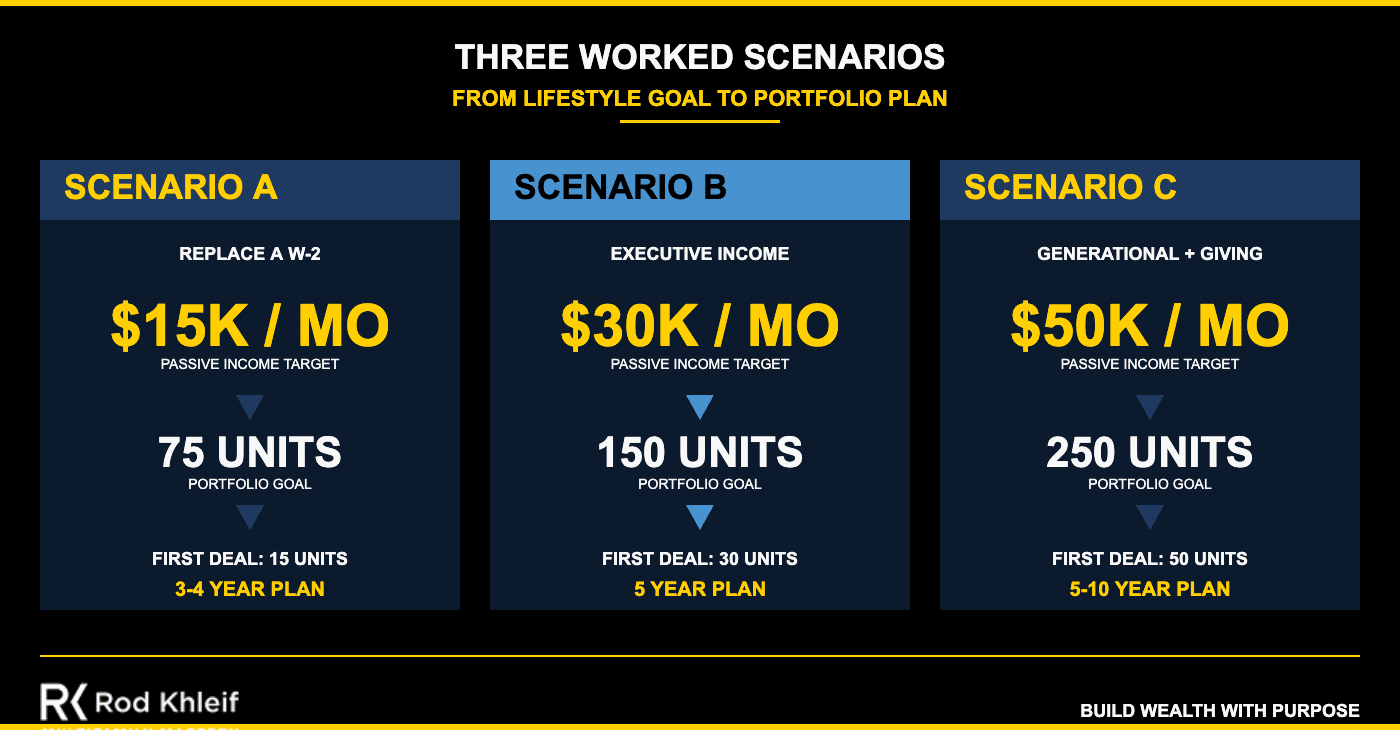
Scenario A: $15,000 per month (replace a mid-career W-2). At two hundred dollars a door, that is seventy-five units. At a first deal of fifteen units, you are four closes from your number. At one close per year through a syndication-and-sponsor path, that is a four-year plan. At two closes per year, it is two years. Most Warriors targeting this number hit it inside thirty-six months.
Scenario B: $30,000 per month (replace a senior executive income and fund two college educations). At two hundred dollars a door, that is one hundred fifty units. At a first deal of thirty units, you are five closes from your number. At one close per year, five years. At two closes per year, two and a half years. This is the most common Warrior target and the most common number Jennifer Barner built around.
Scenario C: $50,000 per month (build generational assets plus active philanthropy). At two hundred dollars a door, that is two hundred fifty units. At a first deal of fifty units, five closes. At one close per year, five years. Investors targeting Scenario C usually structure as a sponsor on larger syndications earlier, because the fee and promote economics compound faster than pure unit accumulation.
Notice what changes across the three scenarios and what stays the same. The math structure does not change. The only variables are your Lifestyle number, your first-deal size, and your timeline. Everything else falls out.
Reactive Goal Setting vs. Lifetime Cashflow Goal Stack
| Area | Reactive Goal Setter | Lifetime Cashflow Goal Stack |
|---|---|---|
| Starting point | Unit count or income target picked from a podcast | Life goals around family, freedom, and legacy |
| Review cadence | Reviewed once at New Year’s, forgotten by March | Hand-written morning and night, reviewed weekly |
| Purpose of cash flow | More cash flow | The specific lifestyle the investor wrote out |
| Response to a bad quarter | Abandons the goal | Adjusts the timeline, not the goal |
| Unit count | Input, chosen first | Output, back-solved from lifestyle |
| Partner and deal filter | Anything that moves the number | Only deals that serve the life goals |
Traditional SMART Goals vs The Lifetime Cashflow Goal Stack
SMART goals, the framework most professionals learn first, are a sanity-check tool. They are useful inside Layer 3 of the stack, and they are dangerous if you try to use them as the whole method. Here is the difference in practice.
| Dimension | Traditional SMART Goals | Lifetime Cashflow Goal Stack |
|---|---|---|
| Origin | 1981 business management paper | Forty years of owning 2,000+ rentals and coaching Warriors controlling 260,000+ units |
| Primary filter | Is the goal specific, measurable, achievable, relevant, time-bound | Does the goal connect to a life and a lifestyle you actually want |
| Starting point | The goal itself | The human behind the goal |
| Risk of failure | Hitting a number that no longer matters | Adjusting timeline while the goal keeps mattering |
| Best use | Quality control on a single Portfolio goal | End-to-end system for decade-long investing |
| Revisit cadence | Typically annual | Daily (write) + weekly (review) + quarterly (audit) |
Run every Layer 3 Portfolio goal through the SMART filter once you have defined it. Do not run your Life and Lifestyle goals through SMART. Those live above the spreadsheet.
What Goal Setting Looks Like in the Warrior Community
My Warrior mentorship community controls over two hundred sixty thousand units collectively. I do not say that to brag. I say it because the through-line in every Warrior success story is written goals, reviewed daily, that were set in the order I just described.
Jennifer Barner came into the community with a Life goal: put four kids through college debt-free and be present while she did it. Her Lifestyle goal backed into the monthly passive income she needed to replace a demanding career. Her Portfolio goal, reverse-engineered from that number, was well above a thousand units. She is past that now, with all four kids in school, with her calendar her own. The goal was not one thousand units. The goal was her kids and her time. One thousand units was the receipt.
Anthony came in with almost no capital and closed a two-hundred-eighteen-unit first deal within his first twelve months in the community. His Lifestyle goal was specific: be done with his W-2 by a certain date. His Portfolio goal was the math that got him there. The first deal was not a miracle. It was what he wrote on a page every morning for a year.
Loren wrote his resignation date on a page sixty days after his first Multifamily Bootcamp. He hit that exact date, to the week, twelve months later. His goal never said “resign.” It said “walk into my boss’s office on X date and hand in paper.” Specific. Written. Every morning. Every night.
Rod Khleif: “None of these people are more gifted than you. They just put their goals on paper in the right order, and then they read them twice a day until the world rearranged itself around the list.”
Goal Setting for Real Estate Success FAQ
Q: Why is goal setting important in real estate investing?
A: Goal setting gives your investing a reason. Without a written goal, every deal looks the same and every bad quarter feels like proof you should quit. With written Life, Lifestyle, and Portfolio goals, you filter deals, partners, and setbacks through a purpose that is bigger than the current month, which is what lets you compound for decades instead of years.
Q: What is the best goal setting method for real estate investors?
A: The one I teach in my goal-setting workshop: write Life goals first, Lifestyle goals second, Portfolio goals third. Review by hand, morning and night. Revisit weekly. The method works because it connects every unit you buy to a life that actually matters to you.
Q: How often should I review my real estate investing goals?
A: Twice a day at minimum. Write them by hand every morning before email and every night before bed. Do a full review once a week to cross out borrowed goals and sharpen the ones that remain. Once a quarter, compare the portfolio you are actually building to the lifestyle goals that define it.
Q: Should I write my goals down every day?
A: Yes, every day, by hand. Handwriting a goal routes it through parts of your brain that passive reading does not reach. The daily repetition is what keeps the goal loud enough to drive the small decisions that actually build a portfolio. Typed goals in a Notes app do not survive a busy week. Handwritten goals do.
Q: What is the difference between a goal and a resolution in investing?
A: A resolution is a wish with a deadline. A goal is a wish with a plan, a timeline, a measurable target, and a daily action attached to it. Resolutions live in January. Goals live on a page you read twice a day for ten years.
Q: How do I set realistic unit count goals as a new investor?
A: Do not set a unit count first. Set a Lifestyle goal in dollars per month, divide by your conservative per-door net cash flow, and the unit count falls out. Then pick a timeline based on how aggressively you want to scale. A new investor aiming for one hundred fifty units in five to ten years is realistic if the goals are written daily and the first deal is structured correctly.
Q: Can visualization really help my real estate investing results?
A: Yes, when you use it as mental rehearsal, not wishing. Top performers in surgery, the military, and professional sports rehearse outcomes before executing. Investors who rehearse a broker call, a lender meeting, or an investor pitch before walking in perform measurably better because the real event is no longer the first run-through.
Q: How do SMART goals apply to multifamily real estate?
A: SMART goals are a useful sanity check on any Portfolio goal. Specific unit count, measurable cash flow, achievable with the capital you have access to, relevant to your Lifestyle goal, and time-bound with a close date. Run every Layer 3 goal through the SMART filter. Do not run Life or Lifestyle goals through it. Those live above the spreadsheet.
Q: What should I do when I miss a real estate investing goal?
A: Adjust the timeline, not the goal. A missed deadline is data, not failure. Rewrite the goal with a new date, diagnose what broke, and correct the single habit that caused the miss. Investors who abandon goals after one miss never compound. Investors who reset the date stay in the game long enough to win it.
Q: How did Rod Khleif set goals when he was starting with nothing?
A: At eighteen, with no money and no network, I wrote my goals by hand every morning and every night. I watched my mother buy her first house with babysitting money and saw her make twenty thousand dollars in her sleep from appreciation. That rewired my expectations. The daily writing ritual kept those expectations loud enough to outlast every early failure, and it is the same ritual I have kept for forty years.
Ready to Take the Next Step?
If you want a room full of investors, a step-by-step deal framework, and the goal-setting structure we just covered applied directly to your first multifamily deal, come to my Multifamily Bootcamp. It is three days that has launched more first deals than any other program in the industry.
Prefer to start on your own? Download my free Lifetime Cashflow Academy ebook and read the chapters on goal setting and deal structure this week.
Disclaimer: This article was written by AI and reviewed by Rod and his team.
When discipline meets clear goals, deals close; see how Patrick Hayter closed 51 units in New York and Roberto Carabetta closed 58 units in Georgia.
At scale, see Ronal and Mary Jane Lou closing 204 units in Texas and Victor Collazo closing 92 units in Kansas.
